
TL;DR:
- Understanding SEO terms helps contractors control marketing strategies and measure results effectively.
- Key SEO elements include keywords, Google Business Profile, backlinks, on-page SEO, and reviews.
- Focusing on local pack visibility and conversions drives more leads and booked jobs.
If you’ve ever sat through a meeting with a digital marketing agency and nodded along while they talked about “backlink profiles,” “local pack rankings,” and “on-page optimization,” you’re not alone. Most roofing and exterior contractors hear these terms constantly but rarely get explanations that connect to actual business outcomes like phone calls, estimate requests, and booked jobs. This guide cuts through the confusion and gives you practical, plain-language definitions for the SEO terms that matter most, so you can make smarter decisions about your marketing and stop leaving local leads on the table.
Table of Contents
- Why knowing SEO terms matters for roofing and exterior contractors
- Essential SEO terminology every service business should know
- How SEO terms translate into more local leads and jobs
- Common SEO jargon traps and what most contractors miss
- Applying SEO knowledge: Talking strategy with agencies and staff
- What most SEO guides overlook: Context is king for service companies
- Level up your local marketing with expert SEO support
- Frequently asked questions
Key Takeaways
| Point | Details |
|---|---|
| Learn the language | Knowing key SEO terms helps you communicate clearly with agencies and set better marketing goals. |
| Connect terms to results | SEO jargon matters most when it translates into more phone calls and booked jobs. |
| Avoid common traps | Focus on metrics that drive business growth—not vanity stats or outdated practices. |
| Talk strategy with confidence | Use your new understanding to ask better questions and hold your team accountable. |
Why knowing SEO terms matters for roofing and exterior contractors
SEO stands for Search Engine Optimization, which is the process of making your website and online presence more visible when local homeowners search for services like yours. But here’s the problem: most explanations of SEO are written for web developers, not business owners who are managing crews and closing jobs.
When you don’t understand the language, you lose control of your marketing budget. You can’t push back on bad strategies, you can’t ask the right questions, and you end up paying for activity instead of results. SEO impacts the visibility and business growth of home services companies in measurable ways, but only when the strategy is built around real business goals.
Here’s what understanding SEO terminology actually does for you as a contractor:
- It helps you evaluate whether an agency is doing meaningful work or just reporting on vanity metrics
- It lets you prioritize the right activities, like local rankings over global traffic
- It gives you confidence to ask questions and redirect strategies that aren’t producing leads
- It helps your office staff understand what actions, like asking for reviews, actually support your SEO
“The best marketing partnerships happen when both sides speak the same language. When you understand what your agency is reporting, you can hold them accountable to results that matter.”
You can see real results from local SEO when the strategy is focused on the right goals from the start. That clarity begins with knowing the vocabulary.
Pro Tip: Before your next agency meeting, write down three business goals (more calls, more estimate requests, more booked jobs) and ask your marketing partner to show you exactly which SEO activities connect to each one.
Essential SEO terminology every service business should know
Let’s get into the actual terms. These are the ones you’ll hear most often, and the ones that have the biggest impact on whether homeowners in your area find you first.
Keywords are the words and phrases people type into Google when they need a service. For your business, high-value keywords look like “roof replacement in [your city]” or “siding contractor near me.” Targeting the right keywords means your website shows up when someone is actively ready to hire.
On-page SEO refers to everything you can optimize on your own website, including page titles, headings, service descriptions, and images. Strong on-page SEO tells Google exactly what services you offer and where you offer them.
Backlinks are links from other websites pointing to yours. Think of them as votes of confidence. A link from your local chamber of commerce or a supplier’s website tells Google your business is legitimate and trusted.

The local pack is the map section that appears at the top of Google search results showing three local businesses. Getting into the local pack for searches like “roofer in [your city]” is one of the highest-value goals in local SEO.
Google Business Profile (GBP) is your free business listing on Google that controls what appears in the local pack and on Google Maps. Your reviews, photos, hours, and service areas all live here.
Organic traffic is the visitors who land on your website through unpaid search results, not ads. This traffic tends to have high intent because these people were actively searching for what you offer.
The local SEO ranking factors for contractors differ from general SEO. Here’s a quick comparison of what the terms mean technically versus what they mean for your business:
| SEO term | Technical definition | What it means for your business |
|---|---|---|
| Keywords | Search query targets | The exact jobs homeowners are searching for |
| Backlinks | Inbound links from other sites | Trust signals that boost your local authority |
| On-page SEO | Website content optimization | Service pages that rank and convert visitors |
| Local pack | Google’s top 3 map results | Prime real estate for high-intent local searches |
| Google Business Profile | Google’s business listing tool | Your most visible local presence on Google |
| Organic traffic | Non-paid search visitors | Potential customers finding you without ad spend |
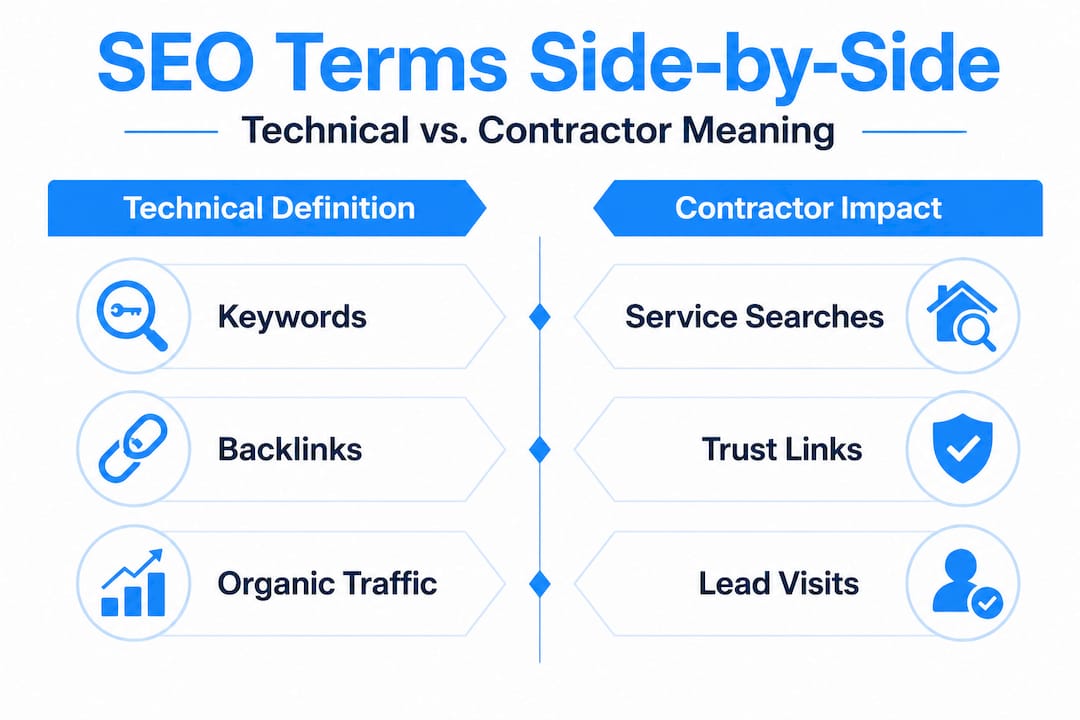
The top ranking factors for home improvement businesses include your GBP completeness, review quantity and quality, on-page relevance, and the authority of your backlinks.
Pro Tip: Tracking rankings isn’t enough. Ask your agency to show you how organic traffic translates into form fills, calls, and booked estimates. Rankings without conversions don’t pay your crew.
How SEO terms translate into more local leads and jobs
Understanding the terms is step one. Understanding how they connect to your revenue is what makes this knowledge worth having. Here’s a numbered walk-through of how each SEO element moves the needle for roofing and exterior contractors:
- A homeowner searches for a service. They type “roof repair after storm [city name]” into Google. Your keyword strategy determines whether your site appears.
- They see the local pack. If your Google Business Profile is optimized with reviews, photos, and accurate service areas, you appear in the top three map results. This is often the first click.
- They visit your website. Your on-page SEO ensures the page they land on is relevant, fast-loading, and clearly describes the service they need.
- They trust your business. Backlinks from local sources and a strong review profile reinforce that you’re a legitimate, established contractor.
- They call or fill out a form. A clear call to action converts the visitor into a lead.
Each step depends on a different SEO element working correctly. Miss one, and you lose the lead to a competitor who has it dialed in.
| SEO element | Where it impacts the customer journey | Typical result when optimized |
|---|---|---|
| Keywords | Discovery stage (search) | More relevant traffic to your site |
| Google Business Profile | Local pack visibility | More calls directly from Google |
| On-page SEO | Landing and trust stage | Lower bounce rate, more form fills |
| Backlinks | Trust and authority signals | Higher rankings across all searches |
| Reviews | Decision stage | More conversions from visitors |
The on-site and off-site SEO methods that work for home contractors are built around this exact journey. Every optimization should serve a step in that path from search to booked job.
“SEO isn’t about impressing Google. It’s about making sure the right homeowner finds you at exactly the right moment and feels confident enough to pick up the phone.”
You can see how SEO drives bookings for local service contractors when each element is aligned with the customer’s decision-making process.
Common SEO jargon traps and what most contractors miss
Not every SEO term you hear deserves your attention. Some are outdated, some are misleading, and some are used by agencies to make their work sound more complex than it is.
Meta keywords are a tag that used to tell search engines what a page was about. Google stopped using them years ago. If an agency mentions optimizing your meta keywords as a key deliverable, that’s a red flag.
Domain Authority (DA) is a score created by a third-party tool, not Google. It can be a rough indicator of your site’s strength, but chasing a higher DA number is not a strategy. Focus on earning real backlinks from real local sources instead.
Keyword density refers to how often a keyword appears on a page. There’s no magic percentage that boosts rankings. Writing naturally for your customer is far more effective than stuffing keywords into every paragraph.
Impressions tell you how many times your site appeared in search results. High impressions with low clicks usually mean you’re ranking for terms that don’t match what your customers are actually searching.
Here’s what actually moves the needle for service-based contractors:
- Review generation (volume and recency matter significantly)
- Service page clarity and local relevance
- Google Business Profile completeness and activity
- Consistent name, address, and phone number across all directories
- Backlinks from local and industry-relevant sources
“Vanity metrics feel good in a report but don’t show up in your bank account. Focus on what you can directly influence: your reviews, your service pages, and your GBP activity.”
The contractor SEO tips that actually drive service calls are rooted in these fundamentals, not in chasing scores that third-party tools invented.
Pro Tip: Focus on metrics that you and your staff can directly impact. Ask your team to request a review after every completed job. That single habit can move your local pack ranking more than most technical SEO changes.
Avoiding these traps is part of what makes service-based SEO different from generic digital marketing advice.
Applying SEO knowledge: Talking strategy with agencies and staff
Now that you have the vocabulary, here’s how to use it in real conversations with your marketing partners and team.
- Ask for a keyword report tied to services, not just traffic. “Show me which keywords are driving calls for roof replacement and gutter installation in our service area.”
- Request a GBP performance summary monthly. “How many calls and direction requests came from our Google Business Profile last month?”
- Ask about backlink sources specifically. “Where are our new backlinks coming from, and are they from local or industry-relevant sites?”
- Tie every report to business outcomes. “Which pages generated the most form fills or calls this month, and what are we doing to improve the ones that didn’t?”
- Set a review goal with your team. “We want to add at least eight new reviews per month. What’s our process for asking after each job?”
A simple checklist to keep your SEO strategy aligned with business goals:
- Monthly review of calls and leads from organic search
- Quarterly check of local pack rankings for your top five service keywords
- Consistent GBP updates with new project photos and posts
- Regular audit of your top service pages for clarity and conversion
The local SEO guide for installers covers how these conversations translate into measurable growth. Using your new vocabulary in these check-ins keeps your agency focused on SEO for local market domination rather than generic reporting.
Pro Tip: Set up a 30-minute monthly check-in with your marketing partner focused only on leads generated from organic search. Bring your own data, like call volume and estimate requests, so you can cross-reference what the SEO reports are showing.
What most SEO guides overlook: Context is king for service companies
Here’s something most SEO content won’t tell you: ranking well nationally or even citywide means very little if the people finding you aren’t ready to hire a contractor. Generic SEO advice is built for e-commerce stores and content publishers, not for businesses where every job is local, seasonal, and project-driven.
For roofing and exterior contractors, the highest-value searches are high-intent and hyper-local. Someone typing “emergency roof repair [your city]” is not browsing. They need help now. Your entire SEO strategy should be built around capturing those moments, not accumulating traffic from people researching roofing materials for a DIY project they’ll never finish.
This is where most contractors get misled. An agency might show you impressive traffic growth, but if that traffic isn’t converting into calls and estimates, it’s not serving your business. The right service-based SEO strategy is narrow, intentional, and ruthlessly focused on the searches that lead to revenue.
Knowing what to ignore is just as important as knowing what to track. Ignore national rankings. Ignore traffic from outside your service area. Ignore any metric that doesn’t connect directly to a customer action. Focus on the local pack, your GBP reviews, your service area pages, and the calls coming in. That’s the context that makes SEO actually work for a contractor.
Level up your local marketing with expert SEO support
Understanding SEO terminology gives you a real advantage when it comes to evaluating your marketing, asking better questions, and making sure your budget is working as hard as you are.
If you’re ready to put this knowledge to work with a team that specializes exclusively in roofing and exterior contractors, Results Digital is built for exactly that. We offer SEO for roofers designed around local lead generation, not generic rankings. From your Google Business Profile to your service pages, every element is optimized to generate calls and booked jobs. Explore our contractor SEO tips for a deeper look at the strategies we use to help contractors dominate their local markets.
Frequently asked questions
What is the most important SEO metric for roofing companies?
For local service companies, the most important SEO metric is the number of calls or bookings generated from organic search, not impressions or overall traffic volume.
How often should I update my Google Business Profile?
You should update your Google Business Profile at least monthly, especially after completing new projects or receiving reviews, to stay active and relevant in local search results.
Are backlinks still important for local contractor SEO?
Yes, quality backlinks from trusted local sources can help your site appear higher in search results, and the most important ranking factors for home improvement businesses still include link authority alongside reviews and GBP optimization.
What is the difference between on-page and off-page SEO?
On-page SEO involves changes to your website like service pages and headings, while off-page SEO includes actions like earning reviews and links from other sites, both of which are covered in website optimization for contractors.
