
More than 60 percent of American local service contractors report that effective lead generation directly boosts job bookings and revenue. With competition increasing in every neighborhood, finding the right strategies for attracting quality clients has never mattered more. This guide reveals proven techniques tailored to home improvement professionals who want reliable leads and smarter digital marketing investments, helping you connect with people who genuinely need your expertise.
Table of Contents
- Defining Lead Generation In Local Services
- Types Of Leads And Lead Generation Methods
- How The Lead Generation Process Works
- Key Costs And Roi Factors Explained
- Common Pitfalls And How To Avoid Them
Key Takeaways
| Point | Details |
|---|---|
| Focused Local Marketing | Prioritize targeted marketing strategies to reach potential customers within your service area, enhancing engagement and conversion rates. |
| Diverse Lead Types | Understand the differences between cold, warm, and hot leads to tailor your outreach efforts effectively. |
| Tracking Success Metrics | Implement tracking systems to monitor lead performance and optimize marketing strategies based on critical ROI factors. |
| Avoid Common Pitfalls | Diversify your lead generation sources and establish a systematic follow-up process to maximize opportunities. |
Defining Lead Generation in Local Services
Lead generation for local contractors represents a strategic approach to attracting potential customers within a specific geographic area. At its core, lead generation transforms strangers into interested prospects who demonstrate genuine interest in specific services like home repairs, renovations, or installations.
Local service businesses rely on targeted marketing techniques to connect with potential clients most likely to book their services. This approach differs from broad marketing strategies by focusing intensely on geographic proximity and highly specific customer needs. Local lead generation prioritizes quality over quantity, ensuring that marketing efforts reach individuals who are not just interested, but actively seeking solutions within their immediate community.
The process involves multiple sophisticated strategies, including local search engine optimization, geographically targeted online advertising, consistent business listings, and strategic community engagement. Contractors leverage these techniques to improve visibility, credibility, and conversion rates among potential customers within their service radius. By understanding precise local customer behaviors and preferences, service providers can craft marketing messages that resonate directly with their target demographic.
Pro tip: Create location-specific landing pages for your services to improve local search rankings and demonstrate your expertise in addressing neighborhood-specific challenges.
Types of Leads and Lead Generation Methods
Local service contractors encounter various types of leads, each requiring unique engagement strategies. Lead generation methods span multiple channels including targeted content marketing, website optimization, and strategic social media engagement, allowing businesses to capture potential customers at different stages of their decision-making process.
Contractors typically categorize leads into three primary types: cold leads, warm leads, and hot leads. Cold leads represent potential customers with minimal initial interest who require extensive nurturing. Warm leads demonstrate some engagement, perhaps by visiting a website or requesting preliminary information. Hot leads are ready to make an immediate purchase and represent the most valuable segment for immediate conversion.
Here’s how local lead types differ in engagement and marketing approach:
| Lead Type | Readiness to Buy | Recommended Outreach Method | Nurture Effort Needed |
|---|---|---|---|
| Cold Lead | Low, minimal interest | Informative ads, educational content | High, requires multiple touches |
| Warm Lead | Moderate, researching | Case studies, skill showcases | Medium, regular follow-ups |
| Hot Lead | High, ready to convert | Direct calls, quick quotes | Low, focus on rapid response |
Effective lead generation incorporates both inbound and outbound tactics. Inbound methods include local search engine optimization, content marketing, and maintaining robust online business listings. Outbound strategies involve targeted advertising, direct outreach through cold calling or emailing, and networking at local community events. Successful contractors blend these approaches to create a comprehensive lead generation ecosystem that maximizes potential customer interactions.
Pro tip: Develop a lead scoring system that helps you prioritize and segment leads based on their engagement level and conversion potential, allowing more focused and efficient marketing efforts.
How the Lead Generation Process Works
Local lead generation follows a strategic funnel that guides potential customers from initial awareness to becoming paying clients. This systematic approach breaks down the customer journey into distinct stages, each requiring targeted marketing tactics designed to progressively move prospects closer to conversion.

The lead generation process typically comprises four critical stages: Awareness, Consideration, Conversion, and Retention. During the Awareness stage, contractors use digital marketing techniques like local SEO, social media advertising, and targeted content to introduce their services to potential customers. The Consideration stage involves providing detailed information, showcasing expertise through case studies, testimonials, and demonstrating value propositions that differentiate the business from competitors.
The Conversion stage represents the pivotal moment where potential leads transform into actual customers. This involves strategic lead capture mechanisms such as compelling website contact forms, clear call-to-action buttons, and streamlined communication channels. Tracking and measuring key performance indicators becomes crucial, including metrics like cost per lead, conversion rates, and customer acquisition costs. Advanced contractors implement sophisticated lead scoring systems that help prioritize and nurture the most promising prospects, ensuring efficient allocation of marketing resources.
Pro tip: Create a comprehensive lead tracking spreadsheet that monitors each lead’s journey, recording interaction points, communication history, and potential value to systematically improve your conversion strategies.
Key Costs and ROI Factors Explained
Local lead generation costs encompass a strategic investment across multiple marketing channels, with contractors balancing advertising spend, technology investments, and content creation to maximize potential returns. Understanding the financial dynamics helps businesses make informed decisions about their lead generation strategies.
The primary cost components include digital advertising expenses such as Google Ads, Facebook targeted campaigns, search engine optimization efforts, and customer relationship management (CRM) tools. Advertising spend typically represents the most significant investment, with costs varying based on industry competitiveness, geographic location, and targeting specificity. Contractors must carefully evaluate cost per lead metrics, comparing the expense of acquisition against potential job values and conversion rates.
Return on investment (ROI) in local lead generation depends on several critical factors: lead quality, conversion rates, customer lifetime value, and efficiency of marketing processes. Successful contractors develop sophisticated tracking mechanisms that monitor not just immediate job bookings, but long-term customer relationships. This approach allows for more nuanced financial analysis, revealing the true value of marketing investments beyond simple transactional metrics. Advanced lead scoring systems and detailed performance analytics enable contractors to continuously refine their strategies, reducing wasted spend and improving overall marketing effectiveness.
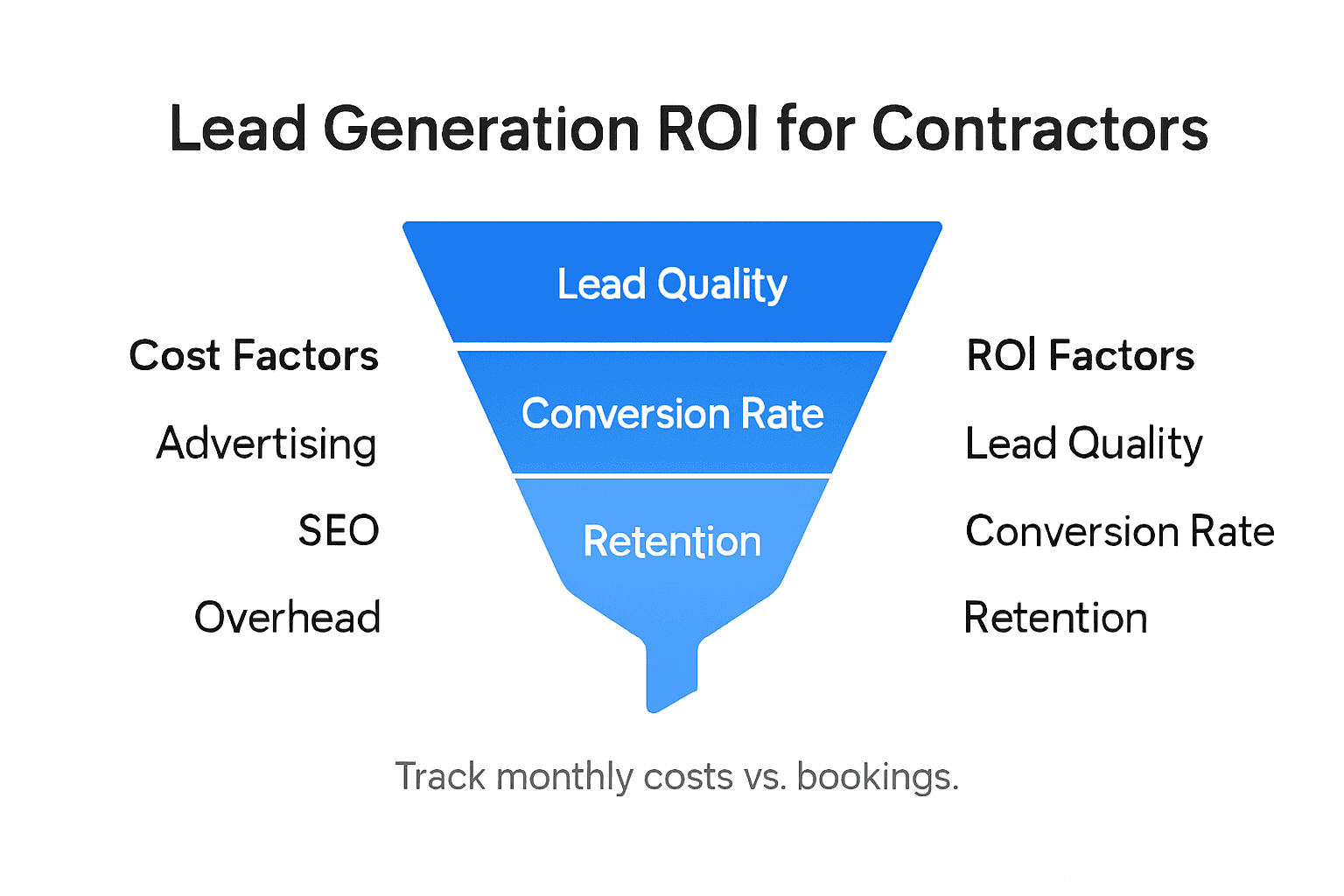
Compare key ROI factors for local lead generation at a glance:
| ROI Factor | Impact on Profits | Optimization Strategy |
|---|---|---|
| Lead Quality | Drives job value | Score and prioritize leads |
| Conversion Rate | Boosts revenue growth | Streamline sales process |
| Customer Lifetime | Increases overall returns | Build long-term relationships |
| Acquisition Costs | Affects marketing budget | Monitor and reduce expenses |
Pro tip: Create a monthly marketing expense spreadsheet that tracks lead acquisition costs, conversion rates, and average job values to systematically optimize your lead generation budget.
Common Pitfalls and How to Avoid Them
Local lead generation strategies often stumble due to common mistakes that can significantly undermine marketing efforts, requiring contractors to be proactive and strategic in their approach. Understanding these potential challenges is crucial for developing a robust and effective lead generation system.
One of the most critical pitfalls is over-reliance on a single lead source. Contractors frequently make the mistake of depending exclusively on one marketing channel, such as Google Ads or Facebook advertising. This approach leaves businesses vulnerable to fluctuations in platform performance, algorithm changes, and increased competition. Successful lead generation demands a diversified strategy that includes multiple channels like local search engine optimization, targeted social media advertising, content marketing, and community networking.
Another significant challenge involves inadequate lead nurturing and follow-up processes. Many contractors invest considerable resources in generating leads but fail to implement systematic communication and engagement strategies. This oversight results in lost opportunities and diminished return on investment. Effective lead management requires developing a comprehensive tracking system, creating personalized follow-up communications, and establishing clear protocols for lead engagement. Contractors should implement customer relationship management (CRM) tools that enable timely, targeted interactions and help maintain consistent communication with potential clients throughout their decision making process.
Pro tip: Design a standardized lead follow-up workflow with automated email sequences and reminder systems to ensure no potential customer falls through the cracks.
Drive High-Quality Local Leads with Proven Digital Marketing Solutions
Struggling to convert cold and warm leads into booked jobs can feel like a constant uphill battle. This article highlights the importance of targeted lead generation strategies tailored specifically for local contractors. If you want to overcome common challenges like over-reliance on a single lead source or missed follow-ups, focusing on measurable local SEO, custom website design, and optimized ad campaigns is essential. At Results Digital, we understand these pain points and build comprehensive marketing systems that prioritize lead quality and rapid conversion.
Ready to transform your local service business by generating consistent calls and bookings through smart SEO and targeted Google Ads or Facebook Ads? Visit Results Digital today to discover how our exclusive partnership model and veteran-owned expertise can help you dominate your market. Don’t wait to secure your local advantage with a partner who delivers transparent results without locking you into long-term contracts. Explore our full suite of digital advertising and lead generation services now at Results Digital Solutions and start converting more leads into paying customers.
Frequently Asked Questions
What is lead generation for local contractors?
Lead generation for local contractors is a strategic approach to attracting potential customers within a specific geographic area. It focuses on transforming strangers into interested prospects for services like home repairs and renovations.
What types of leads do local contractors typically encounter?
Local contractors encounter three primary types of leads: cold leads (minimal initial interest), warm leads (some engagement), and hot leads (ready to convert). Each type requires different engagement strategies to nurture and convert.
How does the lead generation process work?
The lead generation process typically follows a funnel consisting of four stages: Awareness, Consideration, Conversion, and Retention. Each stage involves targeted marketing tactics aimed at moving prospects closer to becoming paying clients.
What are common pitfalls in local lead generation?
Common pitfalls in local lead generation include over-reliance on a single marketing channel and inadequate lead nurturing processes. Diversifying lead sources and implementing systematic follow-up communication are essential for effective lead generation.
