
Most American contractors underestimate how rapidly local market competition can shift. Mastering advanced lead generation is no longer optional if you want more bookings and true market dominance in 2025. With over 80 percent of homeowners now searching online for HVAC and roofing services, knowing exactly who your competitors are and how to target high-value audiences will set you apart. This guide shows how strategic analysis and smart digital tactics can fuel your growth.
Table of Contents
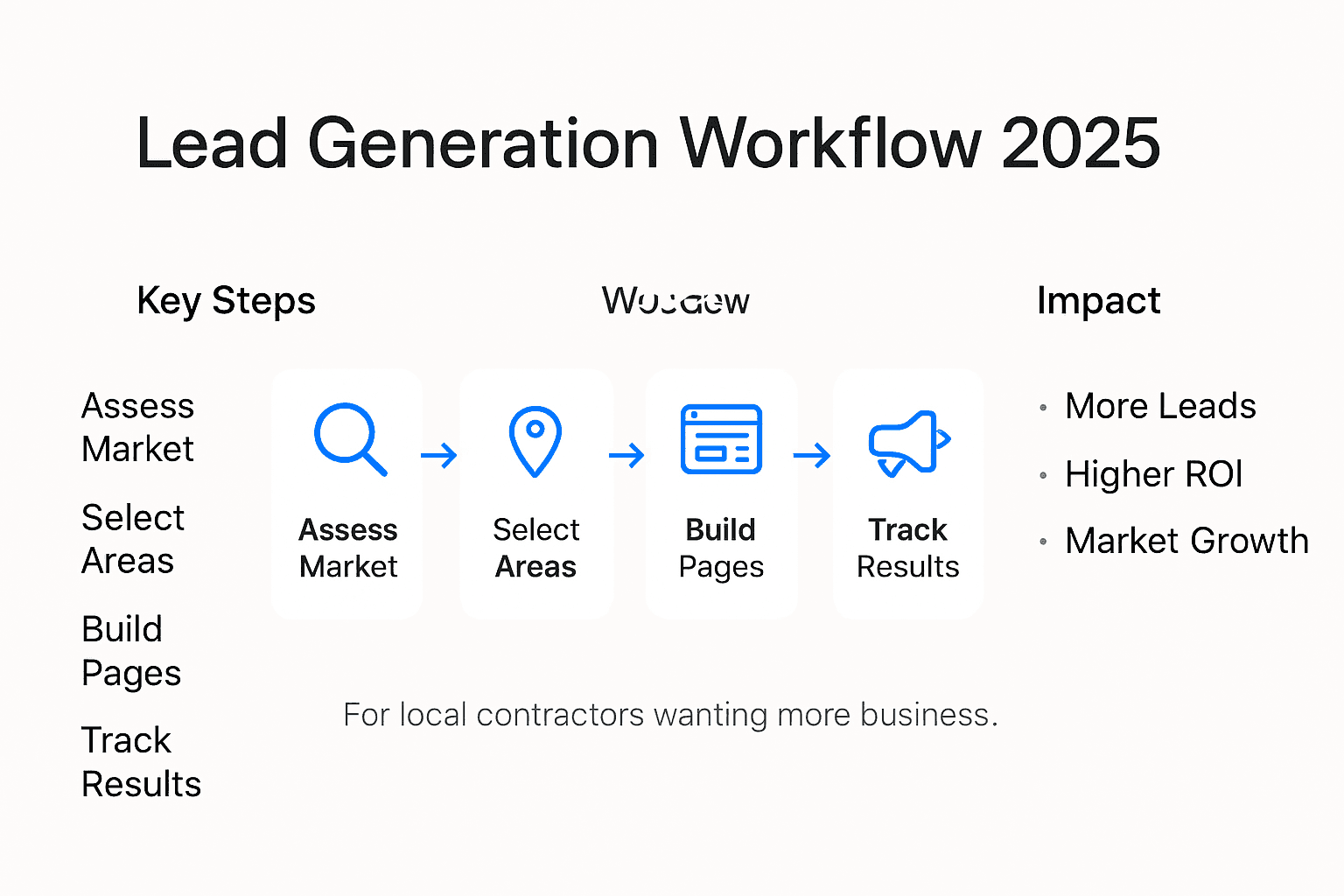
- Step 1: Assess Local Market And Competition
- Step 2: Select Targeted Service Areas And Audiences
- Step 3: Build High-Converting Landing Pages
- Step 4: Launch Multi-Channel Ad Campaigns
- Step 5: Track, Test, And Optimize Results
Quick Overview
| Key Insight | Explanation |
|---|---|
| 1. Conduct thorough market research | Analyze competitors’ strengths and weaknesses to identify your unique market position. |
| 2. Define targeted service areas | Create an ideal customer profile to maximize lead generation in profitable segments. |
| 3. Design effective landing pages | Tailor landing pages for specific services to enhance visitor-to-lead conversion. |
| 4. Launch multi-channel campaigns | Use multiple platforms to reach potential customers simultaneously for better engagement. |
| 5. Track and optimize campaign results | Implement a continuous testing framework to improve lead generation effectiveness over time. |
Step 1: Assess local market and competition
Diving into your local contractor market requires strategic intelligence. You will map out exactly who is competing in your service area and identify opportunities to differentiate your business.
Start by conducting comprehensive market research through multiple channels. Pull local business directories and search engine results for contractors in your specific trade. Analyze their websites, service offerings, pricing structures, and online reviews. Look beyond surface details – examine how competitors position themselves. Are they emphasizing speed? Quality? Price? Understanding their strategic approaches helps you find your unique market angle.
Create a detailed competitive spreadsheet tracking key metrics. Include business names, years operating, service radius, primary marketing channels, average project pricing, and customer satisfaction ratings. Use tools like Google Maps Business Search and industry-specific platforms to gather accurate data. Pay special attention to businesses serving similar geographic zones and customer demographics as your own.
Pro tip: Schedule quarterly competitive analysis reviews to stay ahead of market shifts and emerging local competitors.
Here’s a quick comparison of competitive factors local contractors should track when assessing the market:
| Factor | Why It Matters | How to Evaluate |
|---|---|---|
| Years in Business | Indicates experience and trust | Research business history |
| Service Range | Shows market reach | Map coverage area |
| Online Reputation | Influences customer decisions | Check reviews and ratings |
| Pricing Approach | Impacts competitiveness | Compare published rates |
Step 2: Select targeted service areas and audiences
Selecting the right service areas and audiences is critical for maximizing your lead generation efficiency. You will strategically define the most profitable customer segments and geographic zones where your contracting business can generate the highest return on marketing investment.
Start by developing a comprehensive ideal customer profile (ICP) that goes beyond basic demographics. Targeted lead generation involves breaking down your larger market into specific segments based on precise qualification criteria. Analyze factors like property types, household income, average home age, and specific service needs unique to your trade. For HVAC and roofing contractors, this might mean focusing on homeowners in neighborhoods with older housing stock or areas experiencing frequent extreme weather conditions.
Utilize multi layered segmentation strategies that combine geographic targeting with behavioral and demographic insights. Contractors should leverage tools like local census data, real estate market reports, and customer relationship management systems to identify high potential service areas. Look for zones with higher concentrations of your target customers, emerging residential development, or regions experiencing infrastructure upgrades that might require specialized contractor services.
Pro tip: Update your targeted service area map every six months to adapt to changing local market dynamics and emerging neighborhood trends.
Step 3: Build high-converting landing pages
Creating landing pages that transform website visitors into qualified leads is an essential skill for local contractors seeking predictable business growth. You will design targeted web experiences that speak directly to your ideal customer and compel them to take immediate action.

Start by developing laser-focused page designs that match specific service offerings and target customer segments. Dedicated landing pages for each service location dramatically improve conversion rates by providing hyper-relevant content. Craft compelling headlines that address specific customer pain points, such as emergency roof repairs or energy-efficient HVAC upgrades. Include clear value propositions that differentiate your services from competitors, utilizing strong visual elements like service area maps, customer testimonials, and professionally shot before-and-after project images.
Implement strategic conversion elements that reduce friction and encourage immediate contact. This means prominent call-to-action buttons in contrasting colors, click-to-call phone numbers, streamlined contact forms with minimal fields, and trust indicators like licensing credentials, industry certifications, and customer review ratings. Optimize your landing pages for mobile responsiveness, ensuring smooth user experience across smartphones and tablets where most local service searches originate.
Pro tip: A/B test your landing page elements quarterly to continuously improve conversion rates and stay ahead of changing customer preferences.
Below is a summary of essential landing page elements and their impact on lead generation effectiveness:
| Element | Purpose | Business Impact |
|---|---|---|
| Targeted Headlines | Address specific customer needs | Increases conversion rates |
| Trust Badges | Build credibility and assurance | Boosts customer confidence |
| Mobile Optimization | Ensures accessibility | Captures mobile search leads |
| Streamlined Contact Form | Simplifies user submissions | Reduces barriers to inquiries |
Step 4: Launch multi-channel ad campaigns
Successfully generating leads requires a strategic approach that reaches potential customers across multiple platforms. You will develop a comprehensive advertising strategy that connects with your target audience through diverse marketing channels, maximizing your visibility and engagement.
Cross-channel lead generation in 2025 demands aligning messaging across email, LinkedIn, retargeting ads, and other platforms to create seamless customer experiences. Focus on platforms most relevant to local contractors: Google Ads for search intent, Facebook and Instagram for visual storytelling, LinkedIn for B2B connections, and targeted display advertising. Craft consistent messaging that speaks directly to specific customer pain points while maintaining a unified brand voice. For HVAC and roofing contractors, this might mean highlighting emergency repair services on search ads, showcasing completed projects on social media, and targeting property managers through professional networking platforms.
Implement sophisticated tracking and attribution systems to monitor campaign performance across channels. Use unique phone numbers, custom landing pages, and advanced analytics tools to understand which platforms and messages generate the highest quality leads. Allocate your advertising budget dynamically based on real-time performance data, shifting resources toward the most effective channels and messaging strategies.
Pro tip: Rotate your ad creative every 45-60 days to prevent audience fatigue and maintain engagement rates.
Step 5: Track, test, and optimize results
Successfully generating leads requires more than just launching campaigns. You will develop a systematic approach to measuring, analyzing, and continuously improving your lead generation performance through data-driven insights and strategic testing.
Contractors should implement data-driven strategies to measure and optimize lead generation results by tracking critical performance metrics. Focus on key performance indicators such as conversion rates, cost per lead, response times, and lead quality scores. Utilize advanced analytics platforms and customer relationship management systems to monitor campaign effectiveness in real time. For local contractors, this means tracking metrics like initial contact rates, quote request conversions, and total job bookings generated from different marketing channels.
Establish a rigorous testing framework that allows for continuous improvement. Conduct systematic A/B tests on landing pages, ad creatives, call-to-action messaging, and targeting parameters. Create controlled experiments that isolate specific variables and measure their impact on lead generation performance. Use statistical significance testing to validate results and make data-driven decisions about your marketing strategies. Implement a quarterly review process where you comprehensively analyze campaign performance, identify trends, and make strategic adjustments to your lead generation workflow.
Pro tip: Create a dedicated performance dashboard that aggregates all key metrics, allowing you to quickly visualize and respond to marketing performance trends.
Transform Your Lead Generation Workflow with Proven Digital Marketing Solutions
The article “Lead Generation Workflow 2025 for Local Contractors” reveals the critical challenges local contractors face such as assessing competitive markets, targeting profitable service areas, and building high-converting landing pages. You understand the pressure to track, test, and optimize multi-channel advertising campaigns while standing out in crowded local markets. Tackling these pain points requires tailored strategies focused on measurable results that deliver consistent high-quality leads and booked jobs.
That is exactly where Results Digital excels. Our veteran-owned agency specializes in designing custom websites, local SEO, and targeted Google Ads and Facebook Ads campaigns crafted specifically for contractors looking to dominate their local area. We combine industry-specific expertise with accountability and transparency. By partnering exclusively with one client per market, we eliminate conflicts of interest while providing monthly performance reports to keep your growth on track. Discover how our proven approach can turn your lead generation workflow into a steady pipeline of calls and requests by visiting Our Landing Page.
Ready to conquer your local market and accelerate lead generation for your contracting business?
Visit Results Digital today and learn how you can leverage expert digital marketing to unlock sustainable growth. Start building the high-converting landing pages and multi-channel advertising campaigns your business deserves with personalized support that puts your success first.
Frequently Asked Questions
How can I assess my local competition for lead generation?
You can assess your local competition by conducting thorough market research. Use local business directories and search engine results to track competitors’ websites, service offerings, and customer reviews, creating a competitive spreadsheet to record important metrics.
What factors should I consider when selecting targeted service areas?
Consider factors like property types, household income, and specific service needs when selecting service areas. Analyze local census data and real estate reports to identify regions with high concentrations of your ideal customers.
How do I create high-converting landing pages for my contracting business?
To create high-converting landing pages, focus on specific service offerings and customer segments. Include targeted headlines, trust badges, and streamlined contact forms to encourage inquiries and optimize for mobile users.
What advertising channels should I prioritize for lead generation?
Prioritize channels such as Google Ads for search intent and social media platforms like Facebook and Instagram for visual engagement. Align your messaging across these platforms to create a cohesive campaign that addresses your customers’ needs.
How can I track and optimize my lead generation results effectively?
You can track and optimize lead generation results by monitoring key performance metrics such as conversion rates and lead quality scores. Establish a testing framework for your campaigns, conducting A/B tests on various elements to continually improve performance.
Recommended
- Local Lead Generation Explained: Driving Booked Jobs
- Why Use Google Ads for Local Service Leads
- Digital Markteting for Roofing Companies
- Digital Marketing for Fire Protection Companies
- Digital Marketing for Damage Restoration Companies
- Digital Marketing for Asbestos Abatement Companies
- Blog – A1 Renovari
