
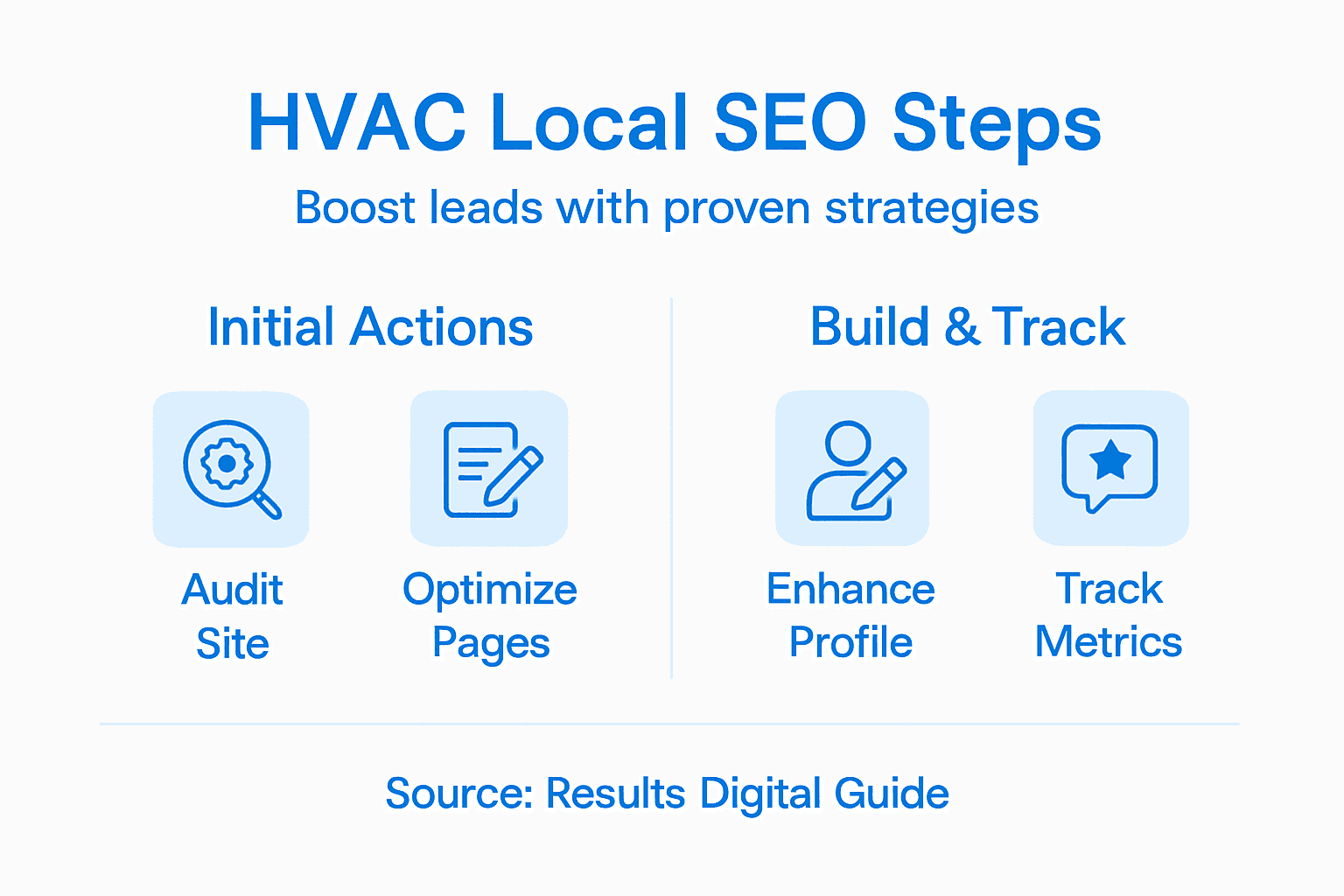
Struggling to stand out among dozens of local competitors is a common challenge for HVAC business owners across the United States. With more customers turning to Google for nearby services, improving your online visibility directly impacts your bottom line. This guide breaks down proven local SEO strategies, from conducting a thorough website audit to claiming your Google Business Profile, helping you attract more local leads and build lasting credibility in your community.
Table of Contents
- Step 1: Audit Your HVAC Website For Local SEO Readiness
- Step 2: Optimize Key Pages For Local HVAC Search Terms
- Step 3: Claim And Enhance Your Google Business Profile
- Step 4: Build Credibility With Local Reviews And Citations
- Step 5: Track Results And Refine Your Local SEO Efforts
Quick Summary
| Key Point | Explanation |
|---|---|
| 1. Audit Your HVAC Website | Conduct a thorough audit to identify technical issues, content gaps, and user experience problems that impact your local SEO. |
| 2. Optimize Key Pages | Focus on improving your homepage and service area pages with location-specific keywords to attract local customers effectively. |
| 3. Enhance Google Business Profile | Claim and completely fill out your Google Business Profile to increase visibility and trust among potential local leads. |
| 4. Build Credibility with Reviews | Actively request and respond to customer reviews to strengthen your business’s reputation and improve local SEO trust signals. |
| 5. Track and Refine Efforts | Monitor key metrics regularly to assess the effectiveness of your local SEO strategies and make necessary adjustments for improved results. |
Step 1: Audit Your HVAC Website for Local SEO Readiness
Before you start optimizing your HVAC website for local search, you need to understand where you currently stand. An audit reveals what’s working, what’s broken, and where your biggest opportunities hide. Think of it like a health checkup for your website before you invest time and money into improvements. You’ll identify technical issues, content gaps, and user experience problems that could be costing you leads right now.
Start by running your website through Google Search Console to check for indexing errors, mobile usability issues, and how Google actually sees your site. Pull up Google Analytics to establish your baseline metrics: current traffic, which pages get the most clicks, bounce rates, and how many conversions happen monthly. These numbers matter because they show what you’re working with. Next, test your site’s technical health. Check page speed using Google PageSpeed Insights, review your mobile responsiveness on different devices, and scan for broken links. Conducting a comprehensive site audit to identify issues like slow load times and mobile usability problems helps you understand your starting point for local SEO readiness.
Then audit your local SEO elements specifically. Verify your Google Business Profile is complete and accurate with your business name, address, phone number, and service areas. Check that your contact information is consistent across your website, local directories, and review sites. Search for your HVAC business by service area terms like “HVAC near me” or “furnace repair in [your city]” and see who appears in the local pack above you. Look at your current content to see if you’re targeting location-based keywords. For example, do you have dedicated service area pages? Is your homepage talking about the specific neighborhoods you serve? Finally, check your competition. Look at the top ranking HVAC websites in your market and note what they’re doing with their content, keywords, and local signals. Understanding your competitive landscape tells you what level of optimization you need to reach.
Pro tip: Document your audit findings in a simple spreadsheet so you can track progress over time and measure the actual impact of your optimization efforts against these baseline numbers.
Here’s a quick comparison of key local SEO tools and their primary functions for HVAC businesses:
| Tool Name | Main Function | Unique Benefit |
|---|---|---|
| Google Search Console | Track indexing and site errors | Reveals technical SEO problems |
| Google Analytics | Monitor traffic and conversions | Measures marketing ROI and audience |
| Google PageSpeed | Analyze website speed | Helps optimize for faster load times |
| Google Business Profile | Manage business info and reviews | Increases visibility in Maps and Search |
Step 2: Optimize Key Pages for Local HVAC Search Terms
Now that you know what your website looks like today, it’s time to optimize your key pages to rank for the local search terms your customers are actually using. Your homepage, service pages, and service area pages are your heavy hitters. They need to be fine-tuned to capture searches like “emergency AC repair in Denver” or “furnace installation near me.” This is where you turn your website into a magnet for qualified local leads.
Start with your homepage and main service pages. Optimizing page titles and meta descriptions with location keywords helps Google understand exactly what you serve and where. Your page title should include your service type and primary location, like “HVAC Repair and Installation in Denver, CO.” Your meta description, the snippet that shows under your title in search results, needs to be compelling and include location modifiers. Don’t stuff keywords awkwardly. Write naturally for people first. Then layer in keywords like “24 hour emergency AC service” or “residential heating repair.” Use your header tags strategically. Your H1 should state what you do and where, your H2s can target related services and locations.

Next, create or optimize service area pages. These are critical for local SEO because they target searches from specific neighborhoods and surrounding towns. If you service 15 neighborhoods, you need 15 pages that specifically address customers in those areas. Don’t just change the city name on a template. Write unique content that mentions local landmarks, neighborhoods, and service specifics for each area. Include your phone number, service area details, and customer testimonials from that location. Creating pillar pages and cluster content around local search terms improves your site structure and authority, helping you rank higher in local search results. Structure matters too. Make sure your URLs are clean and descriptive, like “resultsdigital.io/hvac-repair/denver” instead of “resultsdigital.io/page123.” This clarity helps both users and search engines navigate your site. Finally, link your service area pages back to your main services pages to build internal linking authority and show Google how your content relates.
Pro tip: Use Google’s search results for your target keywords to see what questions and pain points competitors are addressing, then write unique content on your pages that answers those questions better and more locally specific.
Step 3: Claim and Enhance Your Google Business Profile
Your Google Business Profile is where local customers find you first. This is your digital storefront, and it shows up right in Google Search and Google Maps when someone searches for HVAC services near them. If you haven’t claimed your profile yet, you’re leaving leads on the table. If you have claimed it but haven’t filled it out completely, you’re missing opportunities to stand out from competitors.
Start by going to Google Business Profile and searching for your business. If it exists, claim it by verifying your ownership through the postcard Google mails you or through other verification methods. If it doesn’t exist, create one from scratch. Once you own it, fill out every single field thoroughly. Your business name, address, and phone number need to match exactly what appears on your website and other directories. This consistency signals trust to Google. Add all your service categories. Don’t just pick “HVAC contractor.” Select specific services like “AC repair,” “furnace installation,” “emergency heating service,” and “ductless mini split installation.” Each category increases the chances you’ll appear in relevant searches. Maintaining an updated Google Business Profile with accurate contact information and operational hours boosts your local search visibility and helps you attract relevant leads in your geographic area. Add your service areas too. List every city and neighborhood you service. This tells Google where you want to appear in local searches.
Now enhance your profile beyond basic information. Upload high quality photos of your team, your service vehicles, completed jobs, and your office. Customers want to see who they’re hiring. Add your business hours and make sure they’re correct, especially if you offer emergency services. Write a compelling business description that includes what makes you different. Are you licensed and insured? Do you offer same day service? Say it here. Post regular updates about seasonal specials, new services, or helpful HVAC tips. This keeps your profile fresh and shows Google you’re actively engaged. Most importantly, respond to every customer review and question within 24 hours. People notice when businesses reply. These interactions build trust and give Google signals that you’re a legitimate, responsive business worth ranking higher. Responding to reviews takes just minutes but makes a huge difference in your local SEO performance.
Pro tip: Encourage your satisfied customers to leave reviews on your Google Business Profile by sending follow up messages or texts after you complete their service, then respond to every single review to show engagement and build social proof.
Step 4: Build Credibility with Local Reviews and Citations
Reviews and citations are the currency of local SEO. When potential customers see that others have had great experiences with your HVAC business, they trust you more. When Google sees your business listed consistently across the web with accurate information, it trusts you more too. Both of these factors directly impact your ability to generate leads from local search.
Start by actively soliciting reviews from your satisfied customers. After you complete a job, send a follow up text or email asking them to leave a review on Google, Yelp, or industry-specific sites like Angie’s List. Make it easy by providing direct links. Don’t ask for positive reviews only. Authentic feedback, even when critical, builds credibility. Authentic positive reviews on Google, Yelp, and industry-specific sites increase credibility and amplify search engine trust for your HVAC company. Aim for at least one new review per week. The more reviews you accumulate, the stronger your social proof becomes. Respond to every review, positive or negative. Thank customers for positive reviews and address concerns in negative ones professionally. This shows you care and signals to Google that you’re engaged. Negative reviews handled well actually boost your credibility more than silence ever could.
Now tackle citations. A citation is simply a mention of your business name, address, and phone number on another website. These need to be consistent everywhere. Audit your current citations by searching for your business name online and noting where it appears. Check Google Maps, Yelp, the Better Business Bureau, local chamber of commerce listings, contractor directories, and industry-specific platforms. Are your address, phone number, and business name spelled the same way everywhere? If not, fix them. Maintaining consistent and accurate business citations across local directories amplifies search engine trust and improves local ranking outcomes significantly. Then build new citations. Submit your business information to major directories like Yelp, Apple Maps, and industry sites relevant to HVAC contractors. Each new citation is another signal to Google that you’re a legitimate, established business. Consistency matters more than quantity. One perfectly accurate citation beats ten inconsistent ones.
Pro tip: Set up a simple spreadsheet tracking where your business is listed and audit it quarterly to catch any outdated or inconsistent information before it damages your local search rankings.
Step 5: Track Results and Refine Your Local SEO Efforts
You’ve made real changes to your website and online presence. Now you need to measure what’s actually working so you can double down on wins and adjust what’s not delivering. Tracking your local SEO performance reveals which tactics generate leads and which ones drain your time and money.
Start by establishing clear metrics before you make any more changes. Go back to the baseline numbers you captured in Step 1. Your key metrics are keyword rankings, organic website traffic, click through rates from Google Search and Maps, phone calls from local searches, and form submissions from your service area. Monitoring keyword rankings, website traffic sources, user behavior, and conversions through analytics tracking helps you understand which local SEO tactics drive real results. Set up a monthly tracking routine. Use Google Analytics to monitor which pages get traffic and where that traffic comes from. Check Google Search Console to see which keywords you’re ranking for and your average position. Track your Google Business Profile performance directly in the profile itself, where you’ll see how many people found you through local search, viewed your photos, and called your business. Look for patterns. If service area pages for Denver are generating calls but your pages for Boulder aren’t, that tells you something. Maybe Denver needs more targeted ads, or maybe your Boulder content isn’t addressing what customers actually search for there.
Refinement happens monthly. Using keyword tracking software and performance data helps assess which tactics generate the best results locally and ensures you maintain competitive positioning. Review your metrics, identify what’s working, and adjust your strategy accordingly. Did adding those service area pages increase local traffic? Great, add more detail and optimize them further. Are you getting zero calls from a specific neighborhood despite ranking there? Test a different keyword angle or consider local paid advertising to supplement organic search. Update your content based on what customers actually ask about. If you’re getting calls from pages about AC repair but not furnace installation, invest more in furnace content. Local SEO isn’t a set it and forget it strategy. The businesses that win are the ones constantly measuring, learning, and adjusting. Your competitors aren’t standing still, and neither should you.
Pro tip: Create a simple monthly dashboard tracking the five most important metrics for your HVAC business, then review it with your team on the same day each month to catch trends early and adjust your strategy before the competition does.
Here are essential metrics to track for ongoing local SEO success:
| Metric | What It Measures | Why It Matters |
|---|---|---|
| Keyword Rankings | Search position for terms | Signals site visibility and progress |
| Organic Traffic | Visitors from search | Monitors impact of optimization |
| Click Through Rate | % of users visiting site | Indicates appeal of page snippets |
| Phone Calls from Search | Inquiries via Google Profile | Shows customer acquisition effectiveness |
| Form Submissions | Online lead capture | Reflects ability to convert visitors |
Unlock Local HVAC Leads With Expert Digital Marketing Support
Driving qualified local leads for your HVAC business requires more than just great service. The article highlights key challenges like optimizing for local search terms, managing your Google Business Profile, and building consistent citations and reviews. If you feel overwhelmed tracking keyword rankings, refining service area content, or responding to reviews promptly you are not alone. These critical local SEO elements directly impact your website traffic, call volume, and booked jobs.
At Results Digital, we specialize in helping local service-based businesses like HVAC contractors master these exact challenges through proven digital marketing solutions. Our custom website designs are optimized for local SEO with clean URLs and targeted service area pages that capture your ideal customers. We also supercharge your Google Business Profile and online reputation to boost visibility and trust right where it matters most. Combined with strategic Google Ads and Facebook Ads campaigns, we help generate consistent calls and requests without long-term contracts.
Explore our comprehensive local SEO and lead generation services to gain measurable results with the peace of mind that your market is exclusive to your business.
Discover how we tailor websites and campaigns specifically for HVAC pros.
Make today the day you transform online searches into booked jobs and dominate your local market.
Start your journey with Results Digital and watch your HVAC leads take off.
Frequently Asked Questions
How can I audit my HVAC website for local SEO readiness?
To audit your HVAC website for local SEO readiness, start by checking for indexing errors and mobile usability issues through Google Search Console. Next, pull metrics from Google Analytics to understand your current traffic and conversion rates, and identify any technical issues like broken links or slow page speed.
What are the key elements to optimize on my HVAC website for local search terms?
The key elements to optimize include your homepage, service pages, and service area pages. Ensure that your page titles and meta descriptions contain location-specific keywords and that your content accurately reflects the services you offer in specific neighborhoods.
How do I create and enhance my Google Business Profile?
To create and enhance your Google Business Profile, first claim your business by verifying it. Complete all fields with accurate information, including your business name, address, phone number, service categories, and business description, and regularly update it with new photos and customer reviews to maintain engagement.
Why are customer reviews important for my HVAC business’s local SEO?
Customer reviews are crucial because they build trust with potential customers and increase your visibility in local search results. Actively solicit reviews from satisfied customers and respond to every review to show engagement and improve your overall credibility in Google’s eyes.
What metrics should I track to measure the success of my local SEO efforts?
You should track metrics such as keyword rankings, organic website traffic, and click-through rates from local searches. Establish a monthly routine to review these metrics, helping you identify successful strategies and areas needing improvement, ideally aiming for consistent growth over several months.
Recommended
- 7 Benefits of Local SEO Every HVAC Business Should Know
- Lead Generation Strategies 2025: Winning More Local HVAC Customers
- Role of SEO in Local Services – Real Results for HVAC Contractors
- Master Local SEO for Contractors 2025 and Boost Leads
- Air Conditioning Service Corby – My Company
- Digital Markteting for Roofing Companies
- Digital Marketing for Fire Protection Companies
- Digital Marketing for Damage Restoration Companies
- Digital Marketing for Asbestos Abatement Companies
