
Chasing every lead feels exhausting when you know most won’t turn into real jobs. Local HVAC company owners across the United States lose valuable time and money without a clear plan for targeting the right customers. By narrowing your focus to the ideal local customer targets and building workflows around their needs, you can secure high-quality job requests and fill your schedule with bookings that matter.
Table of Contents
- Step 1: Define Ideal Local Customer Targets
- Step 2: Build Optimized Website And Profiles
- Step 3: Launch Targeted Google And Facebook Ads
- Step 4: Track Lead Data And Adjust Strategies
Quick Summary
| Key Insight | Explanation |
|---|---|
| 1. Define your ideal customer profiles | Clearly identify target customer segments based on problems, demographics, and preferences to optimize marketing efforts. |
| 2. Optimize your website for conversion | Design your website to encourage clear actions, such as calls or service requests, ensuring ease of use for visitors. |
| 3. Launch targeted ad campaigns | Use Google and Facebook ads to reach specific demographics actively searching for HVAC services, using compelling copy. |
| 4. Track and analyze lead data diligently | Establish metrics to measure ad performance and customer conversion rates, allowing for quick and informed adjustments. |
| 5. Regularly adjust strategies based on data | Continuously refine your marketing approaches based on performance insights to maximize efficiency and effectiveness. |
Step 1: Define ideal local customer targets
You’ve got to know who you’re going after. Without clarity on your ideal local customers, you’ll waste time and money chasing every lead that comes your way. This step narrows down exactly which customers to target in your area, so your lead generation efforts land with precision.
Start by identifying the specific problems your services solve. For HVAC work, this might be homeowners with aging systems, commercial buildings needing maintenance contracts, or properties in neighborhoods with extreme seasonal weather. When you understand customer pain points, you can target people actively looking for solutions.
Next, define your customer personas. Think about the types of people most likely to call you. Are they:
- Homeowners in certain age groups or income brackets
- Property managers handling multiple buildings
- New construction companies needing ongoing service partners
- Rental property owners with maintenance obligations
- Commercial facilities with compliance requirements
Each persona should have distinct characteristics. A 65-year-old homeowner with a 25-year-old furnace behaves differently than a 35-year-old in a newly built home. They have different budgets, timelines, and communication preferences.
Now look at geography. Your local service area shapes everything. Define which neighborhoods, zip codes, or districts you’ll target first. Many HVAC companies find success focusing on a tight geographic “beachhead” before expanding outward. This approach helps you dominate a smaller area faster than spreading thin across a large territory.
Consider what motivates your best customers to buy. Emergency repairs? Seasonal maintenance? System replacements? Understanding how to prioritize customer needs reveals which messaging resonates most with different segments.
Create a simple one-page profile for each target persona that includes their location, typical problems, budget range, and how they prefer to be contacted. This becomes your targeting reference when running ads or optimizing your website.
Here’s a quick comparison of local HVAC customer personas:
| Persona Type | Typical Needs | Communication Preference | Average Budget |
|---|---|---|---|
| Aging homeowner | System replacement, repairs | Phone call | $3,000-$7,000 |
| Property manager | Maintenance contracts, fast fixes | Email or phone | $5,000+/month |
| New construction company | Ongoing service partnerships | Scheduled meetings | Project-based |
| Rental property owner | Preventative maintenance | $500-$2,000 | |
| Commercial facility | Compliance, urgent repairs | Business phone or portal | $10,000+/year |
Your ideal customer profile should be so specific that you could recognize them in a coffee shop. If it’s vague, your targeting will be too.
Pro tip: Interview your last 10 best customers to identify common traits—same neighborhood, similar property age, comparable job values, or referral patterns. These patterns reveal your most profitable target segment.
Step 2: Build optimized website and profiles
Your website is your 24/7 salesperson. It needs to convert visitors into calls and job requests, not just look pretty. This step covers creating a website and online profiles that turn your ideal customers into booked jobs.

Start with a clear conversion goal. Every page should guide visitors toward one action: calling you, requesting a quote, or booking a service. Before you design anything, know exactly what you want visitors to do when they land on your site.
Your website structure matters more than you’d think. Visitors should find what they need in three clicks or less. When designing mobile-optimized website navigation, ensure menus are logical and calls-to-action are visible above the fold on every page.
Mobile optimization is non-negotiable. Most customers searching for HVAC repair are on their phones right now. Your site must load fast, display properly on small screens, and have clickable phone numbers and contact buttons.
Build out these critical pages and sections:
- Homepage with your service area and main services
- Service pages explaining what you offer and why you’re different
- About page showing your credentials and experience
- Customer testimonials and case studies
- Contact page with multiple ways to reach you
- FAQ section addressing common customer questions
Use a memorable, short URL like yourcompanyname.com rather than something long and complicated. Make your domain easy to spell and remember.
Content should speak directly to your ideal customers. Instead of generic descriptions, address their actual problems. A homeowner doesn’t care about your technical credentials as much as whether you’ll fix their system without overcharging them.
Claim and optimize all local business profiles. Ensure your Google Business Profile, Facebook, and industry-specific directories (like HomeAdvisor or Angi) all have consistent name, address, phone number, and photos. Inconsistencies confuse customers and hurt your search rankings.
Your website should make a nervous homeowner feel confident calling you. If they can’t find your phone number or understand what you do in 10 seconds, redesign it.
Pro tip: Add a trust badge like “Licensed and Insured” prominently on your homepage and service pages—customers want proof you’re legitimate before they call.
Step 3: Launch targeted Google and Facebook ads
Paid ads accelerate your lead generation dramatically. Instead of waiting months for SEO results, Google and Facebook ads put your business in front of customers actively searching for your services right now. This step shows you how to launch campaigns that convert.
Start by setting up your ad accounts and budgets. Google Ads and Facebook require separate setup, but both follow similar principles: define your audience, write compelling ad copy, and direct clicks to your website or phone number.
Your audience targeting makes or breaks your campaign. With location-based and demographic targeting options, you can narrow ads to homeowners in specific zip codes, income levels, and age ranges. For HVAC, target neighborhoods with older homes or those experiencing seasonal weather extremes.
Google Ads works best for intent-based targeting. Someone typing “emergency furnace repair near me” is ready to hire. Use keywords matching what your ideal customers search. Set up search campaigns with keywords like “HVAC repair,” “heater installation,” or “emergency AC service.”
Facebook and Instagram ads work differently. They reach people based on interests and behaviors rather than search intent. Use these platforms to build awareness and retargeting campaigns. Target homeowners interested in home maintenance, property management, or home improvement.
Structure your campaigns strategically:
- Create separate campaigns for different service types
- Set geographic boundaries around your service area
- Use ad scheduling to show ads during peak calling hours
- Run multiple ad variations to test messaging
- Direct clicks to specific landing pages, not your homepage
Your ad copy must address customer pain points immediately. Don’t talk about yourself. Talk about their problem and your solution. Example: “Your furnace won’t start? Same-day emergency service available.” That resonates more than “Trusted HVAC experts since 2010.”
Use AI-driven personalization and context-based targeting to refine who sees your ads. Modern platforms automatically optimize ad delivery to reach high-intent prospects most likely to call or book.
Start small with a weekly budget you’re comfortable testing with, around $300 to $500. Track every dollar spent and which ads generate actual booked jobs. Kill underperforming ads quickly and double down on winners.
Your first week of ads won’t be perfect. You’re gathering data. Use that data to improve targeting and messaging ruthlessly.
Pro tip: Add a phone number directly in your ad copy and use click-to-call buttons on mobile ads—customers should be able to call you without leaving the ad.
Step 4: Track lead data and adjust strategies
Data tells you what’s working and what’s not. Without tracking, you’re flying blind, spending money on ads that don’t convert and missing opportunities to optimize. This step shows you how to measure results and continuously improve your lead generation workflow.
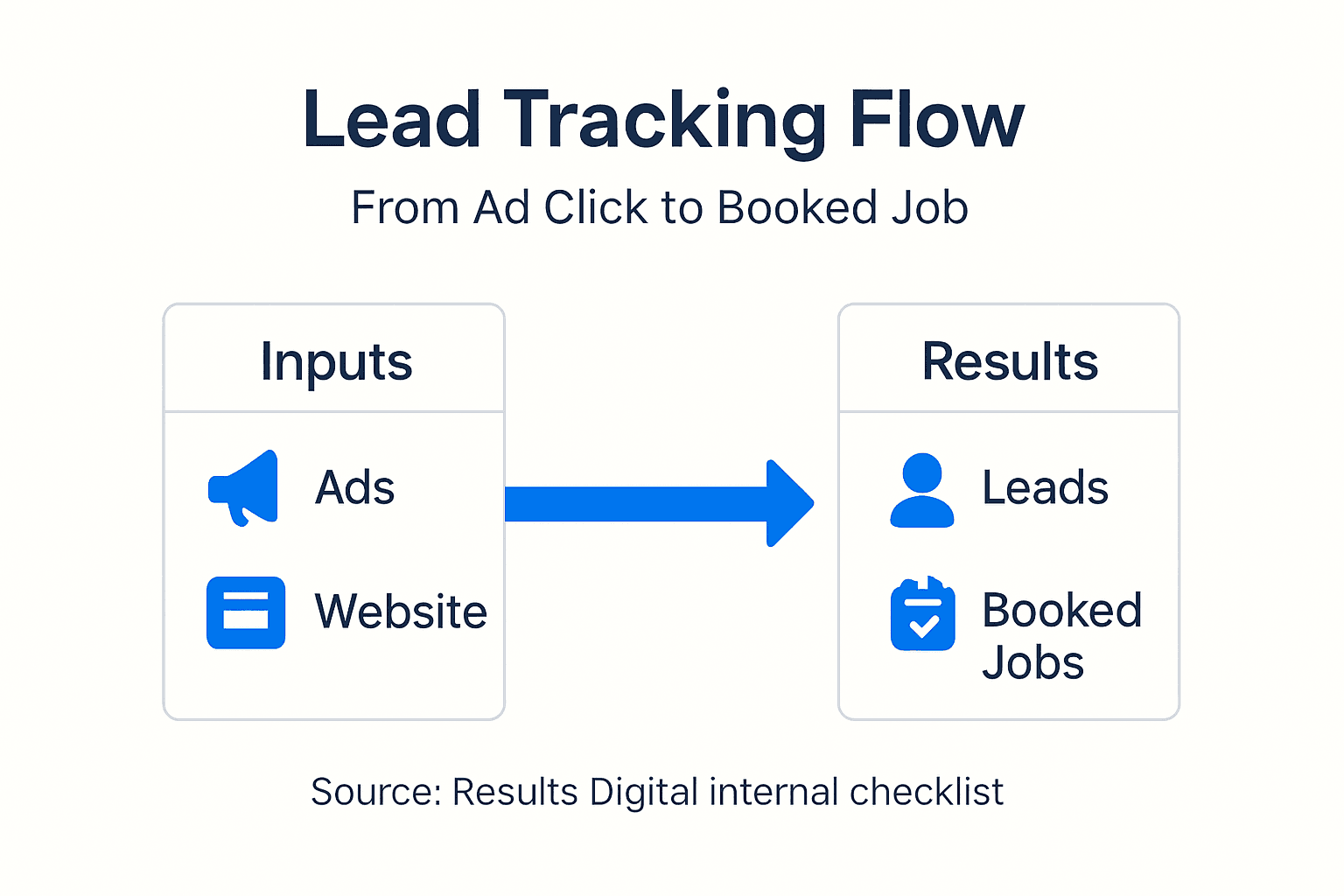
Set up tracking from day one. Every ad, every landing page, every phone call should be trackable. Use Google Analytics on your website to see which traffic sources send the most visitors. Install call tracking software that assigns unique phone numbers to different ad campaigns.
Campaign performance analytics reveals which strategies drive actual booked jobs versus which just generate noise. Track metrics like cost per lead, conversion rate from lead to phone call, and most importantly, cost per booked job.
Create a simple weekly tracking spreadsheet. Record how many leads came from Google Ads, Facebook, your website, referrals, and other sources. Note which service types generated those leads. Calculate your cost for each lead source. This becomes your decision-making tool.
Monitor these critical metrics consistently:
Below is a summary of critical metrics to track for lead generation optimization:
| Metric | What It Measures | Why It Matters |
|---|---|---|
| Cost per lead | Expense for each new lead | Reveals ad spend utility |
| Conversion rate | Leads to bookings percentage | Assesses sales efficiency |
| Call volume by source | Number of calls per channel | Identifies top performers |
| Return on ad spend | Revenue vs. advertising costs | Optimizes budget allocation |
- Cost per lead from each ad campaign
- Phone call volume and source
- Website form submissions and quality
- Conversion rate from lead to scheduled appointment
- Average job value from each lead source
- Return on ad spend for paid campaigns
Look for patterns monthly. If Facebook ads cost $45 per lead but Google Ads costs $22, shift more budget to Google. If leads from neighborhood X convert at 40% but leads from neighborhood Y convert at 15%, focus on neighborhood X.
Adjustments should be data-driven and rapid. Don’t wait six months to make changes. Review performance weekly and make small adjustments to targeting, ad copy, and budgets. Pause campaigns that aren’t working after 2-3 weeks of data.
Talk to your team about which leads actually converted to jobs. Sometimes a cheap lead source produces great customers, while expensive leads disappear. Your sales data matters more than click counts.
Numbers don’t lie. If your data says something isn’t working, trust it. Stop doing it and try something else.
Pro tip: Create a simple dashboard showing last week’s leads by source, cost per lead, and conversion rate—review it every Monday morning and adjust your week’s ad spending accordingly.
Accelerate Your Local Trades Growth with Proven Lead Generation Solutions
The article highlights the challenge of capturing precise local leads and converting them into booked jobs quickly. Key pain points include identifying ideal customers, launching targeted Google and Facebook ads, building an optimized website with clear calls to action, and continuously tracking lead performance. If you feel overwhelmed refining your local service area targeting or frustrated by paid ads that fail to deliver, you are not alone. The concepts of audience personas, intent-based targeting, and detailed analytics are critical to solving these common hurdles.
At Results Digital, we specialize in empowering trades businesses with these exact strategies to create measurable, fast lead generation results. From custom website design optimized for mobile and conversion to expertly managed Google Ads and Facebook campaigns tailored to your service area, we take the complexity off your plate. Our exclusive, conflict-free partnership model ensures you get focused digital marketing support without long-term contracts or guesswork. Discover how our veteran-owned agency has helped local contractors dominate their markets through transparent reporting and account-based advertising solutions.
Ready to stop wasting ad spend and start booking more jobs fast Our lead generation solutions are designed for trades professionals who want real growth without the hassle. Visit Results Digital now to learn how our strategic approach to local SEO, targeted ads, and conversion-focused websites can transform your business. Take action today and turn your next lead into a loyal customer.
Frequently Asked Questions
What steps should I take to define my ideal local customer targets in the trades?
Start by identifying the specific problems your services solve for potential customers. Then, develop customer personas based on demographics and geographic areas that align with those needs to target your marketing efforts effectively.
How can I optimize my website for better lead generation in the trades?
Ensure your website has clear conversion goals, fast loading times, and mobile optimization. Create essential pages that address customer pain points and include easily accessible contact methods to encourage potential clients to reach out.
What is the best strategy for launching Google and Facebook ads for my trades business?
Start by defining your target audience and setting up ads based on their location and demographics. Aim to use compelling ad copy that speaks to the specific problems your ideal customers face, and direct traffic to tailored landing pages to increase lead conversion.
How do I track lead data effectively to optimize my lead generation workflow?
Set up tracking for all ads, phone calls, and website traffic from the beginning. Use a simple spreadsheet to record important metrics such as cost per lead and conversion rates, and analyze this data weekly to identify opportunities for improvement.
How quickly can I expect to book more jobs using these lead generation strategies?
With consistent implementation of the outlined strategies, you may start seeing improvements in leads and bookings within 30–60 days. Focus on refining your targeting and messaging as you gather data to enhance effectiveness.
Recommended
- Local Lead Generation Explained: Driving Booked Jobs
- Local Lead Generation Explained: Driving Booked Jobs
- Lead Generation Workflow 2025 for Local Contractors
- Lead Generation for Contractors: Driving Local Growth
- Digital Markteting for Roofing Companies
- Digital Marketing for Fire Protection Companies
- Digital Marketing for Damage Restoration Companies
- Digital Marketing for Asbestos Abatement Companies
