
Every contractor who serves a specific city or zip code has faced the challenge of being invisible to local customers online. That problem matters because your next high-quality lead is searching for your services on Google right now, not across the country, but in your neighborhood. By understanding and applying local search optimization, you can turn those searches into jobs, outpace competitors, and capture the urgent calls local homeowners are ready to make.
Table of Contents
- What Is Local SEO and Why It Matters
- Essential Local SEO Strategies for Contractors
- Optimizing Google Business Profile for Visibility
- Risks and Misconceptions in Local SEO
- Comparing SEO to Other Lead Generation Approaches
Key Takeaways
| Point | Details |
|---|---|
| Importance of Local SEO | Local SEO is essential for contractors as it connects them with high-intent customers searching for services in their area. Optimizing for local search results directly impacts lead quality and conversion rates. |
| Role of Google Business Profile | A well-optimized Google Business Profile is the cornerstone of local SEO, significantly enhancing visibility and attracting qualified leads. Regular updates and complete information are crucial for effectiveness. |
| Ongoing Management is Key | Local SEO requires continuous effort, including managing online reviews, ensuring citation consistency, and optimizing website content. Abandoning these tasks can lead to diminished visibility and competitiveness. |
| Integrate Lead Generation Strategies | Successful contractors combine local SEO with other lead generation methods like Google Ads for immediate results, creating a balanced and effective marketing approach over time. |
What Is Local SEO and Why It Matters
Local SEO is the process of optimizing your business to appear in local search results when potential customers search for services in your area. These results include Google Maps listings, “near me” queries, and geographically specific searches like “HVAC repair in Denver” or “roofing contractor 80210.”
Traditional SEO casts a wide net. Local SEO narrows the focus to your specific service area, whether that’s your city, neighborhood, or zip code. The difference matters tremendously for contractors because your customers aren’t searching nationally—they’re searching locally.
Why Local SEO Matters for Trade Contractors
Here’s the reality: most searches have local intent. When someone types “emergency plumber near me” at 2 a.m., they want someone arriving within 30 minutes, not someone three states away.
Local search traffic converts at significantly higher rates because searchers have immediate purchase intent. They’re not researching—they’re ready to hire. This direct connection between search and action is why local SEO delivers qualified leads instead of window shoppers.
Without local SEO, you’re invisible to these high-intent customers. Your competitor who ranks locally captures the job you should have won.
What Local SEO Includes
Local SEO isn’t one tactic. It’s a combination of strategies working together:
- Google Business Profile optimization – Your listing must be complete, accurate, and keyword-optimized
- Review management – Customer reviews boost visibility and build trust with prospects
- Local citations – Consistent business information across directories strengthens your authority
- Location-specific content – Web pages targeting your service areas with relevant keywords
- Google Maps optimization – Ensuring your pin, photos, and details are customer-friendly
- Schema markup – Structured data that tells search engines exactly what you do and where
Your Google Business Profile is the foundation of local SEO. Without it optimized correctly, you’re leaving leads on the table every single day.
The Difference Between SEO and Local SEO
SEO evolved into local optimization in the early 2000s to connect searchers with nearby businesses. Traditional SEO focuses on ranking nationally or globally. Local SEO targets people in your service area who are ready to buy right now.
For an HVAC contractor, ranking #1 nationally is worthless. Ranking #1 for “HVAC repair in [your city]” fills your schedule with calls.
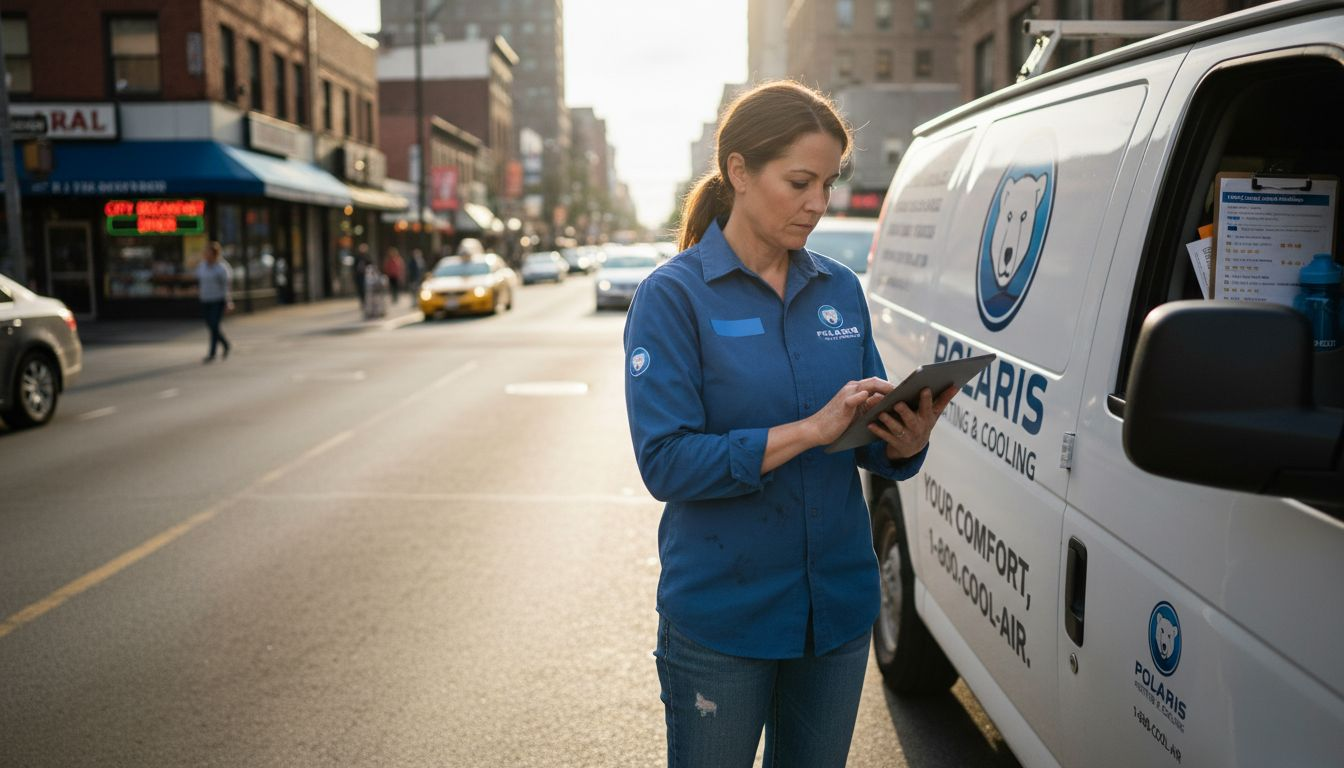
Local SEO also accounts for different search behaviors. Someone searching “best heating repair” expects educational content. Someone searching “heating repair 80202” expects your phone number and service availability.
Here’s a quick comparison to help you understand when to use traditional SEO versus local SEO:
| Aspect | Traditional SEO | Local SEO |
|---|---|---|
| Target Area | National or global | City, zip code, or neighborhood |
| Searcher Intent | Broad information discovery | Ready-to-buy local customers |
| Results Format | Standard Google listings | Maps, local packs, address info |
| Lead Quality | Often lower intent | High-intent, ready to convert |
| Main Assets | Website content, backlinks | Google Business Profile, citations |
Pro tip: Start by claiming and fully optimizing your Google Business Profile—this single action delivers more qualified local leads than almost any other tactic and takes less than an hour to set up correctly.
Essential Local SEO Strategies for Contractors
Dominating your local market requires a strategic approach to local SEO. It’s not about implementing one tactic—it’s about stacking multiple strategies that work together to establish authority and visibility in your service area.
The contractors pulling in the most consistent leads aren’t hoping to rank. They’re executing a deliberate system that addresses how local search actually works.
Strategy 1: Optimize and Manage Your Google Business Profile
Your Google Business Profile is your local search headquarters. Every detail matters: business name, address, phone number, service areas, hours, and photos.
Incomplete profiles rank poorly. Accurate, fully optimized profiles dominate.
- Verify your business address matches your actual location
- Add all service categories that apply to your business
- Upload high-quality photos of your team, vehicles, and completed work
- Respond to all customer reviews promptly
- Post regular updates about services, special offers, or seasonal maintenance
Your Google Business Profile is the single highest-impact local SEO tactic. Competitors with incomplete profiles are handing you market share.
Strategy 2: Build and Manage Customer Reviews
Reviews are a ranking signal and a conversion tool. Potential customers trust reviews almost as much as word-of-mouth referrals.
Professional review solicitation after completing jobs builds social proof and boosts your local visibility simultaneously. Ask satisfied customers to leave reviews on Google, Yelp, and industry-specific platforms.
Don’t ignore negative reviews—respond professionally and offer to make it right. This shows future customers that you care about service quality.
Strategy 3: Register with Local Directories and Citations
Local citations are consistent mentions of your business name, address, and phone number across directories like Angi, HomeAdvisor, Yelp, and local business databases.
Search engines use citation consistency to verify your business legitimacy. Inconsistent or missing citations hurt your rankings.
- Register your business in major local and national directories
- Ensure your NAP (name, address, phone) is identical everywhere
- Update citations whenever your information changes
- Include your license number where appropriate
Strategy 4: Comply with Advertising Guidelines While Building Credibility
Contractors must follow specific advertising rules. Accurate licensing information belongs in all promotions, including online listings and review profiles.
Compliance isn’t just legal—it’s an SEO advantage. Search engines reward businesses with verified credentials. Customers trust licensed contractors more. It’s a win on both fronts.
Strategy 5: Target Local Keywords on Your Website
Your website should have dedicated pages for each service area you serve. A roofing contractor in a multi-county region needs pages optimized for “roof repair Denver,” “roof repair Boulder,” and “roof repair Fort Collins.”
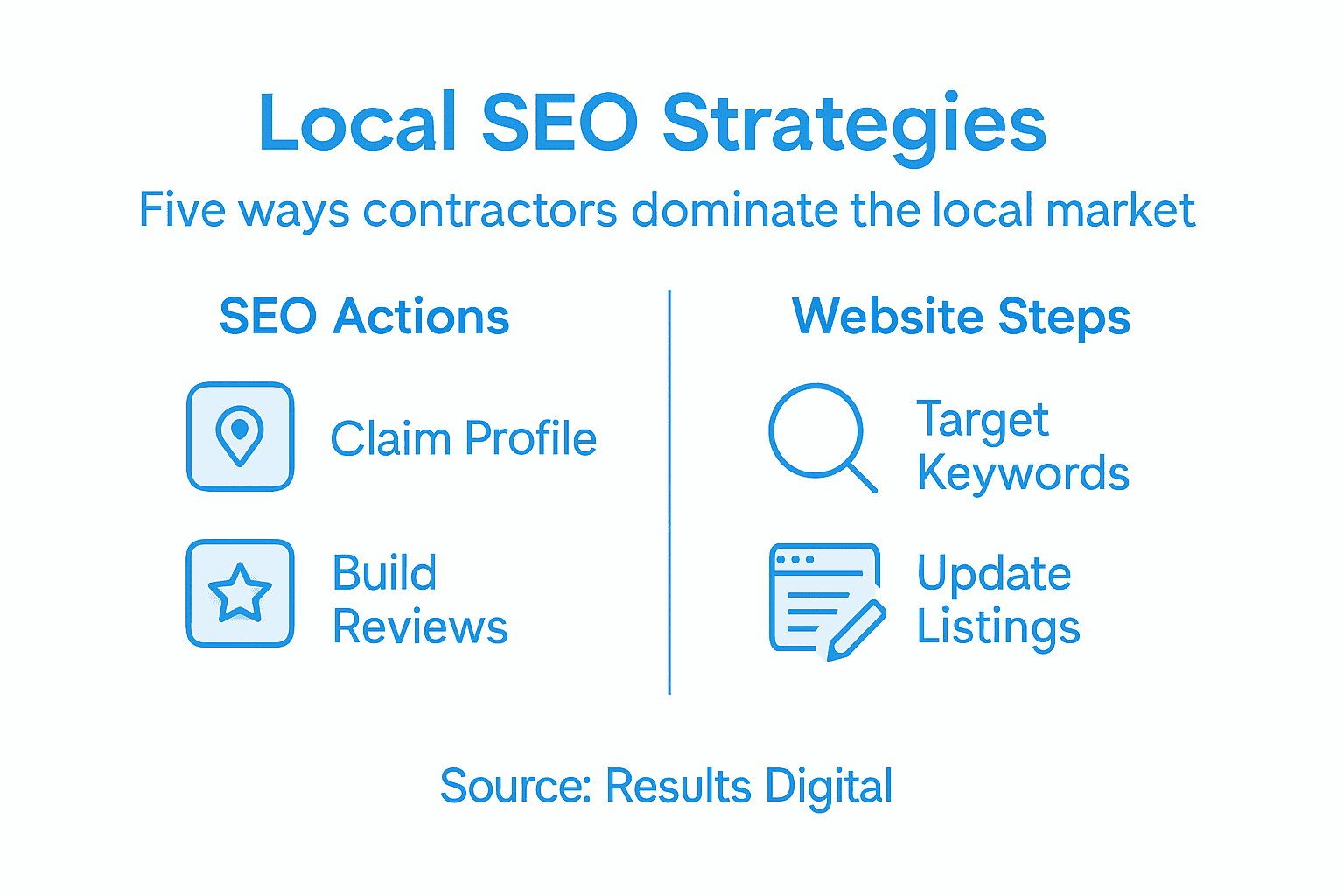
These pages should include local keywords naturally in headings, service descriptions, and content. This tells search engines exactly where you operate and what services you provide in each location.
Pro tip: Create a service area checklist and audit your Google Business Profile, website, and major directory listings quarterly—consistency across all platforms is what separates top-ranking contractors from the middle of the pack.
Optimizing Google Business Profile for Visibility
Your Google Business Profile is the control center of your local SEO. It’s where customers find your address, call your number, read reviews, and decide whether to hire you. A neglected profile is leaving money on the table.
Optimization isn’t complicated, but it requires attention to detail and ongoing maintenance. The contractors winning in their markets treat their profiles like they treat their equipment—they keep them in top condition.
Claim and Verify Your Profile
First step: claim your profile if you haven’t already. Search your business name on Google Maps and look for your listing. If it exists but you don’t manage it, claim ownership through Google.
Verification usually happens via postcard or phone. Complete this process immediately—unverified profiles have limited functionality and lower visibility.
Complete Every Required Field Accurately
A well-optimized Google Business Profile requires correct categories, business hours, and contact information. Missing or incorrect information tells Google your profile isn’t trustworthy.
Here’s what to fill in completely:
- Business name exactly as it appears on your license
- Complete address (no PO boxes for service-based contractors)
- Phone number customers can actually reach you on
- Website URL
- All applicable service categories
- Accurate business hours, including seasonal changes
- Service areas you serve (critical for contractors)
A profile missing even one key detail loses visibility in local search results. Completeness is a ranking factor.
Upload Authentic, High-Quality Photos
Photos boost engagement and conversions dramatically. Customers want to see your team, your vehicles, your work quality, and your professionalism.
Upload photos that show:
- Your team in action on job sites
- Before-and-after shots of completed projects
- Your branded vehicles
- Your office or service area
- License or certifications on display
Low-quality or generic stock photos hurt credibility. Real photos of real work win trust.
Encourage and Respond to Customer Reviews
Reviews improve prominence and relevance in local search rankings. After every completed job, ask satisfied customers to leave a review on Google.
Make it easy for them—send a text link or email with clear instructions. Respond to all reviews, positive or negative, within 24-48 hours. Professional responses show you care about customer satisfaction.
Keep Your Profile Updated
Update your profile whenever anything changes: hours, service areas, phone number, address, or seasonal availability. Stale information damages trust and visibility.
Post regular updates about seasonal services, special offers, or new services you offer. Active profiles rank higher than abandoned ones.
Pro tip: Set a calendar reminder to review and update your entire Google Business Profile every month—this consistency signals to Google that your business is active and legitimate, which directly improves your local visibility.
Risks and Misconceptions in Local SEO
Local SEO isn’t magic. It requires patience, strategy, and ongoing maintenance. Many contractors fail not because local SEO doesn’t work, but because they believe common misconceptions that lead them astray.
Understanding these pitfalls protects your investment and accelerates your results.
Misconception 1: Local SEO Delivers Instant Results
This is the biggest mistake contractors make. They expect rankings and calls within weeks and abandon the strategy when they don’t materialize.
SEO is an ongoing process requiring regular updates and monitoring, not a one-time fix. Local SEO typically takes 3-6 months to show meaningful results, sometimes longer in competitive markets.
Ranking takes time because Google needs to verify your business, accumulate reviews, build citations, and see consistent engagement. Patience wins.
Misconception 2: Set It and Forget It Works
Many contractors optimize their Google Business Profile once and assume they’re done. That’s like changing your oil once and expecting your truck to run forever.
Effective local SEO requires sustained effort in managing listings, reviews, and local citations. Search algorithms change. Competitors improve. Customer expectations evolve. Your local SEO needs ongoing attention.
Risk: Inconsistent Business Information
One of the fastest ways to sabotage your rankings is to have different information across platforms. Your name, address, and phone number must match exactly everywhere—Google Business Profile, website, Yelp, directories, and local citations.
Inconsistencies confuse search engines and damage customer trust. Update your information everywhere simultaneously whenever anything changes.
Watch out for:
- Different phone numbers on different platforms
- Address variations (123 Main St. vs. 123 Main Street)
- Outdated hours still showing on old listings
- Different business names across profiles
Inconsistent business information is one of the quickest ways to tank your local visibility. One wrong address listed somewhere costs you real jobs.
Risk: Neglecting Review Management
Reviews aren’t optional—they’re a ranking factor and a conversion tool. Ignoring customer reviews damages both your search visibility and your reputation.
Negative reviews must be addressed professionally and quickly. Ignoring them signals to customers that you don’t care about service quality. They also signal to Google that your business isn’t actively managed.
Risk: Using Shortcuts and Black-Hat Tactics
Don’t buy reviews. Don’t stuff keywords unnaturally into your profile. Don’t create fake business listings. These tactics might help short-term, but Google catches them and penalizes heavily.
A penalty from Google is harder to recover from than starting from scratch. Build your local SEO legitimately.
Risk: Ignoring Mobile Optimization
Most local searches happen on smartphones. If your website isn’t mobile-friendly, you’re invisible to customers searching on the devices they actually use.
Pro tip: Audit your business information across at least five major platforms monthly—Google Business Profile, Yelp, Angi, HomeAdvisor, and your website—to catch and fix inconsistencies before they damage your rankings.
Comparing SEO to Other Lead Generation Approaches
Local SEO isn’t your only lead generation option. Google Ads work fast. Facebook Ads target specific demographics. Cold calling still closes deals. Each approach has strengths and weaknesses. The real question is: which approach—or combination—delivers the best results for your business?
Understanding the trade-offs helps you invest your marketing budget wisely.
To clarify how local SEO stacks up against other lead generation channels, see this overview:
| Channel | Speed of Results | Cost Over Time | Lead Quality |
|---|---|---|---|
| Local SEO | Slow start, builds fast | Drops over time | Very high (urgent need) |
| Google Ads | Immediate | Consistently high | High (but depends on spend) |
| Social Media | Moderate | Variable | Medium (brand-focused) |
| Cold Calling | Slow, labor-intensive | Labor cost | Low to medium |
SEO vs. Paid Advertising (Google Ads and Facebook Ads)
SEO requires upfront and ongoing effort with longer timelines to see results but delivers sustainable organic traffic and credibility. Paid ads generate immediate traffic but require continuous funding to sustain.
Here’s the practical difference:
- SEO: Slow start, lower monthly cost, sustainable long-term, builds asset value
- Google Ads: Immediate leads, higher monthly spend, stops working when you stop paying, no long-term asset
- Facebook Ads: Fast targeting, lower cost-per-click, less local control, better for brand awareness
Most successful contractors use both. Paid ads fill your pipeline immediately while SEO builds a long-term lead machine.
Why SEO Beats Traditional Lead Gen Methods
SEO attracts potential clients actively searching for relevant services, increasing conversion quality compared to face-to-face meetings or events. Someone typing “emergency plumbing near me” at midnight is ready to hire. Someone at a networking event might be curious.
Intent matters. High-intent leads convert faster and at higher rates.
The Cost Comparison Over Time
Initially, paid ads seem cheaper. You pay per click and see immediate results. But costs add up fast, and you’re renting traffic.
SEO costs more upfront but compounds over time. After 6-12 months, your cost-per-lead from SEO drops dramatically while paid ads stay constant. After 2 years, SEO becomes significantly cheaper.
SEO is an investment in your business. Paid ads are a recurring expense. Over time, SEO builds equity; ads don’t.
The Best Strategy: Integrated Approach
Top-performing contractors don’t choose one approach. They stack them.
Your strategy might look like:
- Months 1-3: Run Google Ads for immediate leads while building SEO foundation
- Months 3-6: Reduce ad spend as SEO gains traction, maintain ads for competitive keywords
- Month 6+: SEO generates base load of leads, ads fill seasonal demand spikes
This approach accelerates growth early and creates sustainability long-term.
Email Marketing and Social Media
Email and social media shine at staying top-of-mind with existing customers and past leads. They complement SEO and paid ads but rarely generate cold leads on their own.
Use them to nurture leads from other channels, not as your primary lead source.
Pro tip: Implement SEO first if you have limited budget, then layer in Google Ads for immediate results—this combination dominates local markets faster than any single channel alone.
Dominate Your Local Market with Proven Digital Marketing Solutions
The challenge in mastering local SEO lies in combining technical expertise with a strategic approach that builds trust, drives high-intent leads, and consistently fills your schedule. This article highlights how vital a fully optimized Google Business Profile, consistent reviews, local citations, and targeted keywords are for contractors eager to win their local markets. If you want to avoid costly mistakes like inconsistent business information or neglecting critical ongoing local SEO management, you need a partner who understands every detail.
At Results Digital, we specialize in custom digital marketing solutions designed exclusively for service-based local businesses. Our veteran-owned agency offers a proven system that integrates professional website design, local SEO, and targeted Google and Facebook ad campaigns to drive trustworthy, booked leads. With our exclusive client-agency partnership, you gain dedicated focus without competition in your market, plus transparency through detailed reporting and no long-term contracts.
Experience the difference that expert local SEO combined with precision digital advertising can make to your lead generation and booked jobs.
Ready to accelerate your growth and dominate your local market? Start by exploring our comprehensive offerings at Results Digital and learn how we tailor solutions that turn local searches into real booked jobs. Visit our site today and take control of your lead flow with a partner committed to your success.
Frequently Asked Questions
What is Local SEO and why is it important?
Local SEO is the process of optimizing your business to appear in local search results, which increases visibility among potential customers in your area. It’s crucial because many searches have local intent, meaning users are ready to buy and looking for nearby services.
How does Local SEO differ from traditional SEO?
Local SEO focuses on optimizing a business’s online presence for local searches, while traditional SEO targets a broader, national, or global audience. Local SEO is essential for businesses serving specific geographic areas, as it connects them with local customers who are ready to purchase.
What are some effective strategies for optimizing my Google Business Profile?
Effective strategies include claiming and verifying your profile, completing all required fields accurately, uploading high-quality photos, encouraging and responding to customer reviews, and keeping your information up to date to maintain visibility in local searches.
How long does it take to see results from Local SEO efforts?
Local SEO results typically take 3-6 months to become evident, as it requires building a strong online presence through reviews, citations, and consistent engagement. Patience is essential for meaningful results.
Recommended
- Dedicated Landing Page for Each Service Location? WHY? | Results Digital
- Role of SEO in Service Industries – Why It Matters
- Marketing Services Will Help Me Dominate: Complete Guide
- Local SEO Step by Step: Dominate Your Service Area Fast
- Digital Markteting for Roofing Companies
- Digital Marketing for Fire Protection Companies
- Digital Marketing for Damage Restoration Companies
- Digital Marketing for Asbestos Abatement Companies
