
Traditional marketing alone limits trades businesses’ growth in 2026. While yard signs and print ads still have value, 93% of buyers research online before deciding on a service provider. Digital marketing opens access to high-intent local customers actively searching for your services right now. This guide explains key digital marketing strategies for trades to grow effectively, from local SEO to targeted advertising, helping you capture more qualified leads and build a sustainable competitive advantage in your market.
Table of Contents
- Key takeaways
- Understanding the value of digital marketing for trades
- Key digital marketing strategies for trades businesses
- Measuring and optimizing your digital marketing efforts
- Comparing digital marketing approaches: SEO vs. targeted advertising
- Grow your trades business with expert digital marketing support
- Frequently asked questions
Key Takeaways
| Point | Details |
|---|---|
| Local digital visibility | Digital marketing increases visibility for near me searches from local customers actively seeking your services. |
| GBP optimization | Completing and updating your Google Business Profile signals trust and improves local search rankings. |
| Hyperlocal city pages | Create city specific service pages and apply schema markup to capture local intent and boost search visibility. |
| Targeted ads | Paid ads like Google Ads and Local Services Ads generate high intent leads quickly while SEO builds over time. |
| Track key metrics | Measuring lead sources and page performance helps optimize spending and demonstrate ROI. |
Understanding the value of digital marketing for trades
The majority of consumers search online before hiring trades services. This shift in buyer behavior creates a massive opportunity for contractors who establish a strong digital presence. Digital marketing delivers better visibility for ‘near me’ searches with intent, connecting you directly with prospects ready to book.
Traditional ads have higher ongoing costs and less targeting precision. A newspaper ad reaches everyone in circulation, but only a tiny fraction needs your services right now. Digital marketing flips this model by putting your business in front of people actively searching for what you offer. You pay for visibility when it matters most.
Online presence boosts credibility and trust via reviews and ratings. Before calling, prospects check your Google reviews, browse photos of completed projects, and compare your ratings to competitors. A well-maintained digital profile answers their questions before the first conversation, shortening the sales cycle significantly.
Key benefits of digital marketing for trades businesses:
- Immediate visibility when customers search for your specific services
- Lower cost per lead compared to traditional advertising channels
- Precise geographic targeting to match your service area
- Measurable results that show exactly where leads originate
- 24/7 marketing presence that works while you focus on jobs
“The trades contractor who dominates local search results captures the highest quality leads at the lowest acquisition cost. Digital marketing isn’t optional anymore, it’s the foundation of sustainable growth.”
Understanding why digital marketing matters helps you allocate budget effectively and avoid wasting money on outdated tactics that no longer deliver strong ROI.
Key digital marketing strategies for trades businesses
Local SEO essentials start with your Google Business Profile. Optimizing GBP categories, services, photos, and posts boosts local search visibility dramatically. Complete every field in your profile, upload high-quality project photos weekly, and respond to all reviews within 24 hours. This signals Google that your business is active and trustworthy.
Build city + service pages on your website to capture hyperlocal searches. A generic “plumbing services” page competes with national brands. A “emergency plumbing repair in Austin” page targets customers in your exact service area with specific intent. Create unique content for each major city you serve, focusing on local landmarks and neighborhood-specific details.
Use structured data markup to enhance search results appearance. Schema markup tells search engines exactly what services you offer, your service area, business hours, and review ratings. This information displays directly in search results, increasing click-through rates by making your listing more informative and visually prominent.
Targeted ads like Google Ads, Local Services Ads (LSA), and PPC capture immediate high-intent leads. While SEO builds over time, paid advertising delivers results within days. Google Ads for trades businesses targets specific keywords like “emergency HVAC repair” or “roof replacement estimate,” ensuring your ad appears exactly when prospects need you most.

Pro Tip: Start with a small daily ad budget focused on your highest-margin services. Test different ad copy and landing pages for two weeks, then scale spending on the combinations that generate the most booked jobs, not just clicks.
Hybrid marketing combines SEO’s long-term value with PPC’s immediate impact. Local SEO for contractors builds a foundation of organic traffic that costs nothing per click once you rank. Layer paid ads on top to fill your calendar during slow seasons or when launching new service offerings.
Implementing these strategies in order:
- Claim and fully optimize your Google Business Profile with photos, services, and posts
- Build location-specific service pages on your website with unique content
- Implement schema markup to enhance search result appearance
- Launch small-scale Google Ads campaigns targeting your most profitable services
- Monitor results weekly and adjust budget allocation based on lead quality
Maintaining a strong contractor digital presence requires consistent effort, but the payoff in qualified leads and reduced marketing costs justifies the investment.
Measuring and optimizing your digital marketing efforts
Track lead sources and revenue with call tracking for accurate ROI analysis. Without knowing which marketing channel generated each lead, you’re flying blind. Call tracking assigns unique phone numbers to different campaigns, showing exactly which ads, keywords, or organic listings drive the most valuable customers. This data reveals where to increase spending and what to cut.
Page speed faster than 2.5 seconds improves user experience and ranking. Google prioritizes fast-loading websites because users abandon slow pages. Compress images, minimize code, and use quality hosting to keep load times under 2.5 seconds. Every additional second of delay costs you leads who click back to competitors.
Maintaining average star rating above 4.6 builds trust with prospects. Reviews influence both search rankings and conversion rates. A 4.8-star rating with 50+ reviews converts significantly better than a 4.3-star rating, even if your services are identical. Actively request reviews from satisfied customers within 48 hours of job completion when their positive experience is fresh.
Regularly analyze ad spend versus conversion to fine-tune campaigns. Track cost per lead, lead-to-customer conversion rate, and average job value for each marketing channel. If Google Ads costs $80 per lead but converts at 40% to $3,000 jobs, that’s a strong ROI. If Facebook Ads costs $30 per lead but converts at 5%, it’s wasting money despite the lower cost.
Pro Tip: Review your marketing dashboard every Monday morning. Look for sudden drops in traffic or spikes in cost per lead. Quick adjustments prevent small issues from becoming expensive problems.
Use data-driven adjustments to balance SEO and paid ads effectively. If organic traffic grows steadily, you can gradually reduce ad spending while maintaining lead volume. During busy seasons, pause ads and let organic leads fill your calendar. During slow periods, increase ad budgets to maintain consistent bookings.
Key metrics to track weekly:
- Total leads by source (organic, paid, direct, referral)
- Cost per lead for each paid channel
- Lead-to-customer conversion rate
- Average job value by lead source
- Website traffic and bounce rate
- Google Business Profile views and actions
| Metric | Target | Impact |
|---|---|---|
| Page load speed | Under 2.5 seconds | Reduces bounce rate, improves rankings |
| Star rating | 4.6 or higher | Increases trust and conversion rates |
| Lead response time | Under 5 minutes | Doubles conversion compared to 30-minute response |
| Cost per lead | Varies by service | Should be 5-10% of average job value |
Local SEO step by step implementation combined with rigorous tracking creates a predictable lead generation system. Local advertising explained shows how to interpret these metrics and make smart budget decisions.
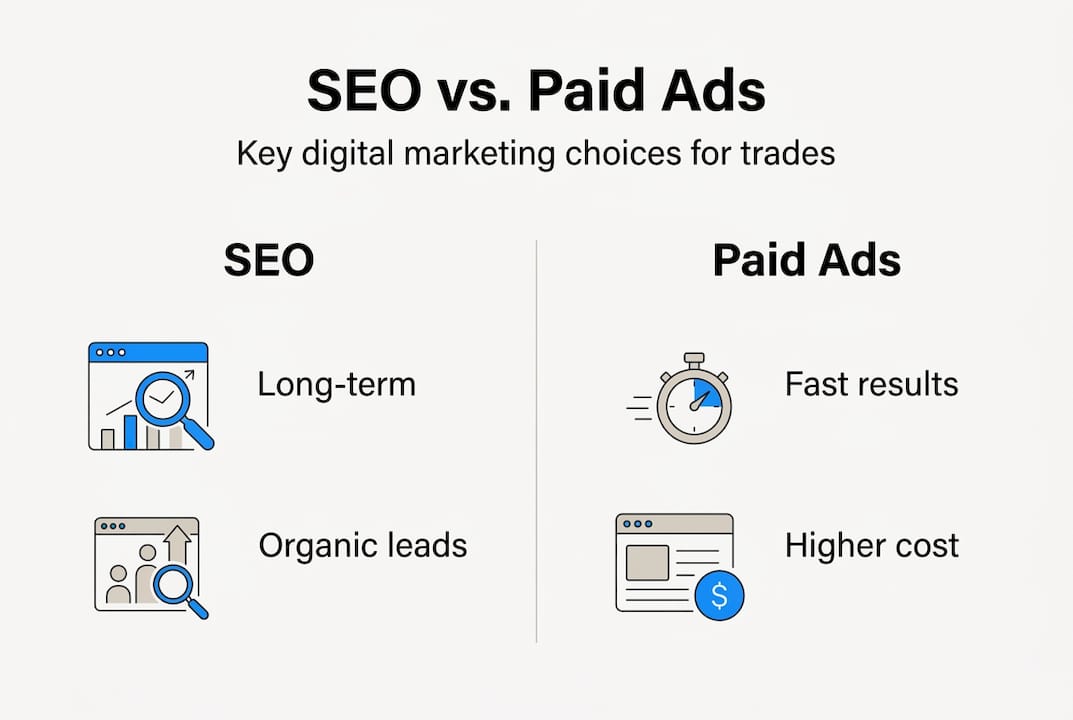
Comparing digital marketing approaches: SEO vs. targeted advertising
SEO builds sustainable visibility and organic traffic over time. Once you rank on page one for valuable keywords, you receive consistent clicks without paying per visitor. Local SEO provides steady organic leads at lower long-term costs while PPC offers immediate traffic but higher costs per click. SEO requires 3-6 months to show results, but those results compound over years.
Paid ads generate faster lead flow but at higher immediate cost. Launch a Google Ads campaign today and receive calls this week. The tradeoff is ongoing expense. Stop paying and traffic stops immediately. For new businesses or seasonal services, this speed justifies the cost. For established contractors, it complements organic traffic during high-demand periods.
Best performance comes from a hybrid approach combining both tactics. Use SEO as your foundation for predictable baseline traffic. Layer paid ads on top to scale during busy seasons, launch new services, or enter new markets. This combination delivers both stability and flexibility.
Local Services Ads (LSA) provide access to high-intent, vetted leads. Google screens participating businesses and guarantees leads, charging only for actual customer contact. LSA appears above traditional search ads, capturing the most motivated prospects. For trades businesses in supported categories, LSA often delivers the highest quality leads despite premium pricing.
Proper budget balancing depends on business goals and cash flow. A startup needs immediate jobs to survive, justifying higher ad spending. An established contractor with strong organic rankings can reduce ad budgets and invest in content marketing for long-term growth. Your ideal mix shifts as your business matures.
| Factor | SEO | Paid Advertising |
|---|---|---|
| Time to results | 3-6 months | 1-7 days |
| Ongoing cost | Low (maintenance only) | High (per click/lead) |
| Traffic sustainability | Compounds over time | Stops when budget ends |
| Targeting precision | Broad local area | Specific keywords and demographics |
| Best for | Long-term growth | Immediate lead generation |
Key considerations when allocating budget:
- New businesses: 70% paid ads, 30% SEO to generate immediate revenue while building organic presence
- Established businesses: 40% paid ads, 60% SEO to leverage existing authority and reduce acquisition costs
- Seasonal businesses: Increase ad spending 60 days before peak season, reduce during slow months
- High-margin services: Justify higher cost per lead through paid advertising
Local SEO techniques work best when combined with strategic paid campaigns. Google Ads benefits become clear when you track lead quality and job value, not just click volume.
Grow your trades business with expert digital marketing support
Implementing these strategies yourself takes time away from running jobs and managing crews. Professional help can optimize your GBP, run targeted ads, and track results while you focus on delivering excellent service. Access proven workflows tailored for local contractors to boost leads without the learning curve or trial-and-error costs.
Combining expert SEO and advertising accelerates business growth by leveraging specialized knowledge and tools. A lead generation workflow designed specifically for trades businesses eliminates wasted ad spending and captures more organic traffic. SEO techniques for local services require ongoing optimization that professionals handle efficiently. Strategic Google Ads for trades management maximizes ROI by continuously testing and refining campaigns based on real conversion data.
Frequently asked questions
What is digital marketing for trades?
Digital marketing includes SEO, online advertising, and managing your online presence to attract local customers. It helps trades businesses connect with prospects actively searching for services through Google, social media, and review platforms. Unlike traditional marketing, digital channels provide precise targeting and measurable results, showing exactly which efforts generate booked jobs.
How does local SEO help trades businesses?
Local SEO improves rankings in ‘near me’ searches, driving qualified, organic leads at low ongoing cost. When prospects search “electrician near me” or “emergency plumber in Dallas,” strong local SEO puts your business in the map pack and top organic results. Google Business Profile optimization is key to maximizing local SEO impact, combining reviews, photos, and accurate business information to build trust before the first call.
Should trades businesses invest in paid digital advertising?
Paid ads deliver faster leads by targeting immediate search intent for specific services. If someone searches “emergency AC repair” at 9 PM, a well-placed ad captures that high-value lead instantly. Best used with a solid SEO foundation for balanced lead generation, paid advertising fills gaps during slow seasons and accelerates growth when you’re ready to scale. The key is tracking ROI carefully to ensure ad spending generates profitable jobs.
How can trades businesses measure digital marketing success?
Track lead origin using call tracking and analytics to understand which channels drive the most valuable customers. Monitor website speed and customer reviews for continuous improvement, as both directly impact conversion rates. Aim for page load under 2.5 seconds and over 4.6 star ratings for improved conversions. Regular analysis through local advertising metrics reveals optimization opportunities and prevents wasted spending on underperforming campaigns.
