
Trying to fill your schedule with qualified local leads can leave many HVAC business owners feeling frustrated when their marketing efforts miss the mark. With the U.S. HVAC industry poised for significant growth and the Southern U.S. showing especially strong profitability, knowing where to focus your digital marketing matters more than ever. This guide offers practical steps for identifying profitable neighborhoods, building a conversion-focused website, launching targeted ad campaigns, and tracking performance to increase your booking rates and grow your American business.
Table of Contents
- Step 1: Identify Profitable Local Target Areas
- Step 2: Build A Conversion-Focused HVAC Website
- Step 3: Launch Targeted Google And Facebook Ad Campaigns
- Step 4: Track Performance And Optimize Lead Sources
Quick Summary
| Key Point | Explanation |
|---|---|
| 1. Identify Profitable Target Areas | Focus on neighborhoods with high HVAC demand based on factors like population growth and income levels for effective marketing. |
| 2. Build a Conversion-Focused Website | Create a user-friendly website featuring clear calls to action and mobile optimization to maximize lead conversion. |
| 3. Launch Targeted Ad Campaigns | Use Google and Facebook Ads to reach homeowners actively searching for HVAC services; refine campaigns based on performance. |
| 4. Track Performance Metrics | Measure lead sources and success through unique phone numbers and tracking software to identify high-performing channels for budget allocation. |
| 5. Optimize Marketing Strategies Regularly | Review and adjust strategies quarterly based on performance data and market shifts to maintain competitive edge and effectiveness. |
Step 1: Identify profitable local target areas
Finding the right neighborhoods to focus on separates thriving HVAC businesses from those struggling to book consistently. Not all markets offer equal opportunity, and targeting the wrong areas wastes your marketing budget before you even start.
Start by examining where HVAC demand is highest in your region. The Southern U.S. shows particularly strong HVAC growth due to larger populations, increasing household incomes, and rapid construction expansion. Your local market may have similar pockets of opportunity waiting to be discovered.
Analyze these key factors when evaluating target areas:
- Population density and growth: Areas adding residents need new HVAC systems and maintenance services
- Income levels: Higher-income neighborhoods can afford premium services and regular maintenance plans
- New construction activity: Building permits indicate fresh installation opportunities
- Age of housing stock: Older homes need replacements; newer homes need regular maintenance
- Seasonal demand patterns: Climate and weather trends affect when customers call for service
Dig into local economic data through government reports and economic development offices. Local and regional economic analysis reveals employment trends, income patterns, and business activity that signal demand. County assessor records, building permit databases, and census data paint a clear picture of which neighborhoods are worth your attention.
Here’s a quick comparison of the most reliable methods for evaluating local HVAC market potential:
| Method | Data Source | Key Benefit | Limitation |
|---|---|---|---|
| Census records | Government database | Reveals growth patterns | May lack housing age info |
| Building permits | City/county offices | Tracks construction trends | Can be time-consuming |
| Economic reports | Local agencies | Shows income trends | Data may be broad |
| Property assessor | County records | Identifies aging homes | Limited demographic detail |
Compare neighborhoods by their potential return on investment. A single wealthy area with 500 homes may generate more revenue than three average neighborhoods with 1,500 homes combined. Focus your initial efforts where you can dominate before expanding.
Profitable target areas share three characteristics: steady population growth, above-average household income, and active construction or aging infrastructure requiring replacement.
Once you have identified 2-3 primary target areas, write them down with specific data supporting each choice. This becomes your geographic foundation for all future marketing decisions.
Pro tip: Pull building permit data from your city or county building department to identify exactly which streets have recent HVAC replacements or installations, then target homeowners near those addresses who likely have similar-aged systems.
Step 2: Build a conversion-focused HVAC website
Your website is your 24/7 sales representative, capturing leads while you sleep and converting curious visitors into booked appointments. Without the right design, even quality traffic disappears without generating a single phone call or quote request.
A conversion-focused website removes friction from the customer journey. Start by placing clear calls to action above the fold on every page. Visitors should know exactly how to request a quote, schedule service, or call you within seconds of landing on your site.
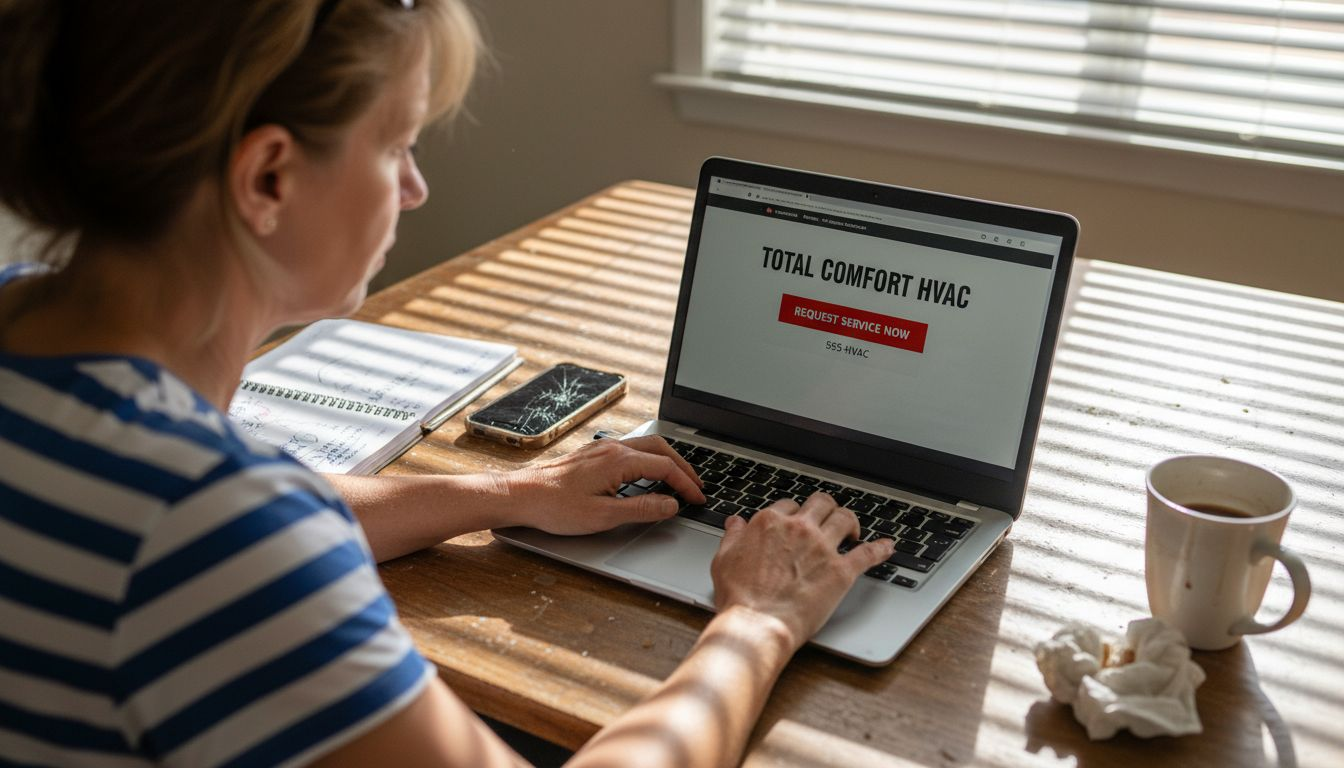
Optimize for the devices your customers use most. Over 60% of HVAC searches happen on mobile phones, so your site must load quickly and display perfectly on small screens. Test your website on smartphones and tablets to ensure forms work smoothly and buttons are easy to tap.
Address what keeps your ideal customers up at night:
- Rising energy bills: Show how efficient systems save money long-term
- System breakdowns: Highlight emergency service availability and response times
- Installation confusion: Explain the process from inspection through installation
- Maintenance neglect: Offer affordable maintenance plans with clear benefits
- Contractor trust: Feature customer testimonials, certifications, and years in business
Content that speaks directly to these concerns builds trust faster than generic marketing language. When visitors see their specific problems addressed, they see themselves in your message.
Strategic website design elements like minimal distractions, fast load times, and strong calls to action maximize conversions. Showcase your services prominently, include customer testimonials prominently, and make your phone number and quote request form impossible to miss.
Your website should guide visitors toward one clear action: booking your service. Remove unnecessary navigation, limit external links, and keep paragraphs short and scannable.
A conversion-focused website feels fast, trustworthy, and answers customer questions before they need to call.
Pro tip: Install a click-to-call button on mobile versions of your site and track which pages generate the most phone calls using call tracking software, then double down on the messaging and offers that perform best.
Step 3: Launch targeted Google and Facebook ad campaigns
Paid advertising puts your HVAC business in front of homeowners actively searching for your services right now. Without it, you rely only on organic traffic and word-of-mouth, leaving money on the table while competitors capture those urgent calls.
Start with Google Ads to catch people searching for HVAC services in your area. When someone types “emergency furnace repair near me” or “AC installation [your city],” your ad appears at the top of search results. These are high-intent customers ready to book.
Set up your Google Ads account by following these steps:
- Create a Google Ads account and link it to your website
- Build campaigns targeting your primary service areas and keywords
- Write compelling ad copy that highlights emergency availability or special offers
- Set a daily budget you can sustain long-term
- Monitor performance weekly and adjust underperforming ads
Facebook Ads work differently but equally powerfully. Targeted demographic and location-based advertising on Facebook builds brand awareness while reaching homeowners by age, interests, and neighborhood. Use image, video, and carousel ads showing before-and-after installations, customer testimonials, or seasonal promotions.
Segment your audiences strategically. Create separate ad sets for different customer types: homeowners needing emergency repairs, those planning seasonal maintenance, and prospects interested in new system installations. Each group responds to different messaging.
Accurately identifying and segmenting your target audience maximizes your ad budget and reduces wasted spend on unqualified prospects. A homeowner with a broken AC in July behaves differently than one researching furnace replacements in October.
Start small and test. Launch campaigns with modest daily budgets (25 to 50 dollars), track which ads generate phone calls and booked appointments, then scale what works.
Your ad budget should always align with your goal: qualified leads that convert to booked jobs, not just impressions or clicks.
Pro tip: Use call tracking phone numbers in your ads separate from your website phone number so you can measure exactly which ads generate calls, then pause underperforming campaigns and double your budget on the winners.
Step 4: Track performance and optimize lead sources
You cannot improve what you do not measure. Without tracking, you are flying blind, spending money on channels that waste your budget while ignoring the sources generating your best leads.
Start by identifying which channels bring leads to your business. Your sources likely include Google Ads, Facebook Ads, your website organic search, Google Business Profile, referrals, and phone directory listings. Each channel performs differently, and some generate higher-quality leads than others.
Here is a summary of the main digital marketing channels and their advantages for HVAC businesses:
| Channel | Targeting Precision | Lead Quality | Best Use Case |
|---|---|---|---|
| Google Ads | High (search intent) | Immediate, urgent calls | Emergency services |
| Facebook Ads | Strong (demographics) | Awareness & appointments | Seasonal promotions |
| Organic SEO | Moderate | Long-term inquiries | Brand visibility |
| Referrals | N/A | Trusted local customers | Repeat business |
Set up tracking for every lead source using these methods:
- Unique phone numbers: Assign different tracking numbers to Google Ads, Facebook Ads, and your website so you know which channel each call comes from
- Call tracking software: Record and analyze call conversations to identify which ads motivated people to call
- Form submissions: Use hidden form fields on your website to track which traffic source submitted each quote request
- Calendar bookings: Note the source when customers schedule appointments through your system
- Spreadsheet logging: At minimum, ask new customers how they found you and record it consistently
Once data flows in, create a simple dashboard showing performance metrics. Track the cost per lead from each channel, the booking rate for each source, and the average job value from different origins. Which Google Ads keywords generate calls? Which Facebook audiences convert best? Your data answers these questions.
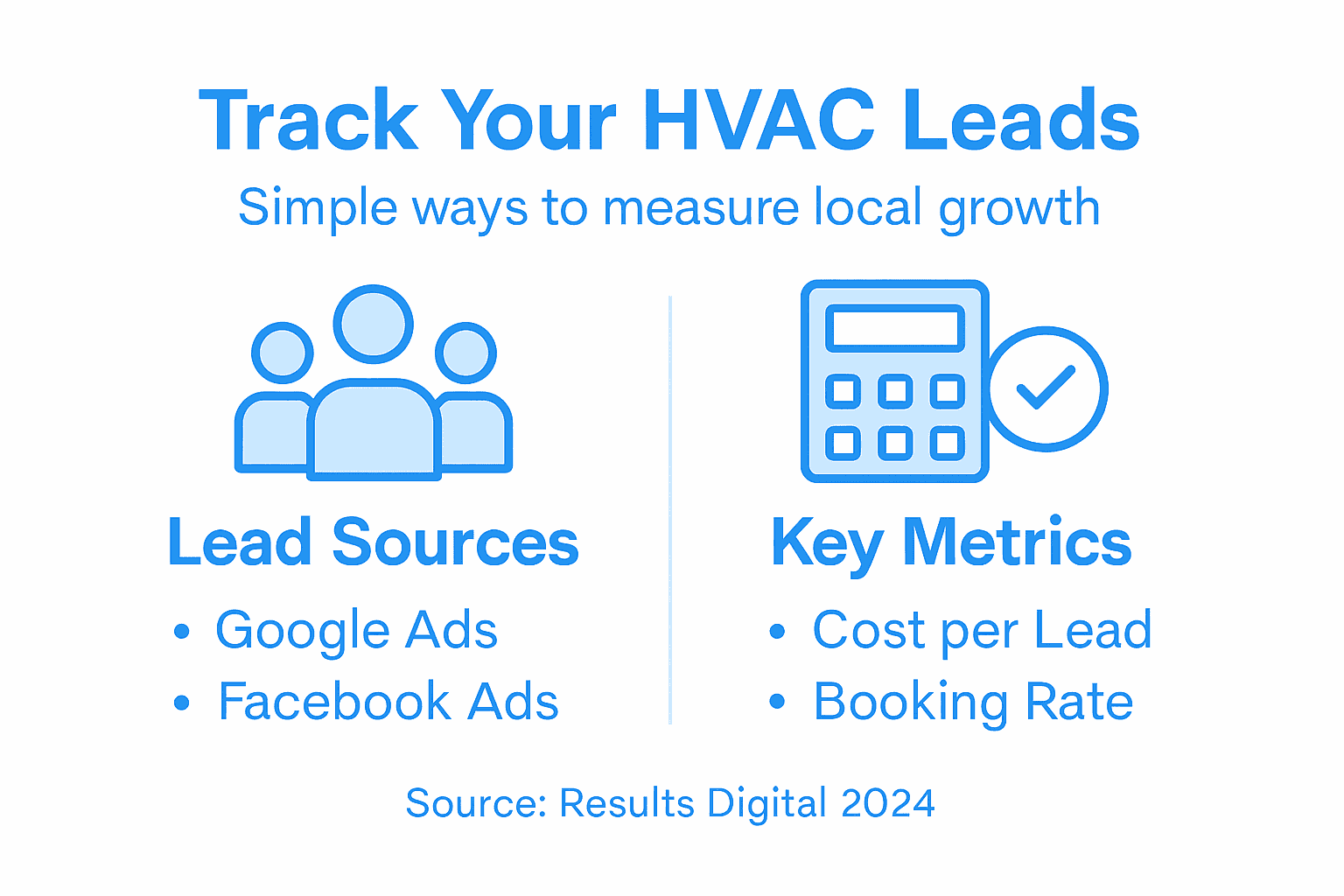
Marketing performance measurement systems aligned with business strategy help identify your highest-performing sources and guide budget allocation decisions. Monthly analysis reveals trends that weekly tracking might miss.
Optimize ruthlessly based on data. If Google Ads generates leads at fifty dollars each while Facebook Ads costs one hundred twenty dollars per lead, shift more budget toward Google. If certain keywords or audiences consistently underperform, pause them immediately.
Review and adjust quarterly. Markets shift, seasons change, and competitor activity fluctuates. What works perfectly in summer might flop in winter, requiring seasonal adjustments to your strategy.
The HVAC business that measures everything wins. Data tells you exactly where to invest next dollar and which channels to cut.
Pro tip: Create a simple spreadsheet tracking leads by source, cost, booking rate, and average job value, then calculate ROI monthly for each channel to identify immediately which marketing investments deserve increased budget.
Unlock Consistent HVAC Leads and Dominate Your Local Market Today
The challenge of generating steady, high-quality HVAC leads requires more than just understanding local target areas and running ads. You need a partner who knows how to convert visitors into booked jobs while maximizing your marketing budget. As the article explains, focusing on conversion-focused websites, targeted Google and Facebook ad campaigns, and precise performance tracking is essential. If rising energy bills, emergency repairs, or expensive installations keep your customers awake at night, a tailored digital marketing strategy can connect you to those urgent calls more effectively.
At Results Digital, we specialize exclusively in local service-based businesses like HVAC contractors. Our veteran-owned agency offers custom website design, local SEO, and optimized ad campaigns that directly address your market’s growth areas and pain points. You get transparent reporting, measurable results, and an exclusive partnership model that keeps your business at the forefront without competition within your industry in your market.
Ready to stop wasting ad dollars and start booking more HVAC jobs consistently? Visit Results Digital now to learn how our proven lead generation solutions can build your brand, generate urgent service calls, and turn clicks into clients. Discover why contractors trust us to help them grow faster with no long-term contracts holding you back. Take the first step toward dominating your local HVAC market by contacting us today.
Frequently Asked Questions
How can I identify profitable local target areas for my HVAC business?
To identify profitable local target areas, analyze factors such as population density, income levels, new construction activity, and the age of housing. Focus on areas with steady growth and above-average income, as these neighborhoods can significantly contribute to your business. Start by gathering local economic data to pinpoint these regions.
What should I include on my HVAC website to increase conversions?
Your HVAC website should feature clear calls to action prominently on every page, addressing customer concerns like rising energy bills and system breakdowns. Ensure that the site is mobile-friendly and loads quickly to create a smooth user experience. Focus on showcasing services and customer testimonials to build trust and encourage bookings.
How do I set up targeted Google Ads for my HVAC services?
To set up Google Ads, create an account, link it to your website, and build campaigns that target relevant keywords for your services. Write ad copy that emphasizes urgent availability and budget-friendly promotions, and monitor performance weekly to optimize your ads based on what generates the most leads. Consider starting with a modest budget to test effectiveness before scaling up.
What metrics should I track to optimize my HVAC lead generation?
Track metrics like lead source, cost per lead, booking rate, and job value for each marketing channel. Use this data to uncover which channels yield the best return on investment and adjust your budget accordingly, such as reallocating funds toward higher-performing ad campaigns. Create a tracking spreadsheet to log these metrics monthly to stay informed about performance.
How can I improve my HVAC ad campaigns using customer data?
You can improve your HVAC ad campaigns by analyzing customer data from different sources, such as tracking phone calls and form submissions. Identify which ads led to the most engagements and focus your budget on those high-performing campaigns. Consider fine-tuning your audience segments based on behaviors and preferences to enhance targeting effectiveness.
