
Most local contractors believe tracking digital marketing results is too complex or not worth the time. This mindset costs businesses thousands in wasted ad spend each year. When you don’t measure what’s working, you’re essentially throwing money at campaigns that might generate zero qualified leads. This guide shows you exactly why tracking matters and how to measure the digital marketing channels that actually drive phone calls and booked jobs for your service business.
Table of Contents
- Why Tracking Digital Marketing Results Matters For Local Contractors
- Key Metrics And Tools To Track Your Digital Marketing Success
- Understanding Attribution Modeling For Better Marketing Decisions
- Applying Your Tracking Data To Grow Your Local Service Business
- How Results Digital Helps Local Contractors Track And Grow Leads
- FAQ
Key takeaways
| Point | Details |
|---|---|
| Tracking identifies top lead sources | Measurement reveals which campaigns generate the most qualified leads for your business |
| Metrics drive smarter decisions | Using conversion rates and customer acquisition cost improves marketing budget allocation |
| Attribution shows channel value | Modeling reveals how different marketing channels contribute to your leads and sales |
| Call tracking works for contractors | Phone lead tracking is essential for service businesses relying on inbound calls |
| Data optimization improves returns | Adjusting campaigns based on tracking data increases your marketing ROI significantly |
Why tracking digital marketing results matters for local contractors
The digital advertising landscape is massive. Digital marketing market valued at $460 billion creates intense competition for local contractors. Every dollar you invest in online ads, SEO, or social media needs to generate measurable returns.
Local service businesses face unique challenges. You depend on consistent lead generation to book jobs and maintain revenue flow. Without tracking, you can’t tell if your Google Ads drive calls or if your Facebook campaign just wastes budget. This guesswork approach leaves money on the table.
Tracking transforms your marketing from guesswork into science. When you measure marketing for service businesses properly, you see exactly which channels deliver qualified leads. You discover whether your $1,000 monthly Google Ads budget generates 20 calls or just 3. You learn if your SEO investment brings in customers or merely bumps vanity metrics.
Consider these critical benefits:
- Identify which platforms generate actual customer inquiries versus empty clicks
- Stop funding underperforming campaigns that drain budget without results
- Double down on channels proven to deliver booked jobs
- Make confident marketing decisions backed by real performance data
- Justify your marketing spend with clear revenue attribution
Contractors who skip tracking often spend months advertising on platforms that never generate a single quality lead. Data visibility changes everything.
Key metrics and tools to track your digital marketing success
Effective tracking starts with the right metrics. Focus on these five essential measurements for your local service business:
- Conversion rate: Percentage of website visitors who call, fill forms, or book appointments
- Lead to opportunity ratio: How many inquiries turn into actual sales conversations
- Customer acquisition cost (CAC): Total marketing spend divided by new customers gained
- Call volume by source: Phone leads attributed to specific campaigns or channels
- Channel attribution: Which marketing touchpoints contribute to each conversion
Call tracking software becomes your most powerful tool. CallRail call tracking report 2023 shows businesses using call tracking experienced increased lead quality. For contractors where 70% of leads arrive by phone, this technology assigns each call to its marketing source. You’ll know if a customer called from your Google Ad, Facebook post, or website SEO.
Website analytics reveal conversion behavior. Tools like Google Analytics show where visitors drop off, which pages drive contact form submissions, and how long people engage with your content. Website conversion metrics provide actionable optimization opportunities.
Calculating CAC helps you understand efficiency. If you spend $2,000 monthly on ads and gain 10 new customers, your CAC is $200. Compare this against your average job value to ensure profitable marketing. Understanding how agencies measure marketing gives you benchmarks for your own tracking.

Pro Tip: Set up call tracking with unique phone numbers for each major campaign. This simple step immediately reveals which ads generate actual phone leads versus wasted impressions.
Review your metrics weekly, not monthly. Weekly analysis lets you catch underperforming campaigns early and reallocate budget to what works. The faster you respond to data, the less money you waste.
Understanding attribution modeling for better marketing decisions
Attribution modeling assigns credit to marketing touchpoints along the customer journey. A homeowner might see your Facebook ad, visit your website through Google search, then call after reading your email. Which channel deserves credit for that lead?
Four common attribution models each answer this differently:
| Model Type | How It Works | Best For | Limitation |
|---|---|---|---|
| First touch | Credits the initial interaction | Understanding awareness channels | Ignores nurturing touchpoints |
| Last touch | Credits the final interaction before conversion | Measuring closing channels | Misses early stage marketing |
| Multi touch | Distributes credit across all touchpoints | Complete customer journey view | Complex to implement properly |
| Algorithmic | Uses machine learning to assign credit | Data rich businesses with volume | Requires significant lead data |
Attribution modeling improves ROMI by revealing which channels truly drive conversions. Instead of guessing, you see concrete data about marketing performance across your entire funnel.
Remember that attribution is allocation, not definitive causation. Models provide frameworks for decision making, not absolute truth. They require ongoing calibration as your marketing mix evolves.
Most local contractors start with last touch attribution since it’s simple to implement. You credit whichever channel directly preceded the customer contact. As you gather more data, graduate to multi touch modeling for deeper insights. This progression reveals how your awareness campaigns (social media, display ads) support your conversion channels (search ads, website).
Comparing models side by side helps identify the best fit for your business. Run reports using different attribution approaches, then validate findings against actual customer feedback. Ask new clients how they found you to verify your model’s accuracy. Understanding digital marketing metrics boosting leads helps you select relevant measurements.
Pro Tip: Start simple with last touch attribution, then layer in first touch data. Comparing these two models immediately shows whether your awareness or conversion marketing needs more investment.
Applying your tracking data to grow your local service business
Data means nothing without action. Once you identify top performers, increase budget allocation to those channels. If Google local service ads generate leads at $50 CAC while Facebook ads cost $200 CAC, shift more dollars to Google.
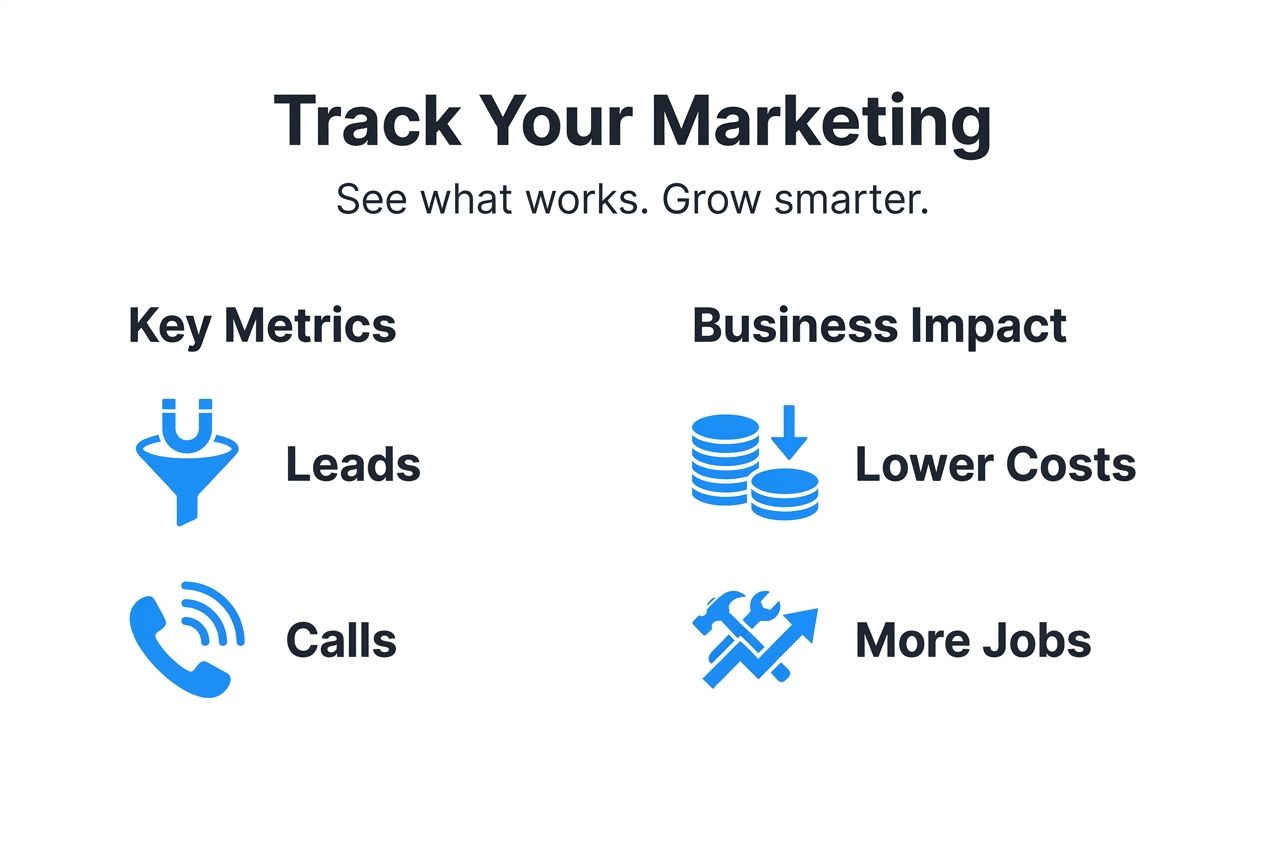
Refine or pause underperforming campaigns ruthlessly. That Facebook audience generating 1,000 impressions but zero calls? Kill it. Redirect those funds toward proven channels. Contractors waste approximately 30% of their marketing budget on ineffective campaigns they never measure.
Optimize your landing pages and calls to action. Businesses with optimized landing pages significantly improve conversion rates. Small changes like clearer contact forms, stronger headlines, or prominent phone numbers can double your lead generation from existing traffic.
Focus on lead quality, not just quantity. Ten qualified leads from homeowners ready to book beat 100 tire kickers researching options. Track which sources deliver customers who actually hire you, then prioritize those channels. Your local lead generation explained guide offers frameworks for qualifying leads effectively.
Test continuously and adjust based on results. Try different ad copy, landing page designs, or targeting parameters. Measure everything. Keep what works, discard what doesn’t. The lead generation workflow 2025 local contractors provides systematic testing approaches.
Key optimization strategies:
- Reallocate 20% of budget monthly from low performers to high performers
- A/B test landing pages with different headlines and contact form placements
- Adjust ad targeting based on which demographics convert best
- Improve website speed and mobile experience to reduce bounce rates
- Create content around keywords that drive qualified search traffic
Pro Tip: Set quarterly revenue goals tied to specific marketing metrics. For example, “Increase Google Ads leads by 25% while maintaining sub $100 CAC” gives you a clear target to track and optimize toward.
The contractors who win in 2026 treat marketing as investment, not expense. They demand measurable returns and adjust tactics based on evidence. Your tracking data provides that evidence.
How Results Digital helps local contractors track and grow leads
Navigating digital marketing tracking alone consumes time you’d rather spend running jobs. Results Digital specializes in local lead generation explained specifically for contractors and trades businesses.
Our team implements proven tracking frameworks customized to your service business. We set up call tracking, configure attribution modeling, and build dashboards showing exactly which campaigns drive revenue. You get clear visibility into marketing performance without becoming a data analyst. Our lead generation workflow 2025 local contractors system combines conversion optimization with ongoing measurement. We continuously test and refine your campaigns based on tracked results, improving returns month over month. With expertise in local service providers SEO techniques, we help you dominate your market through data backed strategy. Partner with specialists who understand contractor marketing challenges and deliver measurable growth.
FAQ
How can local service contractors start tracking their digital marketing results?
Begin by implementing call tracking software to monitor phone leads from different campaigns. Set up Google Analytics on your website to measure visitor behavior and form submissions. Define your key metrics like conversion rate, cost per lead, and customer acquisition cost based on your business goals. Use attribution modeling to assign credit to marketing channels driving results. Review performance data weekly and adjust campaigns based on what the numbers reveal. Many contractors find success starting with basic last touch attribution before graduating to more sophisticated multi touch models. The digital marketing for contractors resource provides implementation steps for tracking systems.
What is the best way to measure the ROI of digital marketing campaigns for trades businesses?
Calculate ROI by comparing revenue generated from new customers against total marketing costs for the period. Track leads through call tracking and website analytics to attribute revenue accurately to specific campaigns. Use customer acquisition cost and return on marketing investment metrics to evaluate campaign efficiency. For precise measurement, tag each lead source in your CRM so you can trace closed jobs back to their marketing origin. This creates a clear picture of which campaigns generate profitable returns.
Why is call tracking important for local service contractors?
Call tracking assigns phone leads to specific marketing campaigns for accurate measurement and optimization. Since most contractor leads arrive by phone rather than web forms, tracking calls reveals which ads and channels generate qualified inquiries. Call tracking users saw increased qualified leads by focusing spend on campaigns proven to drive phone conversations. Without call tracking, you’re blind to your highest value conversion channel, making it impossible to optimize effectively.
What metrics matter most for local contractor marketing success?
Focus on conversion rate (percentage of visitors who become leads), customer acquisition cost (marketing spend per new customer), and lead to customer ratio (how many leads turn into paying jobs). Track call volume by source to understand which channels drive phone inquiries. Monitor cost per lead across different platforms to identify your most efficient marketing investments. These metrics directly tie marketing activity to business revenue, unlike vanity metrics such as website traffic or social media followers.
How often should contractors review their digital marketing data?
Review key metrics weekly to catch underperforming campaigns early and reallocate budget quickly. Conduct deeper monthly analysis to identify trends and plan strategic adjustments. Quarterly reviews should assess overall marketing ROI and set goals for the next period. Weekly monitoring prevents wasting entire months on ineffective campaigns, while monthly reviews provide enough data to spot meaningful patterns. The frequency of optimization directly impacts how efficiently you spend your marketing budget.
