
TL;DR:
- Custom website design enhances local SEO, trust signals, and conversion rates for contractors.
- It offers scalable, high-performance pages tailored to each service area, unlike templates.
- Investing in a custom site increases leads, reduces ad dependence, and improves long-term ROI.
Most roofing and exterior contractors assume any website will do the job. You put up a few pages, list your services, add a phone number, and wait for calls. The problem? Your competitors are doing the exact same thing, and homeowners searching for a roofer in your area have no reason to pick you over them. Custom website design changes that equation entirely. It gives your business a platform built to rank locally, earn trust fast, and turn visitors into booked jobs. This guide breaks down exactly why custom beats template, what it means for your leads, and how to make the investment work for your bottom line.
Table of Contents
- What makes custom website design different?
- How custom design powers better local SEO
- Unlocking trust and conversions with a custom web experience
- Real ROI: Long-term benefits of investing in custom design
- Our take: Why custom design is your most underrated sales tool
- Ready to get leads rolling in? Next steps
- Frequently asked questions
Key Takeaways
| Point | Details |
|---|---|
| Custom vs. template impact | Custom website design empowers contractors with a flexible, scalable site optimized for long-term growth. |
| Local SEO advantages | A custom-built site makes it easier to rank in your target area and attract ready-to-book homeowners. |
| Higher trust, more leads | Contractors win more jobs when their site builds trust quickly through personalized elements and clear calls-to-action. |
| ROI over time | Investing in custom design brings steady leads, higher job values, and reduces future website expenses. |
What makes custom website design different?
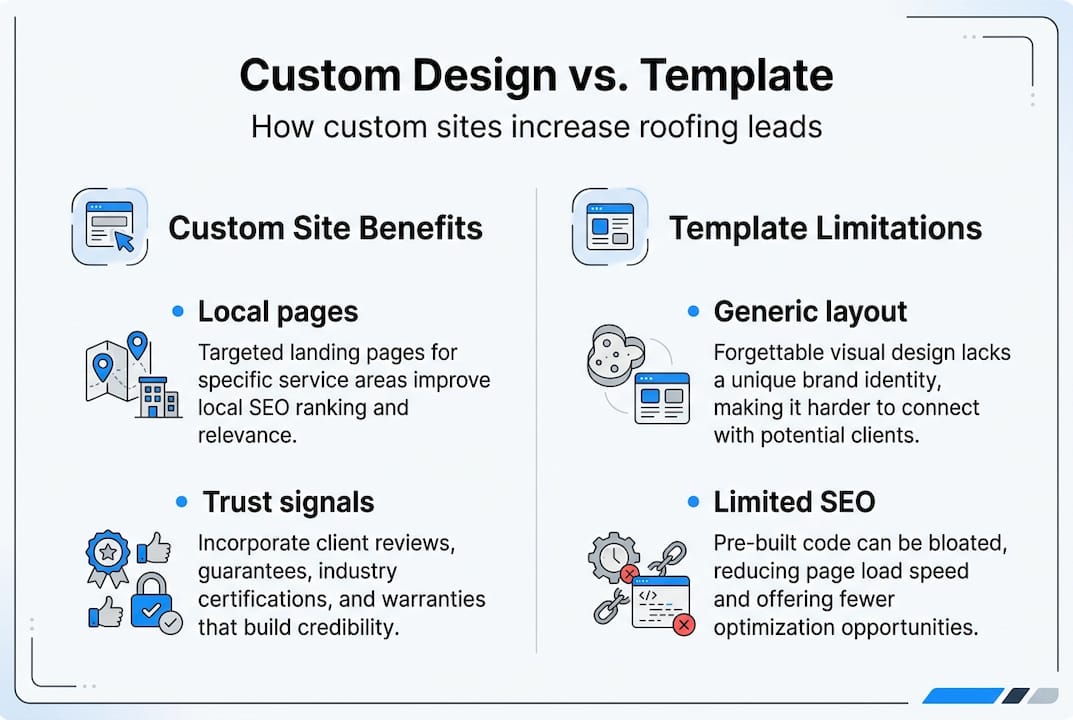
The word “custom” gets thrown around a lot in marketing, so let’s be specific about what it actually means for a roofing or exterior contractor. A template site is a pre-built layout you drop your content into. It looks decent, it loads, and it checks the basic boxes. A custom site is built from the ground up around your business, your service area, your target customers, and your goals.
Here is what that difference looks like in practice:
| Feature | Template site | Custom site |
|---|---|---|
| Local service area pages | Generic or limited | Built for every town you serve |
| SEO structure | Fixed, hard to change | Flexible and fully optimized |
| Load speed | Varies, often bloated | Engineered for performance |
| Trust elements | Stock photos, basic layout | Real photos, testimonials, guarantees |
| Scalability | Difficult to expand | Grows with your business |
| Conversion focus | Minimal | Every page built to generate calls |
One of the biggest gaps shows up in scalability. If you add a new service or expand into a neighboring city, a template site makes that painful. You are fighting against a rigid structure that was never designed for your specific growth path. Custom sites for contractors are built with that expansion in mind from day one.
Contractors often choose templates to save money upfront. That logic makes sense until you realize what you are leaving on the table. A site that cannot rank well in your service area, cannot load fast on mobile, and cannot guide a homeowner toward booking a call is not saving you money. It is costing you jobs.
As one industry comparison notes, premium templates lack tailored scalability for contractor growth, even when optimized well. That ceiling becomes a real problem the moment your business starts to grow.
“A website is not just a digital brochure. For a roofing contractor, it is the first sales conversation you have with every potential customer.”
The contractors who treat their website as a living sales tool, not a static page, are the ones who consistently win more jobs at higher margins.
How custom design powers better local SEO
Local SEO is the process of getting your business to appear when someone nearby searches for a roofer, siding installer, or gutter company. It is not magic. It is structure, content, and technical precision working together. Custom website design gives you all three.
Here is how improving local SEO becomes far more achievable with a custom-built site:
- Dedicated service area pages. A custom site lets you build a unique page for every city or suburb you serve. Each page targets local search terms, includes area-specific content, and signals to Google exactly where you work.
- Local schema markup. This is structured data code that tells search engines your business name, address, phone number, and service area. Custom sites implement this cleanly. Most templates make it messy or incomplete.
- Faster load times. Google uses page speed as a ranking factor. Custom sites are built lean, without the bloated code that slows templates down on mobile devices.
| SEO capability | Template site | Custom site |
|---|---|---|
| City-specific landing pages | Limited | Unlimited, fully optimized |
| Schema markup | Basic or missing | Precise and complete |
| Mobile performance | Inconsistent | Engineered for speed |
| Content flexibility | Restricted | Total control |
| Internal linking structure | Generic | Strategic and SEO-focused |
As the service area SEO guide for contractors explains, ranking in multiple nearby towns requires a site structure that templates simply cannot deliver at scale. You need individual pages, localized content, and clean technical foundations.
Pro Tip: Add a unique service page for every city within your target radius. Include the city name, local landmarks, and specific services you offer there. Pair this with local schema markup and you dramatically increase your chances of ranking in that area.
The SEO tips for contractors that consistently produce results all point back to one thing: a site structure that was built to be found. Custom design is how you get there. And custom site structure lets contractors target local markets with far more precision than any template allows.
Unlocking trust and conversions with a custom web experience
Getting traffic to your site is only half the battle. What happens when a homeowner actually lands on your page? That first impression either earns their trust or sends them to your competitor. Custom design controls that moment.

Homeowners making decisions about roofing or exterior work are spending thousands of dollars. They are cautious. They look for signals that tell them you are legitimate, experienced, and reliable. A cluttered, generic template site does not send those signals.
Here are the trust-building elements that matter most in a custom contractor website:
- Real project photos showing before and after results from actual jobs in your area
- Verified customer reviews pulled directly from Google or integrated review platforms
- Clear service guarantees and licensing or insurance information displayed prominently
- A professional headshot or team photo so homeowners know who they are calling
- Fast, obvious calls to action like click-to-call buttons and simple quote request forms
Pro Tip: Use a hero image on your homepage that shows your actual crew working on a local job, not stock photography. Homeowners respond to authenticity. Pair it with a short testimonial from a local customer and your inquiry rate will climb.
Custom design also eliminates the friction that kills conversions. Template sites often bury the phone number, use confusing navigation, or load slowly on mobile. A homeowner who cannot figure out how to contact you in ten seconds will leave. A custom site is built so every path leads toward a call or a form submission.
As the lead generation for home services framework shows, custom design delivers a tailored user journey with clear calls to action and the proof points contractors need to convert visitors into paying customers. The lead generation tips that move the needle for exterior contractors all connect back to a site that was built to persuade, not just inform.
Real ROI: Long-term benefits of investing in custom design
Let’s talk numbers. Contractors sometimes hesitate on custom design because of the upfront investment. But the financial picture looks very different when you calculate what a better-performing site actually delivers over time.
Here is a simple way to think through the return:
- Calculate your average job value. If your average roofing job is worth $12,000, every additional booked call has significant revenue attached to it.
- Estimate your current close rate. If you close 40% of leads and your site generates 10 calls per month, that is 4 jobs. Improve conversions by 30% and you are looking at 13 calls and 5 to 6 jobs.
- Factor in ad spend savings. A site that ranks organically reduces your dependence on paid ads. Lower cost per lead means more margin on every job.
- Project over 12 months. One or two extra jobs per month at $12,000 each adds up to $144,000 or more in additional annual revenue.
Contractors with optimized custom sites report more consistent inbound inquiries and lower cost per lead over time. That consistency is what separates contractors who grow predictably from those who rely on referrals and slow seasons.
Custom redesigns can generate up to 45% more booked calls compared to outdated template sites, according to contractor performance data tracked across digital marketing campaigns.
The hidden costs of not going custom are real and they add up fast:
- Lost leads from poor mobile performance
- Low trust signals that push homeowners to competitors
- Slow load times that hurt Google rankings
- Inability to add new service pages without breaking the site
- Higher ad spend needed to compensate for weak organic traffic
The lead gen tips that deliver the best long-term results for contractors always include a strong website foundation. Custom design is not an expense. It is infrastructure that pays for itself.
Our take: Why custom design is your most underrated sales tool
After working with roofing and exterior contractors across dozens of local markets, we have seen one pattern repeat itself. The contractors who treat their website as a cost to minimize are the same ones who struggle to get consistent leads without pouring money into ads every month.
Here is the contrarian truth: your website is your best salesperson. It works 24 hours a day, never calls in sick, and handles the first and most critical impression with every potential customer. A custom site lets your real expertise, your actual work, and your unique value shine through in a way no template ever will.
The contractors winning in their local markets right now are not necessarily the best roofers. They are the ones who show up first in search results and immediately earn trust when a homeowner lands on their page. Optimizing for local leads with a custom-built site is how you take that position before your competitors do.
Ignoring custom web presence does not keep you neutral. It actively hands ground to smarter competitors who are investing in it right now.
Ready to get leads rolling in? Next steps
If you have made it this far, you already know that a generic template site is not going to cut it in a competitive local market. Custom website design is how roofing and exterior contractors build a lead generation engine that works around the clock, ranks in every town they serve, and turns visitors into booked jobs.
At Results Digital, we build website design for roofers that are engineered specifically for lead generation, not just good looks. Our digital marketing for service companies approach combines custom design with local SEO and targeted ads so every piece works together. If you want to understand how local lead generation actually works for contractors in your market, we are ready to show you exactly what is possible.
Frequently asked questions
Why should a local roofing contractor invest in custom website design?
Custom website design helps roofing contractors stand out locally, attract more leads, and convert visitors into jobs by showcasing real expertise and building homeowner trust. As the data shows, custom design supports long-term contractor growth and credibility in ways templates cannot match.
Is a custom website more effective than a template site for lead generation?
Yes, a custom site is built for local SEO, stronger trust signals, and higher conversions, giving contractors a measurable lead generation advantage over template competitors. A custom-built site structure directly boosts local SEO performance and conversion rates.
What ROI can contractors expect from investing in custom website design?
Contractors typically see more quality leads, higher job values, and lower cost per lead as their custom site builds organic visibility and reduces paid ad dependence. Contractors with custom sites report more consistent inquiries and lower lead costs over time.
How does custom web design support local SEO for exterior service companies?
Custom web design allows for optimized service pages, localized content, and precise technical SEO that help contractors rank across multiple nearby towns and service areas. Custom design enables precise targeting of local markets in ways that rigid template structures cannot support.
