
Local contractors lose thousands in potential revenue because their SEO strategies fail to target specific service areas effectively. When plumbers in Dallas or HVAC technicians in Phoenix don’t optimize for neighborhood-level searches, competitors capture leads first. This guide provides actionable steps to dominate local search results, increase map pack visibility, and generate consistent booked jobs through precise service area SEO.
Table of Contents
- Prerequisites: Tools And Knowledge Needed
- Step 1: Conduct Local Keyword Research And Mapping
- Step 2: Optimize Your Google Business Profile For Multiple Service Areas
- Step 3: Build Authoritative Local Citations And Backlinks
- Step 4: Leverage Online Reviews And Reputation Management
- Step 5: Technical Seo And Mobile Optimization For Local Search
- Common Mistakes And Troubleshooting In Service Area Seo
- Expected Results And Outcome Benchmarks For Service Area Seo
- How Results Digital Can Help Contractors Boost Local Leads
- Frequently Asked Questions
Key takeaways
| Point | Details |
|---|---|
| Essential preparation | Set up Google Business Profile, Search Console, and citation tracking tools before starting optimization work. |
| Hyper-local targeting | Map keywords to specific neighborhoods and service areas to capture high-intent local searches without cannibalization. |
| Authority building | Maintain consistent NAP data across 80+ directories and acquire backlinks from local trade associations. |
| Review management | Active review generation and professional responses boost click-through rates by 25% and strengthen local rankings. |
| Timeline expectations | Measurable improvements typically appear within 3 to 6 months with consistent implementation and monitoring. |
Prerequisites: tools and knowledge needed
Before implementing service area SEO tactics, you need the right tools and foundational knowledge. Access to your Google Business Profile dashboard is non-negotiable, as this platform directly controls your map pack visibility. Without proper tool setup, you’ll struggle to track progress or identify optimization opportunities.
Recommended tools include Google Search Console for monitoring organic performance, BrightLocal for citation tracking, and SEMrush for competitive keyword analysis. These platforms provide data-driven insights that guide your optimization decisions. Free alternatives exist, but professional tools save hours of manual work and deliver more accurate metrics.
Your website must be mobile-friendly and load quickly. Mobile searchers represent over 60% of local service queries, and slow-loading sites kill conversions before customers even read your content. Test your site speed using Google PageSpeed Insights and fix issues immediately.
Basic service-based SEO for local contractors knowledge helps you understand why specific tactics work. You don’t need to become an SEO expert, but grasping concepts like search intent, keyword mapping, and citation consistency prevents costly mistakes. Spend a few hours learning fundamentals before executing tactics.
Essential tools checklist:
- Google Business Profile dashboard access
- Google Search Console verified account
- Citation tracking tool (BrightLocal, Moz Local, or Whitespark)
- Keyword research platform (SEMrush, Ahrefs, or free Google Keyword Planner)
- Mobile speed testing tool (Google PageSpeed Insights)
| Tool Category | Recommended Options | Primary Function |
|---|---|---|
| Local Listings | Google Business Profile | Map pack visibility and local search presence |
| Analytics | Google Search Console | Organic performance tracking and keyword monitoring |
| Citations | BrightLocal, Moz Local | NAP consistency management across directories |
| Keywords | SEMrush, Ahrefs | Competitive analysis and search volume data |
Step 1: conduct local keyword research and mapping
Identifying hyper-local keywords separates contractors who dominate their markets from those who waste money on broad, ineffective terms. Start by listing every neighborhood, suburb, and district you service. Then combine these location modifiers with your specific services: “emergency plumber Oak Lawn Chicago” or “HVAC repair Scottsdale Desert Ridge.”
Use Google’s autocomplete and “People Also Ask” features to discover customer language patterns. Type your service plus location into Google and note the suggested completions. These suggestions reveal actual search terms customers use, not what you think they search for. Customers rarely search “residential plumbing services,” but they constantly search “plumber near me” or “fix leaking faucet Phoenix.”
Map each keyword to a specific service area page on your website to avoid cannibalization. When multiple pages target identical keywords, Google struggles to determine which page deserves rankings, and both pages suffer. Create dedicated landing pages for each major service area, optimizing each page for its specific neighborhood keywords.
Prioritize keywords by search intent: transactional (“hire electrician Tempe”), informational (“how much does rewiring cost”), and navigational (“ABC Electric Phoenix reviews”). Transactional keywords generate immediate leads, while informational content builds authority and captures customers earlier in their decision journey.
Pro Tip: Create a spreadsheet mapping each service area to its primary keywords, search volume, and assigned landing page URL. This prevents keyword overlap and provides a clear optimization roadmap.
Keyword research process:
- List all service areas (neighborhoods, suburbs, districts)
- Identify core services offered in each area
- Use Google autocomplete to discover customer search patterns
- Analyze competitor rankings for target neighborhoods
- Map keywords to specific landing pages to prevent cannibalization
- Prioritize by search intent and commercial value
For comprehensive local SEO strategies examples and templates, explore proven frameworks that contractors use to structure their keyword mapping. Effective service area SEO strategies require precise planning before execution begins.
Step 2: optimize your Google Business Profile for multiple service areas
Your Google Business Profile directly controls whether you appear in the map pack, which generates the highest-quality local leads. Set your service area boundaries accurately, covering every neighborhood you actively serve without overextending into areas you can’t service effectively. Google penalizes businesses that claim service areas far from their actual location.

Complete every section of your profile: business description, services offered, hours, photos, and attributes. Upload high-quality photos showing your team, completed projects, and service vehicles with visible branding. Businesses with complete profiles receive 70% more location visit requests than incomplete listings.
Leverage GBP posts to share updates, promotions, and project completions weekly. These posts appear in your profile and provide fresh content signals to Google. Use the Q&A feature proactively by posting common customer questions yourself, then answering them with keyword-rich responses that address local search intent.
Select accurate business categories, with your primary category matching your main service offering. Add secondary categories for additional services, but avoid irrelevant categories that dilute your profile focus. Research shows Google Business Profile optimization reduces local lead losses over 45% when contractors maintain complete, accurate profiles.
Pro Tip: Set up separate location listings only if you have physical offices in different cities. For service area businesses operating from one location, use service area settings instead of creating fake addresses, which violates Google’s guidelines and risks suspension.
GBP optimization checklist:
- Verify accurate business name, address, phone (NAP consistency)
- Define precise service area boundaries without overextension
- Complete business description with local keywords
- Upload minimum 10 high-quality photos (team, projects, vehicles)
- Post weekly updates about services, projects, or promotions
- Seed Q&A section with common customer questions
- Select accurate primary and secondary business categories
- Enable messaging and respond within hours
For detailed guidance on optimizing Google Business Profile features, follow contractor-specific best practices that maximize map pack visibility and customer engagement.
Step 3: build authoritative local citations and backlinks
Consistent NAP (name, address, phone) information across directories builds algorithmic trust and stabilizes your local rankings. Search engines cross-reference your business information across hundreds of sites. Inconsistencies trigger doubt about your legitimacy and suppress your rankings, even when everything else is optimized perfectly.
Submit your business to 80+ core citation sites including Yelp, Yellow Pages, Angie’s List, HomeAdvisor, and industry-specific directories. Use citation tracking tools to monitor accuracy across platforms and quickly correct errors. Even minor differences like “St.” versus “Street” or inconsistent suite numbers damage your citation strength.
Acquire backlinks from local chambers of commerce, trade associations, and complementary local businesses. A link from your city’s official business directory or the National Association of Home Builders carries significantly more local relevance than generic directory links. Research confirms local link building from trade associations boosts domain authority by 15% when pursued strategically.
Partner with suppliers, manufacturers, and complementary service providers for reciprocal links and co-marketing opportunities. If you install specific HVAC brands, request a listing on the manufacturer’s dealer locator page. These high-authority backlinks signal expertise and industry connections to search algorithms.
Priority citation sources:
- Google Business Profile (highest priority)
- Bing Places for Business
- Apple Maps Connect
- Yelp for Business
- Yellow Pages, Angie’s List, HomeAdvisor
- Industry-specific directories (trade associations)
- Local chamber of commerce websites
- Better Business Bureau profile
| Citation Type | Authority Impact | Acquisition Difficulty | Maintenance Required |
|---|---|---|---|
| Google Business Profile | Highest | Low | Monthly updates |
| Industry Associations | High | Medium | Annual verification |
| Local Directories | Medium | Low | Quarterly audits |
| Chamber of Commerce | High | Medium | Annual renewal |
| Trade Partners | Medium-High | Medium | Relationship-based |
Explore comprehensive local service companies SEO strategies that detail effective citation building and link acquisition workflows specifically designed for contractors.
Step 4: leverage online reviews and reputation management
Reviews function as powerful local ranking signals and social proof that directly influences customer decisions. Google weighs review quantity, quality, recency, and your response patterns when determining map pack rankings. Contractors who actively generate and respond to reviews see 25% higher click-through rates compared to businesses with sparse or ignored reviews.
Request reviews immediately after completing jobs when customer satisfaction peaks. Send personalized text messages or emails with direct review links, making the process effortless. Timing matters: requests sent within 24 hours of job completion generate 3x more responses than delayed requests.
Respond to every review within 48 hours, regardless of sentiment. Thank customers for positive reviews specifically mentioning details from their feedback. Address negative reviews professionally, offering solutions publicly and taking conversations offline for resolution. Your response demonstrates commitment to customer satisfaction for future prospects reading reviews.
Establish a systematic review generation workflow rather than sporadic requests. Train your team to ask for reviews naturally during final walkthroughs. Automate follow-up emails through your CRM system. Consistency compounds: businesses maintaining steady review growth outperform competitors who occasionally request reviews.
Review generation workflow:
- Complete job and ensure customer satisfaction
- Send personalized review request within 24 hours via text or email
- Include direct links to Google and industry-specific review platforms
- Monitor reviews daily and respond within 48 hours
- Share positive reviews on social media and website
- Document and address negative feedback immediately
For detailed systems covering managing online reviews and implementing automated workflows, follow proven frameworks that contractors use to generate consistent positive feedback.
Step 5: technical SEO and mobile optimization for local search
Technical foundations determine whether your content and citations translate into actual rankings. Mobile page speed directly impacts local search performance because over 60% of local searches occur on smartphones. Your site must load in under 3 seconds or customers abandon before reading your content.
Implement structured data markup (schema) on every service page, highlighting your business name, address, phone, service areas, hours, and customer ratings. This code helps search engines understand your content and can trigger enhanced search results like star ratings and business information displayed directly in search listings.
Use Google PageSpeed Insights to identify specific technical issues slowing your site: oversized images, render-blocking JavaScript, or inefficient server response times. Compress images, enable browser caching, and minimize code to improve load times. Every second of delay costs you leads and rankings.
Conduct monthly technical audits checking for broken links, crawl errors, mobile usability issues, and duplicate content. Set up Google Search Console to receive alerts about critical technical problems. Small technical issues compound into major ranking penalties when ignored.
Pro Tip: Implement click-to-call buttons prominently on mobile versions of your site. Mobile users want immediate contact, and streamlined calling processes convert significantly higher than contact forms requiring typing on small screens.
Technical optimization priorities:
- Achieve mobile page load times under 3 seconds
- Implement LocalBusiness schema markup on all service pages
- Fix crawl errors and broken links identified in Search Console
- Ensure mobile-responsive design across all devices
- Enable HTTPS security certificates sitewide
- Optimize images with compression and proper sizing
- Create XML sitemap and submit to search engines
For comprehensive technical guidance, explore resources covering technical SEO for contractors that explain implementation details and provide actionable checklists.
Common mistakes and troubleshooting in service area SEO
Keyword stuffing with non-local, generic terms damages your relevance signals and frustrates readers. Repeating “plumbing services” 50 times per page triggers spam filters and provides zero value to customers. Focus on natural language that addresses customer questions while incorporating location-specific terms strategically.
Inconsistent NAP information across directories confuses search algorithms and weakens your citation strength. Regularly audit your listings quarterly using citation tracking tools. When you change phone numbers or addresses, update every directory immediately rather than allowing inconsistencies to accumulate over months.
Neglecting full Google Business Profile optimization leaves money on the table. Many contractors claim their profile but never add photos, answer questions, or post updates. Incomplete profiles lose to competitors who actively maintain their listings, regardless of other SEO factors.
Ignoring mobile site speed and usability issues costs you rankings and conversions simultaneously. Test your site monthly on actual mobile devices, not just desktop browsers resized to mobile dimensions. Real-world testing reveals issues like difficult-to-tap buttons or forms that malfunction on smartphones.
Mistakes to avoid:
- Keyword stuffing with repetitive, unnatural phrases
- Inconsistent NAP data across citation sources
- Incomplete or abandoned Google Business Profiles
- Ignoring negative reviews or responding defensively
- Slow mobile load times exceeding 3 seconds
- Creating fake service area locations
- Neglecting regular citation audits
- Using identical content across multiple location pages
Learn from common local SEO mistakes other contractors have made and implement preventive measures before problems damage your rankings and reputation.
Expected results and outcome benchmarks for service area SEO
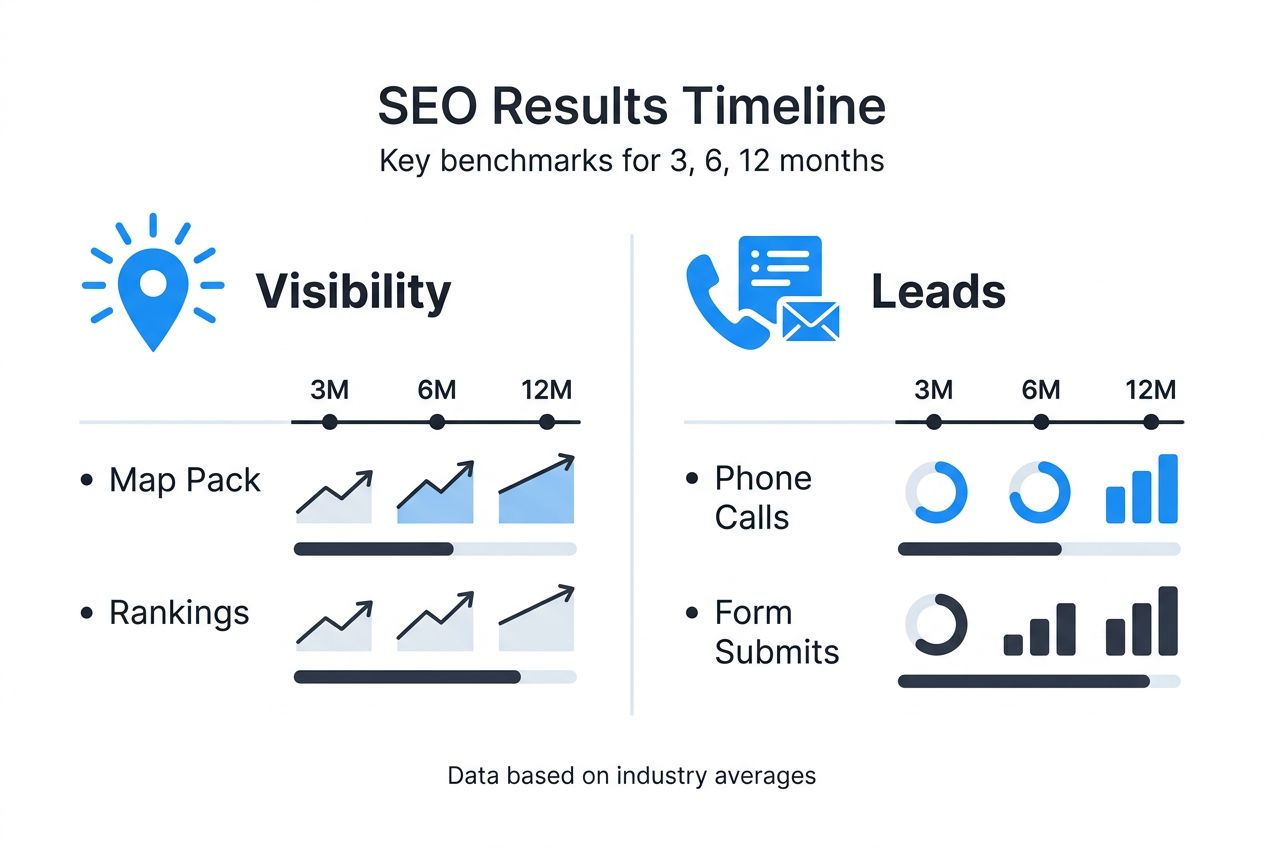
Realistic timelines prevent frustration and help you stay committed during the initial optimization period. Most contractors see measurable improvements within 3 to 6 months of consistent implementation. Competitive markets require longer timeframes, while contractors in smaller cities often see faster results.
Track map pack visibility improvements as your primary success metric. Tools like BrightLocal’s Local Rank Tracker show your position in map results across different neighborhoods. Target 40 to 50% improvement in map pack appearances within six months for priority service areas.
Monitor organic lead volume separately from paid advertising leads. Expect 30 to 35% growth in organic calls, form submissions, and booked appointments as your rankings improve. Document baseline metrics before starting optimization to accurately measure progress.
Faster mobile load times enhance both rankings and user experience, reducing bounce rates while improving conversion rates. Businesses that reduce load times from 5 seconds to under 3 seconds typically see 20 to 25% increases in mobile conversions independent of ranking improvements.
| Metric | 3-Month Target | 6-Month Target | 12-Month Target |
|---|---|---|---|
| Map Pack Visibility | 20-25% increase | 40-50% increase | 60-70% increase |
| Organic Lead Volume | 15-20% growth | 30-35% growth | 50-60% growth |
| Google Business Profile Views | 30-40% increase | 60-75% increase | 100%+ increase |
| Average Review Rating | Maintain 4.5+ | Maintain 4.6+ | Maintain 4.7+ |
| Mobile Page Speed | Under 4 seconds | Under 3 seconds | Under 2.5 seconds |
Case studies demonstrate measurable revenue impacts when contractors implement comprehensive service area SEO strategies. Businesses report 40 to 60% increases in booked jobs within the first year of consistent optimization efforts. For detailed performance data, review service area SEO results benchmarks from contractors across various trades and markets.
How Results Digital can help contractors boost local leads
Implementing comprehensive service area SEO requires expertise, tools, and consistent effort that many contractors struggle to maintain while running their businesses. Results Digital specializes in proven SEO and lead generation strategies designed specifically for local contractors who need measurable results without the learning curve.
Our customized workflows handle everything from keyword research and Google Business Profile optimization to citation building and review management. We focus exclusively on service-based businesses, ensuring strategies align with contractor-specific challenges and opportunities. Learn about our proven lead generation workflow for local contractors that combines SEO with targeted advertising for maximum lead volume.
Discover how local lead generation explained through our comprehensive approach delivers consistent booked jobs and measurable ROI. Explore specialized SEO services for contractors designed to dominate your local market while you focus on delivering exceptional service to customers.
Frequently asked questions
What tools do I need to start service area SEO?
Google Search Console and Google Business Profile access are essential starting points for any local SEO effort. These free tools provide critical data about your organic performance and local visibility. For more advanced tracking, consider BrightLocal for citation management and SEMrush for competitive keyword analysis. Basic local SEO knowledge helps you use these tools effectively and understand why specific tactics improve rankings.
How long does it take to see results from local SEO?
Expect measurable improvements within 3 to 6 months of consistent optimization work. Competitive markets with established players require longer timelines, while contractors in smaller cities often see faster ranking improvements. Results depend heavily on implementation quality, market competition, and your starting point. Track metrics monthly to document progress and adjust strategies based on performance data.
Can I optimize Google Business Profile for multiple neighborhoods?
Yes, use service area settings to define all neighborhoods you actively serve from your primary business location. Create dedicated landing pages for each major service area, optimizing content for neighborhood-specific keywords. This approach enhances map pack visibility across multiple locations without violating Google’s guidelines against fake addresses. Keep all information accurate and consistent across your profile and website.
What are common mistakes to avoid in service area SEO?
Keyword stuffing damages your relevance signals and frustrates readers who want genuine information. Ensure NAP consistency across all directories, as conflicting information weakens your citation strength significantly. Never neglect Google Business Profile optimization, including photos, posts, and review responses. Address mobile speed issues immediately, as slow-loading sites lose rankings and conversions regardless of other optimization efforts.
