
TL;DR:
- A structured digital workflow improves lead tracking, bidding, and optimization for pool services.
- Google Ads captures high-intent local buyers, providing faster, measurable results.
- Focusing on one or two channels and continuous measurement maximizes ad spend efficiency.
Most pool service businesses spending money on digital ads aren’t losing because of budget. They’re losing because of broken workflow. Ads go live without proper tracking. Leads come in and sit for hours before anyone calls back. Campaigns run for weeks without a single optimization. The result is wasted spend and a calendar that never fills up the way it should. A structured digital advertising workflow changes all of that. This guide walks you through every phase, from planning your campaigns to measuring real revenue, so your ad dollars actually turn into booked jobs.
Table of Contents
- Understanding the digital advertising essentials for pool services
- Preparing your digital advertising workflow: goals, prerequisites, and assets
- Step-by-step execution: launching and managing digital ad campaigns
- Troubleshooting, seasonality, and maximizing campaign ROI
- Measuring results and optimizing for growth
- Our perspective: what most pool businesses miss about digital advertising workflow
- Next steps: power up your pool service advertising workflow
- Frequently asked questions
Key Takeaways
| Point | Details |
|---|---|
| Use a focused workflow | The Bullseye Framework prevents wasted ad spend by prioritizing, testing, and scaling only the best channels. |
| Prep assets before launch | Define goals, set up geo-targeting, research keywords, and build optimized landing pages before spending ad dollars. |
| Act fast on new leads | Contact every lead within five minutes using automation for a dramatic increase in conversion rates. |
| Track and optimize ROI | Regularly review metrics like CPL and ROAS, and shift budget to highest-performing campaigns for growth. |
Understanding the digital advertising essentials for pool services
Before you touch a campaign, you need to know which channels are worth your time and what kind of results to expect. The digital marketing types for pools landscape includes Google Ads, Facebook and Instagram, YouTube, and LinkedIn for B2B pool contractors. Each plays a different role.
Google Ads is where high-intent buyers live. Someone searching “pool cleaning near me” is ready to hire. Facebook and Instagram work better for brand awareness and retargeting. YouTube builds trust over time. LinkedIn is niche but useful if you serve commercial accounts or HOAs.
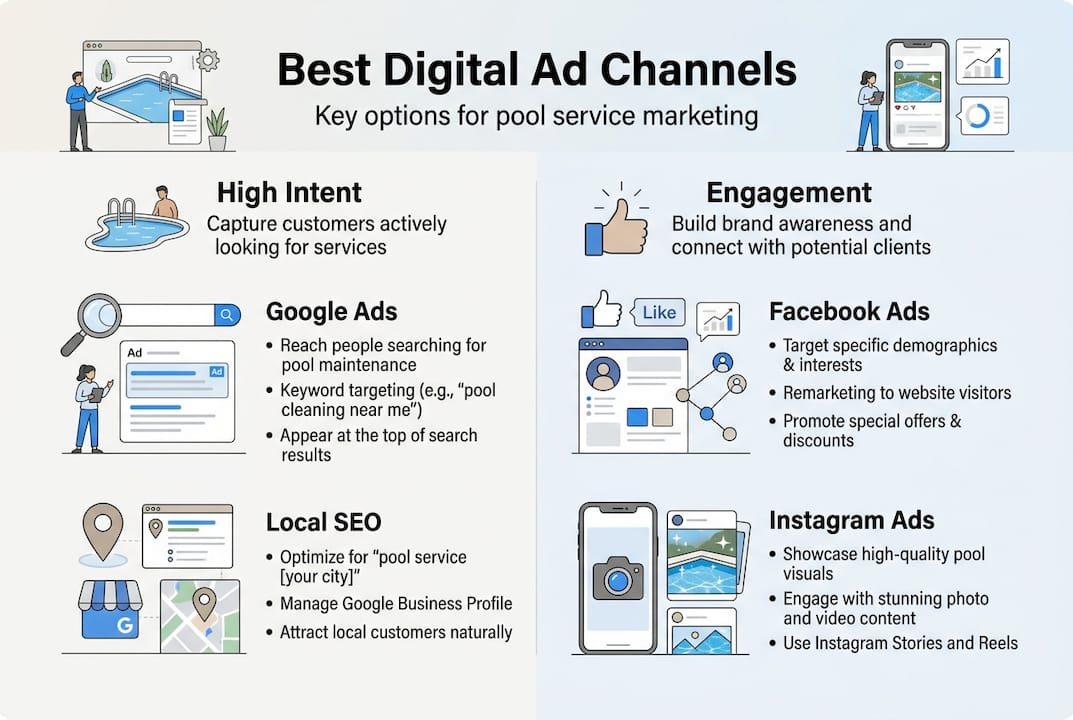
The Bullseye Framework gives digital advertising workflow a clear structure: brainstorm channels, rank them by potential, prioritize the top two or three, test with small budgets, then iterate based on data. This keeps you from spreading resources too thin across every platform at once.
Here’s a quick look at how the main channels compare for pool services:
| Channel | Best use | Avg. intent level | Cost control |
|---|---|---|---|
| Google Search Ads | Direct lead gen | Very high | Bid-based |
| Facebook/Instagram | Awareness, retargeting | Medium | Budget cap |
| YouTube | Brand building | Low to medium | CPV bidding |
| B2B, commercial pools | High (B2B) | Higher CPCs |
Knowing your benchmarks matters just as much as knowing your channels. For the Pools and Spas category, industry averages show a cost per click of $5.81, a conversion rate of 10.89%, a cost per lead of $45.15, and a return on ad spend between 4x and 8x. These numbers give you a realistic baseline before you start spending.
Key advantages of Google Ads for local pool services:
- Captures buyers at the exact moment of intent
- Geo-targeting keeps spend local and efficient
- Call extensions let prospects call directly from the ad
- Conversion tracking ties spend to actual leads
- Faster results than SEO, especially in peak season
Understanding why digital marketing is essential for pool builders starts with this: local, high-intent traffic is the most valuable traffic you can buy. Everything else in your workflow should support capturing it.
Pro Tip: Start with Google Search Ads before testing any other channel. Once you’re generating consistent leads there, use retargeting on Facebook to re-engage visitors who didn’t convert.
Preparing your digital advertising workflow: goals, prerequisites, and assets
With an understanding of what to expect, the next step is getting prepared for ad campaigns. Skipping prep is the fastest way to burn budget.
A solid Google Ads workflow follows four core steps: define your goals, complete keyword research, build your campaign structure, and set up conversion tracking. Each step depends on the one before it.

Start by defining what success looks like. Do you want more inbound calls? Form submissions? Booked maintenance contracts? Your goal shapes everything from your ad copy to your landing page design.
Step-by-step prep checklist:
- Set your primary goal (calls, form fills, or booked jobs)
- Research high-intent keywords like “pool cleaning near me” and “pool repair service”
- Build separate campaigns for each service (maintenance, repair, remodeling)
- Set up geo-targeting to your actual service area, not just your city
- Configure device targeting, since most local searches happen on mobile
- Build or optimize landing pages for each campaign (mobile-first design)
- Install call tracking software to attribute calls to specific ads
- Connect your CRM so leads flow directly into your pipeline
Your service area landing pages deserve special attention. A generic homepage does not convert paid traffic well. Each campaign needs a focused page that matches the ad’s message, loads fast, and has one clear call to action.
| Prep element | Why it matters | Common mistake |
|---|---|---|
| Keyword research | Targets buyers, not browsers | Using broad match only |
| Campaign structure | Keeps data clean and actionable | Lumping all services together |
| Landing pages | Converts clicks into leads | Sending traffic to homepage |
| Call tracking | Proves ROI from calls | Not tracking phone leads |
| CRM integration | Closes the loop on every lead | Manual lead entry, slow follow-up |
Pro Tip: Use phrase match and exact match keywords in your initial campaigns. Broad match burns budget fast when you’re still learning what converts in your market.
Step-by-step execution: launching and managing digital ad campaigns
Once preparations are complete, it’s time to set your workflow in motion. Launch is not a one-time event. It’s the start of a continuous cycle.
Campaign launch workflow:
- Build campaigns by service category with tightly themed ad groups
- Write three to five ad variations per ad group to test messaging
- Add negative keywords from day one (“cheap,” “DIY,” “jobs,” “free”)
- Set daily budgets low at first, around $20 to $30 per campaign
- Enable call extensions, location extensions, and sitelinks
- Confirm conversion tracking is firing before you spend a dollar
Once campaigns are live, measure what actually matters. Clicks are vanity. Track metrics beyond clicks including lead rate, conversion rate, and ROAS to understand what’s actually driving revenue.
Metrics to review weekly:
- Cost per click (CPC)
- Click-through rate (CTR)
- Conversion rate per campaign
- Cost per lead (CPL)
- Number of booked jobs from leads
Automation is where execution gets a real edge. Speed-to-lead under five minutes dramatically improves your connect rate. AI-powered SMS and email tools can fire the moment a form is submitted, keeping you ahead of every competitor who calls back three hours later.
“The businesses that win with digital ads aren’t always the ones spending the most. They’re the ones responding the fastest and iterating the quickest.”
For Google Ads setup steps and Facebook Ads tips tailored to local service businesses, use those resources to accelerate your setup and avoid common configuration mistakes.
Pro Tip: After two weeks, pause any ad group with zero conversions and shift that budget to your top performer. Don’t wait a full month to make decisions.
Troubleshooting, seasonality, and maximizing campaign ROI
With campaigns running, be ready to spot and handle common pitfalls while dialing in your returns. Seasonality is one of the biggest variables in pool service advertising.
Spring brings a 20 to 30% premium on cost per lead as competition heats up. Smart operators plan for this by increasing budgets in March and April before the rush, not after. In slower months, pull back spend and shift focus to maintenance contract renewals.
Common workflow bottlenecks and fixes:
- High CPL: Add more negative keywords and tighten geo-targeting
- Low CTR: Rewrite ad headlines to focus on urgency or local relevance
- Leads not converting: Audit your landing page speed and call-to-action clarity
- Poor lead quality: Exclude irrelevant search terms weekly
- Seasonal slumps: Promote off-season services like heater repair or winterization
Geography matters more than most pool businesses realize. Markets like California, Florida, Arizona, and Texas generate the highest volume of pool-related searches year-round. If you operate in those markets, your competition is fierce but so is the opportunity.
Focusing on services with recurring revenue, like weekly maintenance contracts, dramatically improves your lifetime value (LTV) per customer. Maintenance contract LTV runs between $10,000 and $15,000 per client. That changes how much you can afford to spend per lead.
For seasonal pool marketing strategies that align your ad spend with demand cycles, use that resource to plan your budget calendar in advance.
The hybrid approach of running paid ads for immediate leads while building SEO for long-term visibility is the most sustainable strategy. Paid ads fill your calendar now. SEO reduces your cost per lead over time.
Pro Tip: Build a negative keyword list before launch using Google’s search term report from any past campaigns. Even a few hours of cleanup saves hundreds in wasted spend.
Measuring results and optimizing for growth
After troubleshooting and making improvements, it’s critical to formalize your measurement and optimization process. Data without action is just noise.
Metrics that actually drive decisions:
- Total leads generated per campaign
- Cost per lead by channel and service type
- Close rate from lead to booked job
- Customer lifetime value by acquisition source
- Return on ad spend (ROAS) by campaign
Set up Google Analytics with UTM parameters (tracking codes added to URLs) on every ad link. Connect your CRM to track leads from click to closed job. Review performance weekly, not monthly, so you catch problems before they compound.
Landing page performance is often the hidden bottleneck. Pages that load in under two seconds and have a single, clear call to action consistently outperform cluttered pages with multiple options. Mobile usability is non-negotiable since most local searches happen on phones.
Exceptional ROAS is possible, with some optimized campaigns reaching 293x, but a realistic target for most pool service businesses is 4x to 8x. The gap between average and exceptional comes down to how precisely you track results past the click and into actual revenue.
| Optimization action | Impact | Frequency |
|---|---|---|
| Pause low-converting ad groups | Reduces wasted spend | Weekly |
| Test new ad copy | Improves CTR and CVR | Bi-weekly |
| Expand negative keyword list | Improves lead quality | Weekly |
| Audit landing page speed | Increases conversions | Monthly |
| Scale top-performing campaigns | Grows lead volume | Monthly |
Pro Tip: Use the lead generation platforms resource to identify which platforms deliver the best CPL in your specific market before scaling spend.
Our perspective: what most pool businesses miss about digital advertising workflow
Here’s what we see over and over again: pool companies launch ads on three or four channels at once, get scattered results, and conclude that digital advertising doesn’t work. The real problem is diffusion. Spreading a $1,500 monthly budget across Google, Facebook, YouTube, and a lead gen platform means none of those channels gets enough data to optimize properly.
Focused, fast iteration on one or two channels almost always outperforms a scattered multi-channel approach, especially in the first 90 days. Get Google Ads working first. Then layer in Facebook retargeting. Then expand.
The second thing most businesses miss is that technology does not replace follow-up. It supports it. AI-powered SMS and email tools that fire within five minutes of a lead submission are powerful, but they work best when a real person follows up within the hour. Automation buys you time. It doesn’t close jobs.
Tracking is only valuable if you act on it. We’ve seen businesses with beautiful dashboards and zero optimization habits. The data is there. The discipline to use it weekly is what separates growing companies from stagnant ones. Review your digital strategies for pools regularly and treat your ad account like a living system, not a set-it-and-forget-it tool.
Next steps: power up your pool service advertising workflow
You now have a clear map from campaign planning to performance optimization. The next move is putting it into practice with the right tools and support behind you.
Results Digital builds and manages high-performance ad campaigns specifically for service businesses that need real leads, not just clicks. Whether you’re starting from scratch or fixing a workflow that’s leaking budget, we can help you structure campaigns that generate consistent, bookable jobs. Explore our lead generation workflow guide, check out the top lead gen platforms for service businesses, and learn how digital advertising drives real revenue for local contractors. Ready to stop guessing and start growing?
Frequently asked questions
What is the most effective digital advertising channel for pool services?
Google Ads leads for pool services because it captures buyers actively searching for local help, making it the highest-intent channel available to local contractors.
How much should a pool service spend monthly on digital ads?
Most pool service businesses should start between $600 and $1,500 per month, scaling up once they identify which campaigns generate the best cost per lead.
How soon should leads be followed up after coming in from ads?
Contact every lead within five minutes. AI-powered SMS and email automation can handle the first touch instantly, giving you a dramatically higher connect rate than manual follow-up.
How does seasonality affect digital ad performance for pool services?
Spring and summer drive higher demand but also 20 to 30% higher CPL due to increased competition. Plan your budget increases before peak season, not during it.
What is a realistic ROI to expect from digital advertising?
Most pool service businesses should target a ROAS of 4x to 8x, with well-optimized campaigns occasionally reaching far higher when tracking is dialed in from click to closed job.
