
Many American restoration contractors face fierce competition and tight margins in their local market. When every lead counts, a smart Google Ads strategy can mean the difference between steady growth and missed opportunities. By learning how to set clear service goals and target local keywords the right way, you can outpace competitors and attract high intent customers ready for urgent damage restoration services.
Table of Contents
- Step 1: Define Your Restoration Service Goals
- Step 2: Set Up and Structure Your Google Ads Account
- Step 3: Research and Select Targeted Local Keywords
- Step 4: Create Compelling Restoration Ad Campaigns
- Step 5: Optimize and Launch Your Ads for Maximum Impact
- Step 6: Monitor Results and Refine Campaign Performance
Quick Summary
| Key Point | Explanation |
|---|---|
| 1. Define Clear Restoration Goals | Establish specific and measurable objectives that align with local market needs for effective Google Ads targeting. |
| 2. Organize Your Google Ads Account | Create campaigns for each service type, using a structured approach to reach potential customers effectively. |
| 3. Research Targeted Local Keywords | Utilize location-specific keywords to enhance ad relevance and attract quality leads for restoration services. |
| 4. Create Compelling Ad Campaigns | Develop engaging ads that highlight unique offerings and emotional triggers relevant to customers facing emergencies. |
| 5. Continuously Monitor and Optimize | Regularly review campaign performance metrics to adjust strategies and improve lead generation efficiency. |
Step 1: Define Your Restoration Service Goals
Successfully setting up Google Ads for your restoration business starts with crystal clear service goals that align with your local market needs. Your goals will serve as the strategic foundation for your entire advertising approach, determining how you target potential customers and invest your marketing budget.
When defining restoration service goals, focus on specific, measurable outcomes that reflect your business priorities. Strategic planning frameworks recommend breaking down your objectives into precise categories like revenue targets, service volume, geographic coverage, and customer acquisition costs. Consider goals such as generating 50 water damage restoration leads per month, maintaining a 25% conversion rate from ad clicks, or achieving a customer acquisition cost under $75 per job. Your goals should be realistic yet ambitious, rooted in your current business performance and market potential.
Think beyond raw numbers and consider qualitative objectives too. These might include positioning your restoration service as the go-to local expert, expanding into specific damage restoration niches like mold remediation or emergency flood response, or targeting higher value commercial restoration contracts. Each goal you set will directly influence your Google Ads strategy, from keyword selection to ad copy and targeting parameters.
Pro tip: Track your goals using detailed analytics and be prepared to adjust your strategy quarterly based on actual performance data and market shifts.
Step 2: Set Up and Structure Your Google Ads Account
Creating a strategic Google Ads account for your restoration business requires thoughtful planning and precise organization. Your account structure will be the backbone of your digital marketing efforts, determining how effectively you reach potential customers and manage your advertising budget.
Account organization strategies recommend starting with a Gmail account dedicated to your business advertising. Begin by creating campaigns specifically tailored to your restoration services such as water damage, mold remediation, fire restoration, and emergency response. Within each campaign, develop tightly themed ad groups that target specific service segments. For example, your water damage campaign might include separate ad groups for residential flooding, commercial water extraction, and emergency water mitigation. This granular approach allows you to craft highly relevant ads and track performance with precision.
Each ad group should contain closely related keywords that match your potential customers search intent. Consider using match types like broad match modifier, phrase match, and exact match to control your ad targeting. Set realistic bid strategies based on your budget and service value, focusing on maximizing conversions rather than simply generating clicks. Remember that your account structure should reflect how customers actually search for restoration services in your local market.
Pro tip: Use Google Ads location targeting to focus exclusively on your service area and prevent wasting budget on irrelevant geographic regions.
Here’s a comparison of common Google Ads campaign structures for restoration services:
| Campaign Type | Target Audience | Best Suited For | Key Benefit |
|---|---|---|---|
| Service-based | Homeowners, businesses | Specialized restoration | Tailored keyword targeting |
| Location-based | Local residents, neighbors | City-wide emergencies | Maximizes local lead quality |
| Damage scenario-based | Victims of specific events | Emergency calls | Highly relevant ad messaging |
Step 3: Research and Select Targeted Local Keywords
Selecting the right keywords is crucial for driving quality leads to your restoration business through Google Ads. Your keyword strategy will determine how potential customers find your services when they need emergency restoration help.
Local keyword research strategies emphasize the importance of understanding exactly how your potential customers search for restoration services. Start by generating a comprehensive list of keywords that reflect different restoration scenarios like water damage restoration, flood cleanup, mold removal, fire damage repair, and emergency water extraction. Focus on location specific phrases that include your city or service area names. For instance, instead of using a generic term like water damage, use more specific phrases such as water damage restoration in [Your City], emergency flood cleanup [Your County], or residential water extraction services near me.

Utilize Google Keyword Planner to analyze search volume, competition, and estimated cost per click for each keyword. Pay special attention to long tail keywords that demonstrate specific customer intent. These might include phrases like emergency water damage cleanup for basement, residential mold remediation after storm, or commercial fire restoration services. Include negative keywords to prevent your ads from showing for irrelevant searches, which helps optimize your advertising budget and improve overall campaign performance.
Pro tip: Create a spreadsheet to track keyword performance and regularly update your keyword list based on actual search term reports from your Google Ads account.
Step 4: Create Compelling Restoration Ad Campaigns
Designing powerful Google Ads for your restoration business requires strategic messaging that captures potential customers during their most urgent moments. Your ad campaigns will serve as the critical first touchpoint between your services and homeowners experiencing emergency damage situations.
Ad campaign principles emphasize creating tightly themed ad groups with targeted messaging that speaks directly to specific restoration scenarios. Craft ad copy that highlights your unique selling points such as 24/7 emergency response, certified technicians, rapid water extraction, or immediate mold remediation. Use powerful emotional triggers that resonate with customers facing stressful property damage scenarios. For water damage ads, phrases like emergency water removal, rapid flood cleanup, or preventing secondary water damage can create immediate connection. Include specific value propositions such as insurance billing assistance, free damage assessment, or guaranteed response within 60 minutes.
Maximize your ad effectiveness by utilizing all available ad extensions. Add location extensions to showcase your service area, call extensions for immediate contact, and sitelink extensions that direct potential customers to specific service pages like water damage, fire restoration, or mold removal. Develop multiple ad variations to test different messaging approaches and continuously refine your campaigns based on performance data. Ensure your ad language matches the keywords you are targeting and reflects the specific restoration services you provide in your local market.
Pro tip: Create at least three ad variations per ad group and set them to rotate evenly to identify which messaging generates the most customer engagement and conversions.
Step 5: Optimize and Launch Your Ads for Maximum Impact
Launching and optimizing your Google Ads campaign for restoration services requires strategic planning and continuous performance monitoring. Your goal is to create an advertising approach that generates high quality leads while maximizing your marketing budget.
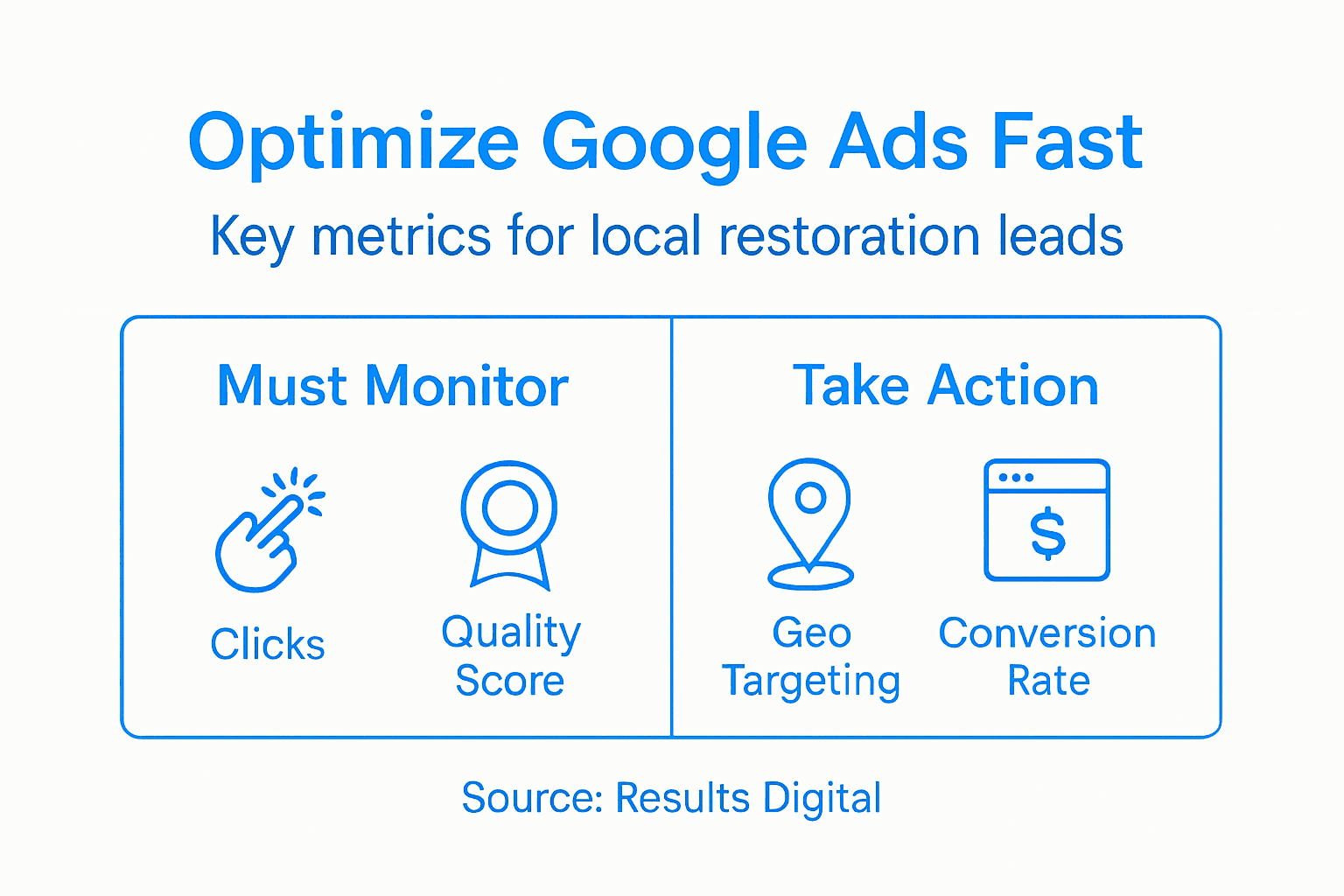
Marketing performance metrics are critical for understanding and improving your ad campaign effectiveness. Start by establishing clear key performance indicators such as click-through rates, conversion rates, and cost per acquisition specific to restoration services. Configure conversion tracking to measure actions like phone calls, form submissions, and emergency service requests. Implement A/B testing for ad variations to identify which messaging resonates most effectively with potential customers experiencing water damage, fire restoration, or mold remediation emergencies.
Utilize Google Ads reporting tools to analyze campaign performance granularly. Monitor your quality score closely and make data driven adjustments to improve ad relevance, landing page experience, and keyword alignment. Focus on targeting parameters that align with your restoration business goals, such as geographic targeting, device preferences, and audience demographics. Adjust bid strategies dynamically based on performance data, potentially using automated bidding strategies that optimize for conversions or target cost per acquisition.
Pro tip: Set up conversion tracking with a unique phone number for your Google Ads campaign to accurately measure lead generation and caller source.
Here is a summary of key marketing metrics to track for Google Ads in restoration services:
| Metric | What It Measures | Business Impact |
|---|---|---|
| Click-through rate (CTR) | Percentage of ad views clicked | Gauges ad relevance |
| Conversion rate | Leads generated per ad click | Shows campaign effectiveness |
| Cost per acquisition | Average spend per new customer | Controls profitability |
| Lead quality score | Value of each generated lead | Focuses budget on best prospects |
Step 6: Monitor Results and Refine Campaign Performance
Successfully managing your restoration company’s Google Ads campaign requires consistent monitoring and strategic adjustments to ensure maximum lead generation and return on investment. Your ability to analyze performance data will directly impact your advertising effectiveness and business growth.
Marketing performance tracking involves developing a comprehensive system for evaluating your campaign’s key performance indicators. Create a monthly review process where you examine critical metrics such as click-through rates, conversion rates, cost per lead, and total lead volume specific to each restoration service type. Pay special attention to variations between water damage, mold remediation, and fire restoration campaigns. Track which keywords, ad variations, and targeting parameters generate the most qualified leads at the lowest acquisition cost.
Utilize Google Ads reporting tools and integrate third-party analytics platforms to gain deeper insights into your campaign performance. Set up conversion tracking for different actions like emergency service calls, online form submissions, and website chat interactions. Compare your campaign performance against industry benchmarks for restoration services and be prepared to make data-driven adjustments. Consider reallocating budget from underperforming ad groups to those demonstrating higher conversion potential. Experiment with different bidding strategies, refine audience targeting, and continuously test ad copy to improve overall campaign efficiency.
Pro tip: Schedule quarterly comprehensive campaign audits to assess long-term performance trends and make strategic optimization decisions.
Drive More Local Leads for Your Restoration Business with Expert Google Ads Support
Setting up Google Ads for your restoration service can feel overwhelming. The article highlights key challenges like defining clear campaign goals, selecting targeted local keywords, and continuously optimizing for the best results. Many restoration businesses struggle to convert clicks into quality leads while managing costs. If you want to turn your Google Ads investment into a steady stream of calls and bookings, you need a strategic partner who understands your industry and local market.
At Results Digital, we specialize in driving high-quality leads for local service providers like restoration contractors. Our tailored approach combines custom website design, local SEO, and expertly managed Google Ads campaigns focused on your unique goals—whether that means emergency water damage response, mold remediation, or fire restoration services. We handle every detail from goal setting to keyword research and ad optimization so you can focus on restoring properties and growing your reputation.
Unlock your restoration business’s potential today.
Take control of your digital advertising with a specialized marketing partner that delivers measurable results without long-term contracts.
Get started with Results Digital to experience exclusive, conflict-free service that drives local dominance.
Explore how our digital marketing solutions work to boost your lead volume and maximize ROI now.
Learn more about our commitment to local service businesses and join the many restoration professionals accelerating their growth with us.
Drive your local restoration leads smarter and faster.
Ready to transform your Google Ads into a lead generation powerhouse today
Frequently Asked Questions
How do I define effective service goals for my restoration business using Google Ads?
To define effective service goals, focus on specific outcomes like generating a set number of leads per month or maintaining a targeted conversion rate. Break down these objectives into measurable categories such as revenue, service volume, and customer acquisition costs to tailor your advertising strategy.
What are the best practices for structuring my Google Ads account for restoration services?
Start by creating a dedicated Gmail account and organizing campaigns based on specific restoration services, such as water damage or mold remediation. Within each campaign, develop focused ad groups for more targeted messaging, which can enhance ad relevance and performance tracking.
How can I select the right local keywords for my restoration Google Ads?
To select the right local keywords, create a list that combines broader terms, such as ‘water damage restoration,’ with location-specific phrases relevant to your service area. Use this focused keyword strategy to capture the intent of potential customers actively searching for restoration services near them.
What elements should I include in my restoration ad campaigns to attract local leads?
Include compelling ad copy that emphasizes your unique services, such as 24/7 emergency response, and leverage emotional triggers relevant to customers dealing with property damage. Additionally, utilize ad extensions like call and location extensions to maximize visibility and encourage immediate engagement.
How often should I monitor and optimize my Google Ads campaigns for restoration services?
Establish a routine for monitoring your campaigns at least once a month, focusing on key performance metrics like click-through rates and conversion rates. Regularly adjust targeting and budget allocations based on these insights to ensure you are maximizing lead generation and return on investment.
Recommended
- Google Ads in Lead Generation: Key Strategies Explained
- Step by Step Google Ads Setup for Local Leads Success
- Why Use Google Ads for Local Service Leads
- Community-Based Movers Explained: Why Local Roots Matter
- Digital Markteting for Roofing Companies
- Digital Marketing for Fire Protection Companies
- Digital Marketing for Damage Restoration Companies
- Digital Marketing for Asbestos Abatement Companies
