
Most roofing contractors assume transparency means handing competitors a playbook or scaring off clients with too much information. That assumption is costing them jobs. 87% will pay more for brands they trust, and local homeowners are actively choosing roofers who communicate openly over those who stay vague. Transparency is not about revealing your pricing formula or exposing every internal process. It is about showing customers that you have nothing to hide, that your results are real, and that you stand behind your work. Done right, it becomes your single most powerful growth engine in a crowded local market.
Table of Contents
- Why transparency matters in digital marketing for roofers
- Proven strategies for transparency: What works for roofers
- Balancing transparency and privacy: What roofing clients actually want
- Overcoming resistance: Addressing internal fears around transparency
- Perspective: Why selective transparency, not radical openness, wins for roofers
- Get hands-on help to build trust through transparent marketing
- Frequently asked questions
Key Takeaways
| Point | Details |
|---|---|
| Trust fuels growth | Transparent digital marketing builds long-term loyalty and referrals among roofing clients. |
| Actionable strategies work | Practical steps like sharing metrics, optimizing profiles, and honest review management drive measurable lead growth. |
| Balance is crucial | Selective transparency maximizes trust without compromising privacy or business advantage. |
| Overcome internal fears | Addressing team worries about transparency prevents missed opportunities and strengthens reputation. |
Why transparency matters in digital marketing for roofers
Trust is the currency of local business. Homeowners searching for a roofer are not just comparing prices. They are asking: Can I trust this company to show up, do the job right, and not disappear after the check clears? When your digital marketing answers that question clearly, you win the job before the first phone call.
Transparency in digital marketing builds trust that is essential for local businesses like roofing contractors to foster customer loyalty and long-term relationships. That loyalty compounds. A client who trusts you refers neighbors, leaves five-star reviews, and calls you back for the next project without shopping around.
The numbers back this up. Transparent practices boost loyalty by 2.4x ROI compared to businesses that keep customers in the dark. That is not a marginal gain. That is the difference between a roofing company that grinds for every lead and one that has a steady pipeline of warm referrals.
Here is what most contractors get wrong: they think transparency means oversharing. It does not. In practice, transparency in digital marketing looks like this:
- Showing real before-and-after project photos with honest descriptions
- Publishing clear pricing ranges or financing options on your website
- Responding to negative reviews professionally and publicly
- Sharing monthly performance reports with clients or partners
- Explaining exactly how your SEO service for roofers generates leads and what metrics matter
- Being upfront about timelines, warranties, and what is included in a quote
“The roofing companies that grow fastest are not the ones with the lowest prices. They are the ones homeowners feel they can trust before they ever pick up the phone.”
Understanding why SEO matters for roofers is part of this picture. When your website ranks locally and your Google Business Profile is fully optimized with honest reviews and accurate information, you are signaling credibility at every touchpoint. Transparency is not a single tactic. It is a posture that runs through every part of your digital presence.
Proven strategies for transparency: What works for roofers
Knowing transparency matters is one thing. Knowing exactly how to implement it is another. The good news is that the most effective methods are also the most practical.
Key methodologies include sharing clear performance metrics, regular SEO reporting, honest communication on strategies, and real-time dashboards to give clients and customers a clear view of what is happening and why.

Here is a quick overview of strategies that move the needle:
| Strategy | What it involves | Primary benefit |
|---|---|---|
| Metric sharing | Monthly reports on traffic, calls, and leads | Builds client confidence |
| Review management | Responding to all reviews publicly | Signals accountability |
| Google Business Profile optimization | Accurate info, photos, Q&A | Boosts local visibility |
| Call tracking | Recording and reporting call volume | Proves ad and SEO ROI |
| SEO reporting | Keyword rankings, traffic sources | Demonstrates progress |
To implement transparent reporting in your client communication, follow these steps:
- Set up a simple dashboard (Google Looker Studio works well) that tracks calls, form fills, and traffic sources.
- Schedule a monthly review call or send a plain-language summary email with key numbers.
- Explain what changed, what you tested, and what the next priority is.
- Invite questions. Clients who feel heard stay longer and refer more.
- Document agreed-upon goals so both sides have a shared benchmark.
Pro Tip: Call tracking tools like CallRail let you show exactly which ads or search terms generated each phone call. This kind of proof is far more persuasive than a general traffic report, and it removes doubt about whether your roofing Google Ads transparency is actually delivering.
The results speak for themselves. Roofers using optimized Google Business Profiles and honest review management saw up to 210% traffic growth and 4 to 5 qualified leads per day. That kind of growth reduces your dependence on expensive paid ads over time, because organic trust starts doing the heavy lifting.
When you pair strong Google Ads for roofers with transparent reporting and solid roofing website optimization, you create a system where every dollar spent is accounted for and every result is visible.
Balancing transparency and privacy: What roofing clients actually want
Not every piece of information belongs in a client-facing report. Customers want clarity, not a data dump. The art is knowing which details build trust and which ones create confusion or expose sensitive information.
44% of consumers demand transparency on data use, and 87% say they will pay more for brands they trust. That tells you two things: customers care about how their data is handled, and they reward businesses that handle it honestly.
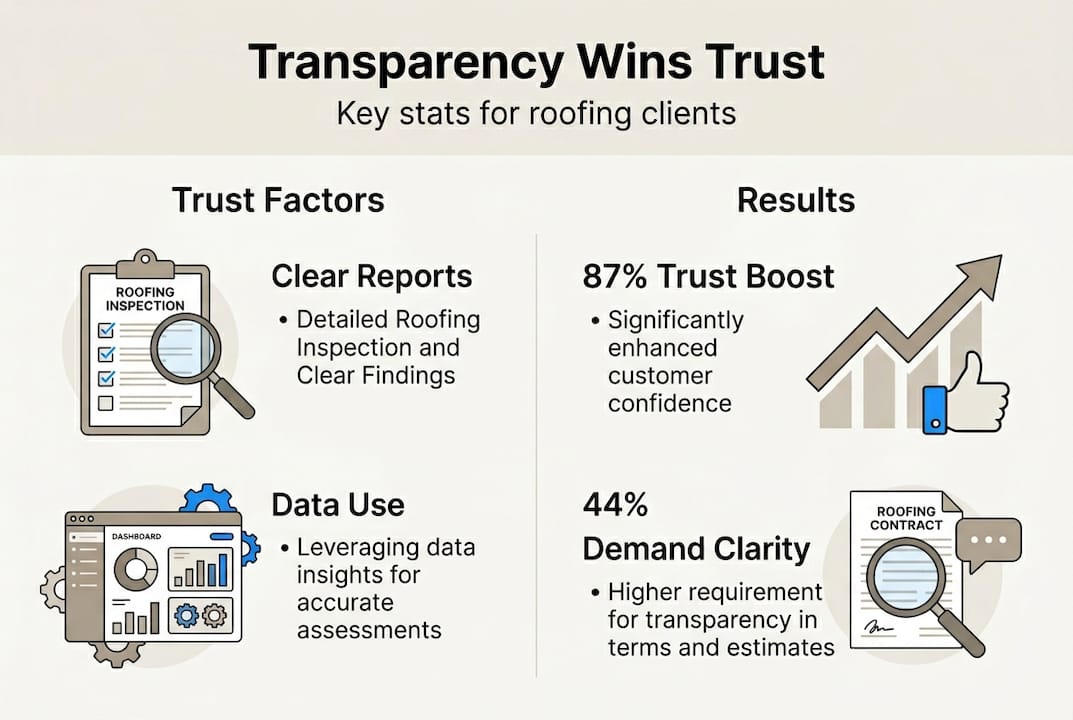
Here is a practical breakdown of what homeowners and business clients actually want to see:
| What clients want to know | What to keep internal |
|---|---|
| How their data is collected and used | Proprietary ad targeting methods |
| What their marketing budget is spent on | Vendor pricing and margins |
| How leads are tracked and attributed | Competitor research details |
| What results to expect and when | Internal team performance reviews |
| Whether AI tools are used in their campaigns | Platform algorithm specifics |
52% trust AI-powered marketing if its use is disclosed transparently. That number drops sharply when customers find out after the fact. So if you or your marketing partner uses AI tools for content, ads, or analytics, say so upfront and explain the benefit to the client.
Here is a simple framework for what to always clarify versus what to safeguard:
Always clarify:
- How you collect and store customer contact information
- What platforms you advertise on and approximate budget allocation
- How reviews are requested and managed
- What the reporting cycle looks like and what metrics are tracked
Keep internal:
- Specific bid strategies or ad copy formulas
- Subcontractor arrangements unless directly relevant
- Detailed competitor analysis
Pro Tip: Turn privacy conversations into a trust-building moment. When a new client asks how you handle their data, walk them through your process confidently. That conversation alone differentiates you from competitors who fumble or dodge the question. Staying current on SEO trends for roofers also means understanding how data privacy regulations are shaping local search and consumer expectations in 2026.
Overcoming resistance: Addressing internal fears around transparency
The biggest obstacle to transparency is usually internal. Business owners worry that showing performance data will expose slow months, that sharing processes will invite scrutiny, or that admitting a campaign underperformed will cost them a client. These fears are understandable but largely unfounded.
Opacity risks perceived incompetence far more than honest disclosure does. When clients sense you are hiding something, they assume the worst. When you proactively share a challenge and explain what you are doing about it, you demonstrate competence and integrity at the same time.
“Transparency is not about being perfect. It is about being trustworthy. Clients forgive mistakes far more readily than they forgive deception.”
Here is how to decide what to share and how much:
- Start with outcomes. Share what the client cares about most: leads, calls, booked jobs, and cost per acquisition.
- Explain the process briefly. Clients do not need a technical deep dive, but a one-paragraph summary of your strategy builds confidence.
- Address problems before they ask. If a campaign underperformed, flag it in your report with a clear explanation and a corrective plan.
- Use visuals. A simple chart showing month-over-month growth is more reassuring than a paragraph of numbers.
- Set expectations early. At the start of any engagement, define what success looks like and how often you will report on it.
Balance transparency with strategic sharing using tools like call tracking and dashboards that prove ROI without overwhelming clients with raw data. The goal is clarity, not volume.
For leadership buy-in, frame transparency as risk management. A roofing company that documents its processes, reports results honestly, and communicates proactively is far less exposed to disputes, chargebacks, or reputation damage. Your roofer SEO transparency practices become a documented record of value delivered, not just a marketing claim.
Train your team to communicate consistently. Everyone who touches a client relationship, from the estimator to the project manager, should reinforce the same message: we are open, we are accountable, and we deliver what we promise.
Perspective: Why selective transparency, not radical openness, wins for roofers
After working with roofing and exterior contractors across competitive local markets, one pattern stands out clearly. The companies with the highest client retention are not the ones who share everything. They are the ones who share the right things, consistently and confidently.
Radical transparency sounds appealing in theory. In practice, it often confuses clients, exposes internal friction, and creates more questions than it answers. What actually works is clarity around three things: outcomes, process, and ethics. Show clients what results they are getting, explain broadly how you achieve them, and be honest about how you operate.
High-retention roofing firms we have observed set clear boundaries from the start. They define which metrics get shared in every report and which details are available on request. That structure is not evasion. It is professionalism.
Pro Tip: Build a “must-share” list for every client relationship. At minimum, include monthly lead volume, cost per lead, and top-performing traffic sources. Everything else can be discussed in a deeper review if the client wants it.
The best agencies and contractors treat openness as a selling point, not a vulnerability. When you lead with transparency through your SEO for roofers strategy and reporting practices, you are not just building trust. You are making it structurally harder for competitors to poach your clients.
Get hands-on help to build trust through transparent marketing
Strategic transparency is significantly easier when you have a partner who builds it into every system from the start. Reporting dashboards, call tracking, and honest performance reviews should not be afterthoughts.
Results Digital works exclusively with roofing and exterior contractors, which means every tool and strategy is built for your industry. Explore digital marketing services for service companies that prioritize measurable outcomes, or go deeper with specialized roofing SEO services designed to generate real local leads. If you want practical tactics you can apply right now, the lead generation tips for trades resource is a strong next step. No long-term contracts. Just results you can see.
Frequently asked questions
How does transparency in digital marketing directly impact my roofing business?
Transparency builds trust with local customers, leading to higher engagement, loyalty, and a measurable increase in qualified leads. Contractors who communicate openly consistently outperform those who stay vague about their processes and results.
What types of digital marketing data should roofers be transparent about?
Share performance metrics, SEO reports, and Google Business Profile results, but avoid disclosing sensitive customer information or competitive strategies. Clear performance metrics and real-time dashboards give clients confidence without exposing proprietary methods.
Can too much transparency harm my reputation if things go wrong?
Strategic transparency builds trust even when addressing setbacks, while opacity risks perceived incompetence far more than honest disclosure does. Clients respect contractors who own problems and explain solutions.
Are there risks to sharing data about AI or marketing automation?
Openly disclosing AI use increases trust, with 52% trusting AI if it is handled transparently. Explain clearly how AI tools benefit the client rather than leaving them to wonder.
