
Over 60% of restoration contractors lose qualified local leads to competitors simply because their website doesn’t appear in Google’s top search results. Many restoration business owners believe SEO is reserved for large corporations or e-commerce brands, but this misconception costs them thousands in potential revenue every year. The reality is that effective SEO directly impacts how many emergency water damage calls, fire restoration requests, and mold remediation jobs you book. This guide walks you through practical SEO strategies specifically designed for restoration contractors who want to dominate their local market and generate consistent, high-quality leads in 2026.
Table of Contents
- Understanding The Role Of SEO In Restoration Businesses
- Local SEO Strategies To Dominate Your Restoration Market
- Technical And Content SEO: Improving Website Performance For Restorers
- Measuring SEO Success And Integrating With Other Lead Generation Tactics
- How Results Digital Helps Restoration Contractors Dominate Online
- Frequently Asked Questions
Key takeaways
| Point | Details |
|---|---|
| Local visibility drives leads | SEO improves your position in local searches where restoration customers actively look for emergency services nearby. |
| Technical optimization matters | Fast, mobile-friendly websites with proper structure convert more visitors into paying customers. |
| Content builds authority | Restoration-specific content answers customer questions and establishes your expertise in water damage, fire, and mold services. |
| Integration amplifies results | Combining SEO with paid ads and reputation management maximizes lead volume and quality. |
| Measurement enables growth | Tracking key metrics helps you refine strategies and prove ROI from your digital marketing investments. |
Understanding the role of SEO in restoration businesses
SEO stands for search engine optimization, the practice of improving your website so it ranks higher when potential customers search for restoration services. Two main types exist: on-page SEO, which involves optimizing your website’s content and structure, and off-page SEO, which focuses on building your site’s authority through backlinks and citations. For restoration contractors competing in saturated local markets, SEO determines whether homeowners find your business or call a competitor when disaster strikes.
Restoration businesses face unique SEO challenges that other service providers don’t encounter. Emergency services operate 24/7, requiring websites that communicate immediate availability and rapid response times. Seasonality affects search volume, with water damage spiking during spring floods and fire restoration peaking in winter. Customer intent varies dramatically, from panicked homeowners needing immediate help to property managers researching preventive services. Your SEO strategy must address all these scenarios simultaneously.
The benefits of proper SEO extend far beyond simple visibility. You attract targeted traffic from people actively searching for restoration services in your area, not random visitors who will never convert. SEO helps local restoration providers attract targeted, high-intent leads because it connects you with customers at the exact moment they need your services. Qualified leads mean higher conversion rates, better project values, and more efficient use of your sales team’s time.
Consider these specific advantages for restoration contractors:
- Immediate visibility during emergency situations when customers search frantically for help
- Long-term positioning that continues generating leads without ongoing ad spend
- Credibility boost from appearing in top search results and Google’s local pack
- Competitive advantage over restoration companies that neglect their online presence
- Cost-effective lead generation compared to traditional marketing methods
Pro Tip: Track which restoration services generate the most search traffic in your area and create dedicated landing pages for each, like separate pages for water damage, fire restoration, and mold remediation.
Local SEO strategies to dominate your restoration market
Local SEO focuses specifically on appearing in searches from customers near your service area. Four core elements drive local SEO success: your Google Business Profile, local citations listing your business information across directories, customer reviews that build trust and influence rankings, and localized content that speaks directly to your community’s needs. Master these elements and you’ll dominate the local pack, that coveted section showing three businesses at the top of Google’s search results.
Your Google Business Profile serves as your digital storefront for local searches. Complete every section thoroughly, including business hours that reflect your 24/7 emergency availability, service areas covering all cities you serve, and high-quality photos showing your team, equipment, and completed projects. Select the most specific business categories, starting with “Water Damage Restoration Service” or “Fire Damage Restoration Service” rather than generic options. Post weekly updates about recent projects, seasonal tips, or emergency preparedness advice to signal active engagement.
Customer reviews directly impact both your rankings and conversion rates. Local SEO directly correlates with increased booked jobs for service-area businesses because reviews provide the social proof homeowners need when choosing a restoration contractor during stressful emergencies. Develop a systematic process for requesting reviews from satisfied customers within days of project completion. Respond to every review, positive or negative, demonstrating your commitment to customer satisfaction and giving you another opportunity to include relevant keywords naturally.
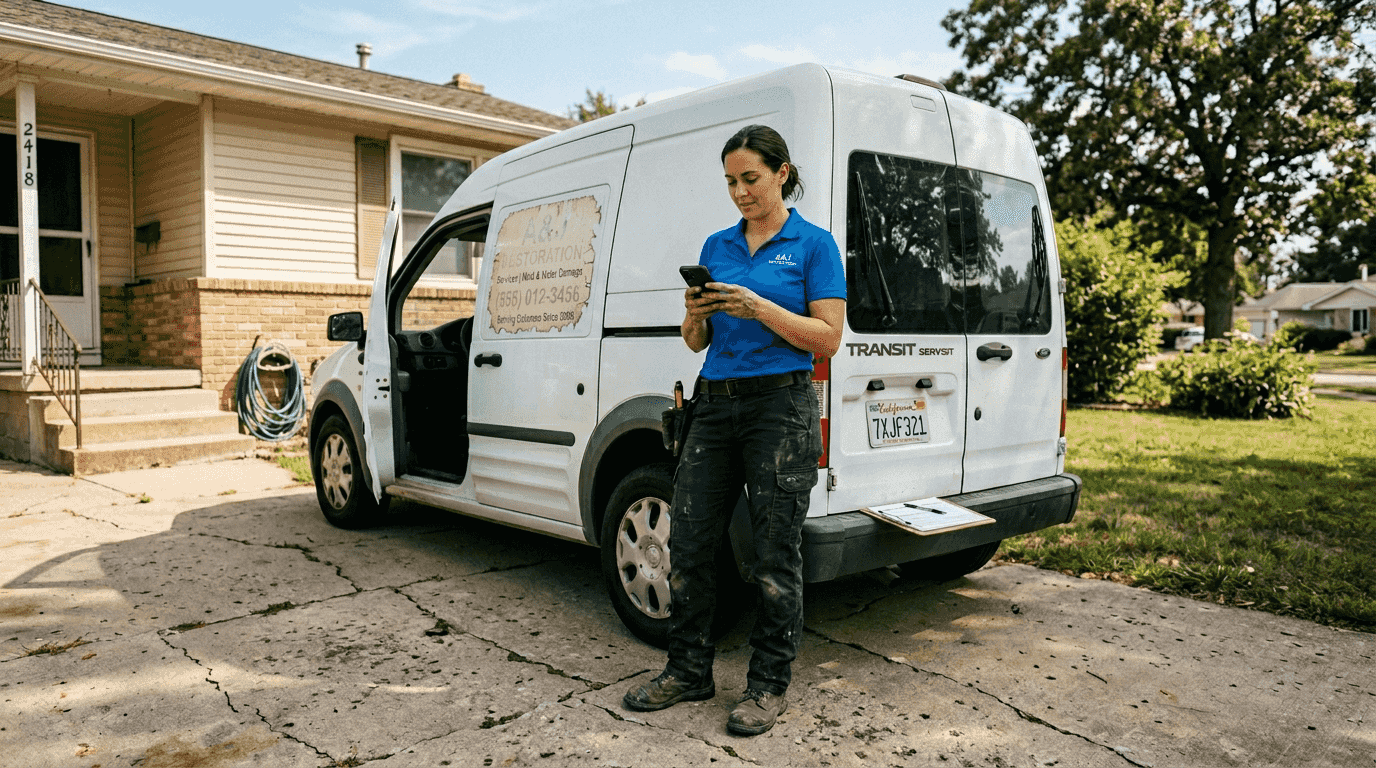
NAP consistency means your business Name, Address, and Phone number appear identically across every online platform. Inconsistent information confuses search engines and dilutes your local SEO strength. Audit all your citations on directories like Yelp, Angie’s List, HomeAdvisor, and industry-specific platforms. Correct any variations in how your address is formatted or which phone number is listed. Build local backlinks by sponsoring community events, joining your chamber of commerce, and partnering with related businesses like plumbers or property managers.
Location-specific landing pages target customers in each city or neighborhood you serve. Create dedicated pages for “Water Damage Restoration in [City Name]” that include local landmarks, neighborhood-specific content, and testimonials from customers in that area. These pages dramatically improve your visibility for geo-targeted searches while providing relevant information that converts visitors into calls. Structure your service based SEO for local contractors around the specific communities where you want to generate more emergency calls.
Pro Tip: Set up Google Posts highlighting your emergency response capabilities and post them every three to five days to maintain fresh content on your Business Profile.
Technical and content SEO: improving website performance for restorers
Technical SEO encompasses the behind-the-scenes elements that help search engines crawl, understand, and rank your website effectively. Site speed determines how quickly your pages load, critical for mobile users searching during emergencies who won’t wait for slow websites. Mobile-friendliness ensures your site works perfectly on smartphones, where most local searches happen. Secure HTTPS protects visitor data and serves as a ranking factor. Schema markup provides structured data that helps search engines display rich results like star ratings and service details directly in search listings.
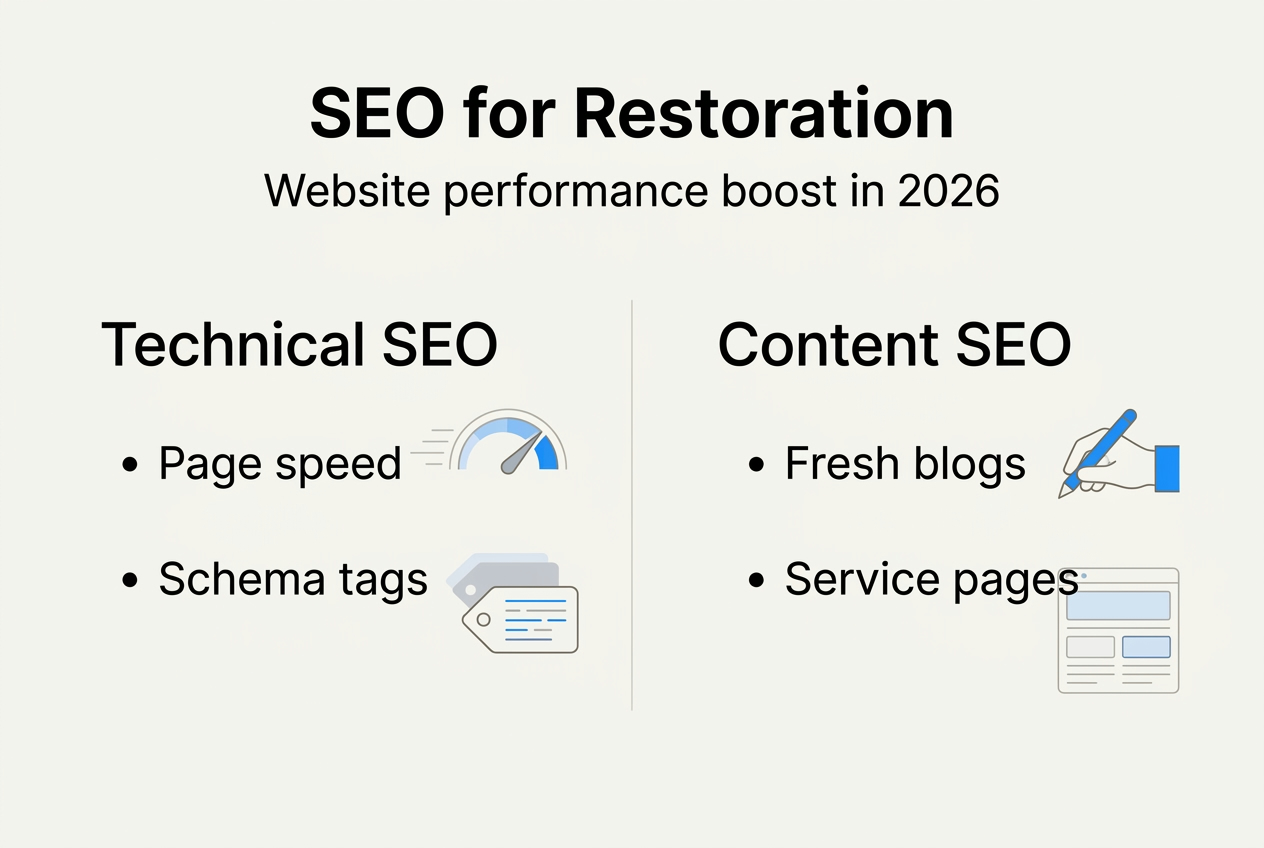
Restoration-specific content addresses the questions and concerns your potential customers search for online. Create comprehensive guides answering common questions: “How long does water damage restoration take?” or “What should I do immediately after a fire?” Target informational keywords that homeowners search before they’re ready to call, building trust and positioning your company as the obvious choice when they need services. Blog posts about seasonal risks, prevention tips, and insurance claim guidance establish expertise while naturally incorporating keywords.
A well-optimized website enhances conversion rates from SEO traffic in restoration because technical performance directly affects whether visitors stay on your site or bounce back to search results. Fast load times, clear calls-to-action, and mobile-optimized contact forms remove friction from the customer journey. Every technical improvement compounds, creating a better user experience that search engines reward with higher rankings.
| Technical Issue | Impact on Restoration Sites | Solution |
|---|---|---|
| Slow page speed | Emergency customers leave before site loads | Compress images, enable caching, use CDN |
| Poor mobile experience | Lost leads from smartphone searches | Implement responsive design, test on devices |
| Missing schema markup | Lower visibility in search results | Add LocalBusiness and Service schema |
| Broken links | Damaged credibility and SEO authority | Regular audits, fix or redirect broken URLs |
| No SSL certificate | Security warnings scare visitors away | Install SSL, redirect HTTP to HTTPS |
Structured data markup tells search engines exactly what services you offer, where you operate, and how customers can contact you. Implement LocalBusiness schema with your NAP details, service hours, and areas served. Add Service schema for each restoration type you provide, helping Google display your services prominently. This technical enhancement increases your chances of appearing in rich results and voice search answers.
Content freshness signals active business operations and industry expertise. Regularly update your website with new blog posts covering restoration industry trends, changes in insurance claim processes, or local weather events that increase demand for your services. Reference local news when appropriate, like “Spring flooding in [Your City] increases water damage risks” to demonstrate community connection and improve local relevance.
Pro Tip: Create a content calendar publishing one in-depth restoration guide monthly and two shorter tips or news updates weekly to maintain consistent freshness signals.
Measuring SEO success and integrating with other lead generation tactics
Tracking SEO performance transforms guesswork into data-driven decisions that improve your lead generation results. Start by setting up Google Analytics to monitor website traffic, user behavior, and conversion events like phone calls or contact form submissions. Configure goals for key actions: emergency service requests, quote form completions, and phone number clicks from mobile devices. Google Search Console provides complementary data showing which keywords drive impressions and clicks, plus technical issues affecting your search visibility.
Key SEO metrics for restoration businesses include organic traffic volume, keyword rankings for priority terms like “water damage restoration near me,” click-through rates from search results, and most importantly, conversion rates from organic visitors to actual leads. Monitor your local pack rankings across different cities in your service area. Track the percentage of traffic coming from mobile devices, typically 60-70% for emergency restoration searches. Measure average session duration and bounce rate to gauge content quality and user experience.
| Lead Source | Primary Benefits | Limitations | Best Use Case |
| — | — | — |
| SEO | Long-term cost efficiency, high-intent traffic, builds authority | Slow initial results, requires ongoing effort | Sustainable lead generation foundation |
| Paid Ads | Immediate visibility, precise targeting, scalable volume | Ongoing costs, stops when budget ends | Quick lead volume, new market entry |
| Referrals | Highest trust, excellent conversion rates, low cost | Unpredictable volume, hard to scale | Relationship-based growth |
| Social Media | Brand awareness, community engagement, visual showcase | Low direct lead conversion, time-intensive | Reputation building, customer education |
Integrating SEO with paid ads enhances lead volume and quality for contractors because the strategies complement each other perfectly. Use paid ads to dominate search results immediately while your SEO efforts build momentum. Analyze which keywords convert best in your paid campaigns, then prioritize those terms in your content strategy. Retarget website visitors from organic search with display ads, maximizing the value of your SEO traffic.
Here’s how to combine multiple lead generation tactics effectively:
- Build your SEO foundation with optimized website structure and core service pages targeting primary restoration keywords.
- Launch targeted paid search campaigns for high-value emergency services to generate immediate leads while SEO matures.
- Implement a systematic review collection process, using both organic customers and paid ad conversions to build social proof.
- Create content addressing common customer questions discovered through paid search query reports and sales conversations.
- Use retargeting ads to recapture organic visitors who didn’t convert on their first visit to your website.
- Develop referral partnerships with complementary businesses like plumbers and property managers, amplifying your local presence.
Iterate your strategy based on performance data every month. If certain keywords drive traffic but low conversions, improve those landing pages or adjust your service offerings. When specific cities generate more leads, increase your local SEO focus there with additional citations and localized content. Test different calls-to-action, page layouts, and content formats to continuously improve conversion rates. The restoration contractors who succeed long-term treat SEO as an evolving process, not a one-time project.
Successful lead generation tips for restoration providers always emphasize measurement and optimization. Set quarterly goals for organic traffic growth, keyword ranking improvements, and most critically, lead volume increases from search. Compare your SEO performance against previous periods and industry benchmarks. Calculate your cost per lead from SEO by dividing your monthly optimization investment by leads generated, then compare this to paid advertising costs to demonstrate ROI.
How Results Digital helps restoration contractors dominate online
Results Digital specializes in helping restoration contractors like you generate consistent, high-quality leads through proven SEO and digital marketing strategies. We understand the unique challenges restoration businesses face, from emergency service demands to seasonal fluctuations, and we build customized solutions that address your specific market conditions. Our exclusive partnership model means we only work with one restoration contractor per market, eliminating conflicts of interest and ensuring your success is our sole focus.
Our comprehensive approach combines technical website optimization, local SEO dominance, and strategic paid advertising to maximize your lead volume. We’ve developed specialized lead generation workflow 2025 local contractors that integrate seamlessly with your business operations, ensuring every lead gets prompt attention. Explore our proven local service providers SEO techniques and discover actionable lead generation tips for trades boost bookings that help restoration contractors book more profitable projects consistently.
Frequently asked questions
What is SEO and why is it crucial for restoration contractors?
SEO is the process of optimizing your website and online presence so search engines like Google rank you higher when potential customers search for restoration services. For restoration contractors, SEO is crucial because most homeowners facing water damage, fire damage, or mold problems turn to Google first to find local help. Appearing in top search results means you capture these high-intent customers at the exact moment they need your services. Without strong SEO, you’re invisible to the majority of local customers actively searching for restoration contractors, handing those leads directly to competitors who invested in their online visibility.
How quickly can restoration companies see results from SEO efforts?
Most restoration companies begin seeing measurable SEO results within three to six months, though this timeline varies based on market competition and current website condition. Initial improvements like better local pack visibility and increased organic traffic often appear within the first 60 days. Significant ranking improvements for competitive keywords typically require four to six months of consistent optimization. The key factor is consistency, as restoration contractors who maintain ongoing SEO efforts see compounding returns, with lead volume continuing to grow over time without proportional increases in marketing spend.
Can SEO work alongside paid advertising for restoration lead generation?
Absolutely, and combining SEO with paid advertising creates the most effective lead generation strategy for restoration contractors. SEO builds your long-term organic presence and generates cost-efficient leads over time, while paid ads provide immediate visibility and quick lead volume when you need it. Use paid search campaigns to dominate results for high-value emergency services while your SEO foundation develops. The strategies inform each other, with paid campaign data revealing which keywords convert best, helping you prioritize your content and optimization efforts for maximum ROI.
What local SEO features are most important for restoration services?
Google Business Profile optimization stands as the single most critical local SEO element for restoration contractors, as it controls your appearance in the local pack and Google Maps results where most customers click. Consistent local citations across directories like Yelp and HomeAdvisor reinforce your location and legitimacy. Customer reviews provide essential social proof and directly influence both rankings and conversion rates. NAP consistency ensures search engines confidently associate all your online mentions with a single business entity, strengthening your local authority and improving rankings across all local search queries.
