
Running a successful HVAC business means keeping your schedule full with qualified local customers who need your services right now. Yet many HVAC contractors struggle to generate consistent leads, relying on word of mouth or outdated marketing methods that produce unpredictable results. Google Ads offers a powerful solution to this challenge, connecting your business with homeowners actively searching for heating and cooling services in your area. This comprehensive guide walks you through the exact process to launch, optimize, and scale Google Ads campaigns that drive real service bookings. You’ll discover proven strategies for campaign setup, budget management, lead conversion, and ongoing optimization tailored specifically for the HVAC industry.
Table of Contents
- Preparing For Your Google Ads HVAC Campaign
- Step-By-Step Setup Of Your Google Ads Campaign For HVAC
- Optimizing And Managing Your HVAC Google Ads For Better Results
- Measuring Success And Troubleshooting Common Issues In Your HVAC Ads
- Boost Your HVAC Leads With Expert Google Ads Management
- FAQ
Key takeaways
| Point | Details |
|---|---|
| Targeted local reach | Google Ads connects HVAC businesses with customers actively searching for services in specific geographic areas, driving qualified local leads. |
| Mobile optimization critical | Over half of ad clicks come from mobile devices, making mobile-friendly landing pages essential for conversion success. |
| Cost control matters | Average cost per click exceeds $5 for HVAC keywords, requiring strategic bid management to maximize return on investment. |
| AI automation advantage | Campaign automation tools can improve conversion rates by nearly 7% through intelligent bid optimization. |
| LSA booking potential | Local Services Ads may achieve 30-40% booking rates from charged leads, outperforming traditional search campaigns. |
Preparing for your Google Ads HVAC campaign
Before launching your first campaign, you need solid groundwork to ensure your advertising dollars deliver maximum impact. Rushing into Google Ads without proper preparation wastes budget and produces disappointing results that discourage many HVAC businesses from digital advertising altogether.
Start by clearly defining your target service areas and ideal customer demographics. Are you focusing on residential or commercial clients? Which neighborhoods or zip codes generate the most profitable service calls? Understanding these parameters allows you to set precise geographic targeting that puts your ads in front of the right local audience. This geographic focus prevents wasted spend on clicks from areas you don’t service.
Keyword research forms the foundation of successful HVAC campaigns. Use Google’s Keyword Planner to identify search terms potential customers actually use when looking for heating and cooling services. Focus on specific, intent-driven phrases like “emergency AC repair near me” or “furnace installation cost” rather than broad terms like “HVAC.” Long-tail keywords typically cost less per click while attracting more qualified leads ready to book service.
Your landing page deserves special attention since mobile traffic accounts for 53% of clicks for HVAC ads. Design a mobile-optimized page that loads quickly, displays your phone number prominently, and includes a simple contact form. Every second of load time matters because impatient mobile users abandon slow pages before they convert into leads. Test your landing page on multiple devices to ensure seamless functionality.
Setting up your Google Ads account correctly from the start saves headaches later. Configure billing information, verify your business location, and establish conversion tracking to measure which ads generate actual service bookings. The local ads setup workflow provides a structured approach to this initial configuration process.
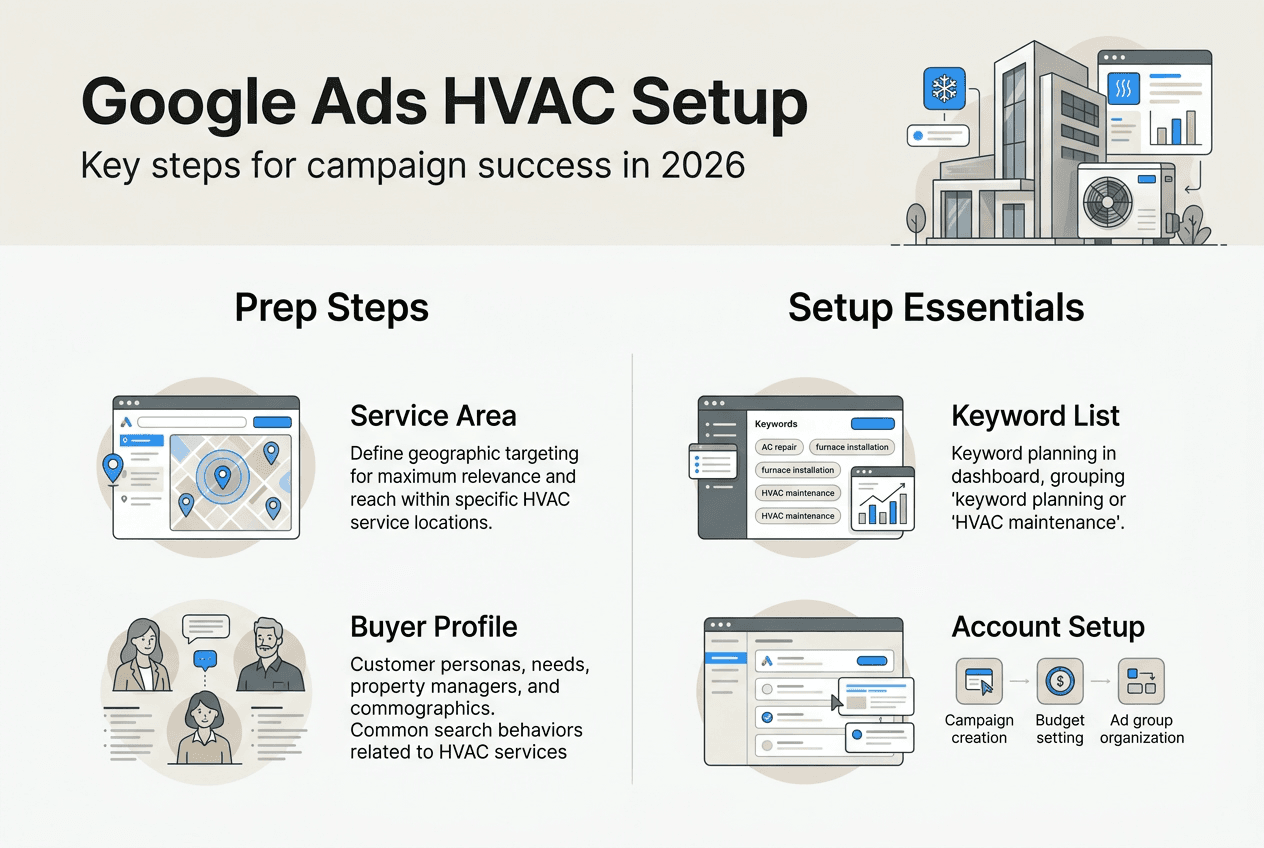
Pro Tip: Use the keyword planner tool to identify cost-effective HVAC keywords with lower competition that still attract qualified local customers searching for your specific services.
Here’s what you need before launching your campaign:
- Clearly defined service area boundaries and target customer profiles
- Researched keyword list with cost estimates and search volumes
- Mobile-optimized landing page with clear calls to action
- Google Ads account with billing and location settings configured
- Conversion tracking installed to measure lead generation results
| Campaign Element | Requirement | Purpose |
|---|---|---|
| Service Area | Specific zip codes or radius | Target only serviceable locations |
| Landing Page | Mobile-responsive design | Capture 53% mobile traffic effectively |
| Keyword List | 15-25 targeted phrases | Balance reach with relevance |
| Conversion Tracking | Phone and form tracking | Measure actual lead generation |
| Budget Plan | Daily and monthly caps | Control spending and test performance |
Step-by-step setup of your Google Ads campaign for HVAC
Creating your first HVAC campaign requires methodical execution through Google’s campaign builder. Following these steps in order ensures you configure settings correctly and avoid costly mistakes that drain your budget without generating quality leads.
-
Define your campaign goals and budget based on realistic local lead targets. Determine how many new service calls you need monthly and work backward to calculate required ad spend. If you need 20 new customers and expect a 10% conversion rate from clicks, you’ll need roughly 200 clicks. With an average CPC around $5, budget at least $1,000 monthly to start.
-
Select Search Network campaigns as your primary campaign type for HVAC advertising. Search campaigns show your ads to people actively looking for heating and cooling services, making them far more effective than display ads for generating immediate service bookings. Skip Display Network and Video options initially until you master search advertising fundamentals.
-
Choose geographic targeting for your specific service areas using radius targeting around your business location or custom-drawn service boundaries. Set location options to target people physically in your service area, not just those showing interest. This precision prevents wasted clicks from users outside your coverage zone.
-
Select keywords strategically by starting with 15-25 highly relevant phrases that balance search volume with cost efficiency. Include a mix of emergency terms (“AC not working”), service-specific keywords (“ductless mini split installation”), and brand terms if applicable. Use phrase match and exact match types to maintain relevance while controlling costs. Average Google Ads CPC reached $5.26 in 2025, making keyword selection critical for ROI.
-
Write compelling ad copy that highlights your unique service benefits, response time guarantees, and special offers. Include your primary keyword in the headline, emphasize local availability, and use strong calls to action like “Call Now for Same-Day Service.” Create at least three ad variations to test which messaging resonates best with your local market.
-
Configure your bidding strategy with a focus on conversions rather than just clicks. Start with manual CPC bidding to maintain control while learning which keywords perform best, then transition to automated bidding once you have sufficient conversion data. Set maximum bid caps to prevent runaway costs on expensive keywords.
-
Link your campaign to a dedicated landing page optimized specifically for mobile lead capture. Ensure the page loads in under three seconds, displays your phone number prominently above the fold, and includes trust signals like reviews and certifications. The landing page experience directly impacts your Quality Score and ad costs.
Review the Google Ads for contractors explained resource for additional setup guidance tailored to service businesses. The 7-step lead generation checklist provides a comprehensive framework for coordinating your advertising with lead capture systems.
Pro Tip: Enable automated bidding with conversion tracking after collecting at least 30 conversions to let Google’s machine learning optimize your bids for maximum efficiency while staying within your budget constraints.
Optimizing and managing your HVAC Google Ads for better results
Launching your campaign marks just the beginning of your Google Ads journey. Continuous monitoring and strategic adjustments separate profitable campaigns from money pits that deliver poor returns. Successful HVAC advertisers treat optimization as an ongoing process, not a one-time setup task.
Monitor these critical performance metrics weekly to identify improvement opportunities:
- Click-through rate (CTR) indicating ad relevance and appeal
- Cost per click (CPC) showing keyword competitiveness and budget efficiency
- Conversion rate revealing landing page and offer effectiveness
- Cost per conversion measuring true lead generation profitability
- Quality Score affecting ad position and cost efficiency
A/B testing provides the fastest path to performance improvements. Create multiple ad variations testing different headlines, descriptions, and calls to action. Run these variations simultaneously and let data determine winners. Similarly, test different landing page layouts, form lengths, and value propositions to maximize conversion rates from your paid traffic.
AI-powered automation tools now offer significant advantages for campaign management. Conversion rates improved 6.84% across industries with AI campaign automation in 2025. Smart Bidding strategies like Target CPA and Maximize Conversions use machine learning to adjust bids in real time based on conversion likelihood, device type, location, and time of day.
Regularly audit your keyword performance to identify underperformers draining your budget. Pause keywords with high costs but low conversion rates. Add negative keywords to prevent your ads from showing for irrelevant searches like “HVAC jobs” or “HVAC schools.” This refinement process improves campaign efficiency over time.
Given that mobile devices generate over half your clicks, prioritize mobile landing page improvements. Ensure forms work flawlessly on smartphones, phone numbers are clickable for instant calling, and page elements don’t require zooming or horizontal scrolling. Mobile experience directly impacts conversion rates and campaign profitability.

Consider the strategic differences between manual and automated bid management:
| Bidding Approach | Advantages | Disadvantages |
|---|---|---|
| Manual CPC | Complete control over individual keyword bids, easier to understand costs, ideal for learning campaign dynamics | Time-intensive management, misses real-time optimization opportunities, requires constant monitoring |
| Automated (Target CPA) | Optimizes bids automatically for conversion goals, saves management time, leverages machine learning | Requires conversion history to work effectively, less granular control, may spend budget quickly |
| Automated (Maximize Conversions) | Focuses entirely on conversion volume, adapts to performance patterns, simplifies bid strategy | Can increase costs if not properly capped, needs sufficient budget to optimize effectively |
Explore the digital advertising workflow 2025 HVAC for a systematic approach to campaign optimization. Learn strategies to manage Google Ads HVAC costs while maximizing lead quality and booking rates.
Pro Tip: Schedule your ads to run during peak local service demand times when homeowners are most likely to book appointments, typically weekday mornings and early evenings, to improve lead quality and conversion rates.
Measuring success and troubleshooting common issues in your HVAC Ads
Accurate measurement separates guesswork from data-driven decision making in Google Ads management. Without clear metrics and troubleshooting skills, you’re flying blind, unable to determine whether your advertising investment generates positive returns or wastes money on ineffective campaigns.
Define specific conversion goals that align with your business objectives. For most HVAC companies, primary conversions include phone calls booked, contact form submissions, and online scheduling completions. Assign appropriate values to each conversion type based on your average service ticket and closing rate. This valuation enables accurate ROI calculation.
Integrate Google Ads with Google Analytics to gain deeper insights into user behavior after they click your ads. Track metrics like bounce rate, time on site, and pages per session to understand how engaged your traffic is. High bounce rates often indicate landing page mismatches with ad messaging or poor mobile experience.
Identify and address these common campaign problems:
- Low click-through rates suggesting weak ad copy or poor keyword relevance
- High cost per click indicating excessive competition or low Quality Scores
- Poor conversion rates revealing landing page issues or weak offers
- Wasted spend on irrelevant search terms requiring negative keyword additions
- Geographic performance variations showing some service areas outperform others
When CTR falls below 3% for HVAC search campaigns, revise your ad copy to better match search intent and highlight compelling service differentiators. Test new headlines that include specific benefits, urgency, or local references. Sometimes small copy tweaks produce dramatic CTR improvements.
High CPC problems often stem from low Quality Scores, which Google assigns based on ad relevance, expected CTR, and landing page experience. Improve Quality Scores by tightening keyword-ad-landing page alignment. Create dedicated ad groups for specific services with tailored ads and landing pages rather than sending all traffic to your homepage.
Poor conversion rates despite decent traffic volume indicate landing page problems. Simplify your contact forms, make phone numbers more prominent, add customer testimonials, and ensure fast load times. Even small friction points dramatically reduce conversion rates on mobile devices.
Consider expanding beyond traditional search ads to Local Services Ads, which connect customers directly with verified local providers. Local Service Ads may generate 30-40% booking rates from charged leads, significantly outperforming typical search ad conversion rates.
Local Services Ads can achieve booking rates between 30-40% from charged leads, making them a powerful complement to traditional search campaigns for HVAC businesses seeking higher-quality leads with stronger booking intent.
Establish a consistent evaluation schedule, reviewing campaign performance weekly for the first month, then bi-weekly once campaigns stabilize. Document changes you make and their subsequent impact on performance metrics. This historical record helps you understand what works for your specific market and avoid repeating past mistakes.
The generate HVAC leads local growth guide provides additional strategies for converting paid traffic into booked service appointments and long-term customer relationships.
Boost your HVAC leads with expert Google Ads management
Mastering Google Ads requires ongoing learning, testing, and adjustment to stay ahead of competitors and market changes. While this guide provides the foundation for successful campaigns, partnering with specialists who focus exclusively on local service businesses can accelerate your results and maximize your advertising ROI.
Results Digital helps HVAC contractors implement proven lead generation workflow for local contractors that combines strategic Google Ads management with conversion-optimized landing pages. Our Google Ads lead generation strategies are specifically tailored for the heating and cooling industry, addressing the unique challenges and opportunities HVAC businesses face in competitive local markets. Discover how local lead generation explained through our exclusive partnership model ensures you receive dedicated attention without competing against other HVAC companies in your service area. We handle the technical complexity while you focus on delivering exceptional service to the qualified leads we generate.
FAQ
What budget should HVAC businesses allocate for Google Ads in 2026?
Budget requirements depend on your service area size, local competition intensity, and lead volume goals. With average CPC around $5.26 for HVAC keywords, plan to invest at least $1,000-$1,500 monthly to generate meaningful lead volume and gather sufficient data for optimization. Start with a modest daily budget, track your cost per conversion carefully, and scale spending based on positive ROI results.
How do Local Services Ads differ from traditional Google Search Ads for HVAC?
Local Services Ads connect customers directly with verified local HVAC providers through a pay-per-lead model rather than pay-per-click. They appear at the very top of search results with your Google Guaranteed badge, business hours, and review ratings prominently displayed. LSAs may yield booking rates between 30-40% from charged leads, significantly higher than traditional search ads because they attract customers with stronger immediate service intent.
What are the top mistakes to avoid when running Google Ads for HVAC?
Ignoring mobile optimization for landing pages wastes over half your clicks since mobile devices generate 53% of HVAC ad traffic. Failing to monitor and adjust bids regularly leads to unnecessarily high CPC costs that erode profitability. Neglecting negative keywords causes wasted spend on irrelevant searches like job listings or DIY tutorials. Overlooking conversion tracking and analytics prevents you from identifying which keywords and ads actually generate service bookings versus just clicks.
How long does it take to see results from HVAC Google Ads campaigns?
You’ll typically see initial clicks and traffic within hours of launching your campaign, but meaningful lead generation data requires two to four weeks of active running. Allow 30-60 days to gather sufficient conversion data for accurate performance assessment and optimization decisions. Campaigns improve continuously over time as you refine keywords, test ad variations, and optimize landing pages based on real performance data from your specific market.
